I've alluded before to how I once made the same dwarf in all four versions of AD&D. This is basically a reproduced transcript of that:
I started with 1st edition because I knew it was the most random, and ended up making a dwarf fighter. Each edition afterwards was simply an attempt to recreate the character from the previous edition, using the rules and character creation methods of the later editions. Here are the stats, straight up, along with some notes I added for explanation.
Mitch the dwarven fighter!
1st edition
the Player's Handbook does not give any specifications on how to roll up a character, it just says The range of these abilities is between 3 and 18." so I'm just using the classic method of rolling 3d6 and putting them in the abilities as I roll them. Rolled 15, 11, 5, 8, 11, 8, the stats after racial modifiers are in the order the book ascribes to them.
Strength 15 = weight allowance +200, Open Doors 1-2 on d6, Bend Bars/Lift Gates 7%
Intelligence 11
Wisdom 5 = magical attack -1
Dexterity 8
Constitution 12 = system shock 80%, resurrection survival 85%
Charisma 7 = maximum number of henchmen 3, loyalty -10%, reaction -5%
Dwarf = saving throws vs. wands/rods/staves & spells +3, poison saves equal to wands/rods/staves, infravision 60 feet, detect grade or slope or new construction 75%, detect sliding/shifting walls 66%, detect traps or depth underground 50%, to hit half-orcs goblins hobgoblins or orcs +1, ogres trolls ogre magi giants and titans have -4 to hit dwarves
Fighter = Hit Points 9, Alignment: Lawful Neutral
Languages: Dwarven, Lawful Neutral, Common, Elvish
Money: 190 gold (before buying equipment), 5 gold and 3 silver (after buying equipment)
Weapon Proficiency: Axe, Dagger, Mace, Sword (non-proficiency penalty is -2)
Equipment: Banded Armor, Large Shield, Great Helmet, Battle Axe (speed 7, damage 1d8), Dagger (speed 2, damage 1d4 vs S/M, 1d3 vs L), Boots (high hard), Belt, Cloak, Leather Backpack w/ 100' rope & 20 large iron spikes & 10 torches, Small Belt Pouch w/ mall silver mirror & 3 wax candles, Draft Horse ("Smythers")
Movement 9"
And that is ALL of the information the 1st edition Player's Handbook gives the player!
2nd edition
I thought about just transferring the stats as is, but that wouldn't be fair to each version since I know 3rd edition uses a completely different method and I'll end up with much higher numbers. Using Method V from the rulebook (roll 4d6 dropping the lowest and assign where you like), since that's the one most 2nd edition games I've ever been in used.
Strength 16 = damage +1, weight allowance 70, maximum press 195, Open Doors 9, Bend Bars/Lift Gates 10%
Dexterity 15 = defensive adjustment -1
Constitution 17 = hit points +3, system shock 97%, resurrection survival 98%
Intelligence 13 = languages +3, spell level 6th, chance to learn spell 50%, spells/level 7
Wisdom 13 = bonus spells: one 1st, spell failure 0%
Charisma 11 = maximum number of henchmen 5
Languages: Common, Dwarf, Elf, Orc
Dwarf = saving throws vs. wands/rods/staves, spells & poison +4; 20% of magic item failure if not made for dwarves; +1 to hit orcs, half-orcs, goblins, and hobgoblins; ogres, trolls, ogre magi, giants, and titans are at -4 to hit dwarves; infravision 60 feet; detect grade or slope in passage or new tunnel/passage construction 1-5 on ld6; detect sliding/shifting walls or rooms 1-4 on ld6; detect stonework traps, pits, and deadfalls or determine approx. depth underground 1-3 on ld6.
Height: 4'2" , Weight: 150 lbs, Age: 53, Maximum Age: 347
Fighter = Hit Points 11, Alignment: Lawful Neutral
Weapon Proficiencies: Battle Axe, Dagger, Broad Sword, Halberd (non-proficiency penalty is -2)
Non-Weapon Proficiencies: Animal Handling Carpentry, Rope Use
Money: 100 gold (before purchasing equipment), 9 gold & 1 silver
Equipment: Splint Mail, Battle Axe (size M, type S, speed 7, damage 1d8), Backpack w/ 100 feet hemp rope & 20 pitons & 10 torches, Small Belt Pouch w/ flint & steel (total 109.5 lbs)
Armor Class 3 (Splint + Dex), THAC0 20
Encumbrance: Light, Movement: 5"
Saving Throws: Paralyzation/Death Magic 14, Rod/Staff/Wand/Poison 12, Petrification/Polymorph 15, Breath 17, Spell 13
And now that's it.
3rd edition
Third edition rules use the Method V dice-rolling equation from 2nd edition, with the option of re-rolling if your scores are too low (i.e. if no score is above 13). So here I go, rolling again:
Strength 15 (+2) = to melee attack rolls, damage
Dexterity 12 (+1) = to ranged rolls, armor class, Reflex saving throws
Constitution 15 (+2) = bonus Hit Points, Fortitude saving throws
Intelligence 10
Wisdom 10
Charisma 8 (-1) = checks to influence others
Dwarf = Medium size, speed 20 feet, darkvision 60 feet, +2 Search stonework, +4 to resist bull-rush or trip attacks, +2 to saving throws against poison and spells, +1 to hit orcs and goblinoids, +4 dodge bonus to Armor Class vs giants, +2 to Appraise stone or metal, +2 to Craft stonework and metalwork
Languages: Common, Dwarven
Fighter = Hit Points 12, Base Attack +1, Fortitude +2, Martial Weapon Proficiency, Simple Weapon Proficiency, Proficient with ALL Armor
Skills (8 points at 1st level): Handle Animal +2, Ride +2, Use Rope +4
Feats (one for 1st level, one bonus Fighter feat): Mounted Combat, Power Attack
Alignment: Lawful Neutral, Age 57, Height 4'2" , Weight 170 lbs.
Money: 140 gold (before purchasing equipment), 2 gold (after)
Equipment: Dwarven Waraxe (damage 1d8 vs S, 1d10 vs M, crit x3), Chain Shirt (check penalty -2), Backpack w/ 100 feet hempen rope & 20 pitons, Belt Pouch w/ flint & steel (total weight 65.5 lbs)
Armor Class: 14 (15 w/ Dex); Attack: Melee +3, Ranged +2; Initiative +1
Saves: Fortitude +4, Reflex +1, Will +0
4th edition
The 4th edition rules ask you to choose race and class before determining ability scores, so...
Dwarf
Height 4'6" , Weight 170 lbs., Size: Medium, Speed: 5 squares, Vision: Low-light
Languages: Common, Dwarven
Ability Bonuses: +2 Constitution, +2 Wisdom
Skill Bonuses: +2 Dungeoneering, +2 Endurance
Cast-Iron Stomach: +5 racial bonus to saving throws against poison.
Dwarven Resilience: You can use your second wind as a minor action instead of a standard action.
Dwarven Weapon Proficiency: You gain proficiency with the throwing hammer and the warhammer.
Encumbered Speed: You move at your normal speed even when it would normally be reduced by armor or a heavy load. Other effects that limit speed (such as difficult terrain or magical effects) affect you normally.
Stand Your Ground: When an effect forces you to move—through a pull, a push, or a slide—you can move 1 square less than the effect specifies. This means an effect that normally pulls, pushes, or slides a target 1 square does not force you to move unless you want to. In addition, when an attack would knock you prone, you can immediately make a saving throw to avoid falling prone.
Got all that? Okay, Fighter
Armor Proficiencies: Cloth, leather, hide, chainmail, scale; light shield, heavy shield
Weapon Proficiencies: Simple melee, military melee, simple ranged, military ranged
Bonus to Defense: +2 Fortitude
And now, finally, I determine starting ability scores. The method for randomly generating ability scores is downplayed in the rulebook with the words "On average, you’ll come out a little worse than if you had used the standard array. If you roll well, you can come out way ahead, but if you roll poorly, you might generate a character who’s virtually unplayable. Use this method with caution."
I find it amusing that they are actually trying to encourage you to not roll dice.
So using the standard method that they describe, I would assign ability scores as I see fit from the following numbers: 16, 14, 13, 12, 11, 10; adjusting for racial modifiers after placement. What I find even more amusing is that the numbers here are already arranged exactly in the order I would want them to be!
Strength 16 (+3) = melee attacks, Fortitude defense
Constitution 16 (+3) = bonus hit points, bonus healing surges, Fortitude defense
Dexterity 13 (+1) = ranged attacks, Reflex defense
Intelligence 12 (+1) = Reflex defense
Wisdom 13 (+1) = Will defense
Charisma 10 (+0) = Will defense
Alignment: Unaligned (because there's no Lawful option anymore and Unaligned is the clossest to Neutral you can get, go figure!)
Trained Skills (from the class skills, choose three): Athletics (Str), Endurance (Con), Streetwise (Cha) This is the first part that forcibly diverges from previous editions. Mitch has no animal handling or rope use equivalent amongst the class skills.
Fighter Abilities: Combat Challenge, Combat Superiority, Two-Handed Weapon Talent
I start with one feat, and there is one for Mounted Combat but it doesn't look like it's very useful or appropriate to the original concept, and there's one for Power Attack, but I'm taking something that fits the original concept better.
Feat: Dwarven Weapon Training: +2 bonus to damage rolls with axes and hammers
Class Powers:
At-Will Powers (2): Cleave - Standard Action Melee weapon, Reaping Strike - Standard Action Melee weapon
Encounter Attack Power (1): Passing Attack - Standard Action Melee weapon
Daily Attack Power (1): Brute Strike - Standard Action Melee weapon
Finally, we're on to equipment. The one thing that could clearly be improved about 4th edition is that all of this information is disorganized. The sequence of character creation has me flipping back and forth through the book, literally from chapter 3 to 4 then 2 then 5 to 6 back to 4 and then ahead to 7.
Starting Money: 100 gold (this is no longer randomized or determined by class), 4 gp (after purchasing equipment
Equipment: Plate Armor (wow! it only costs 50 gold pieces in 4th edition), Greataxe (+2 to hit, 1d12 damage, high crit.), Standard Adventurer's Kit (and with that I've already got a magic item in the form of Sunrods - the fantasy equivalent of glowsticks), 10 torches (total weight 105 lbs. = no penalty to movement)
And with that I just have to add all of the modifiers together to figure out the final stats.
Hit Points 18, Bloodied 9, Healing Surges 12 at 4 HP
Speed 5 squares, Initiative +1
Armor Class 18, Fortitude 15, Reflex 11, Will 11
Whew! And now I'm done.
The 4th edition version is obviously the most powerful, he is clearly defined as a powerhouse of destruction. The text blocks for 4th edition tend to come fairly simplified so despite the enormous amount of text written above 3rd edition is actually the most complex. It seems like 4th edition was trying to streamline 3rd edition, but in the process became a game of superheroic adventurers with very little connection to the original sulking and scavenging game that once was D&D.
Surprisingly, and I can only speak for myself, the 2nd edition version seemed the most interesting - it's the most concise and simplest version, and the character has some obvious flaws. I also found it surprising that the 1st and 2nd edition versions of the Player's Handbook led me to creating a character that was nearly identical, but also the weakest in terms of sheer power. The 1st edition book is very vague in some places, and what's most interesting is that the player is not given their character's combat scores. But you can clearly see in the 2nd edition rulebook where they were simply streamlining a proven process and putting a lot of the nuts and bolts of the system into the player's hands, likely to free up the DM so he could focus on the challenges of the adventure.
So, if you are limiting yourself to using only one version of Dungeons & Dragons for your role-playing group, a summary of what each set of rules exemplifies might be:
If you want action with superheroic characters, play 4th edition.
If you want complexity and rules headaches yet clearly defined equalities and powers across all classes and races, play 3rd edition.
If you want weak PCs with obvious inequalities and no sign of modern or innovative rules that enhance PCs, play 2nd edition.
If you want even weaker PCs, vague but complex rules and a lot of arbitrary randomness, play 1st edition.
Each has their own strengths and weaknesses for style and ease of play. Convoluted or confusing creation process notwithstanding.
Or maybe you will draw your own conclusions.

> bonebox = nerdwerds AT gmail
Friday, April 11, 2014

Wednesday, April 9, 2014
Hidden Fortress
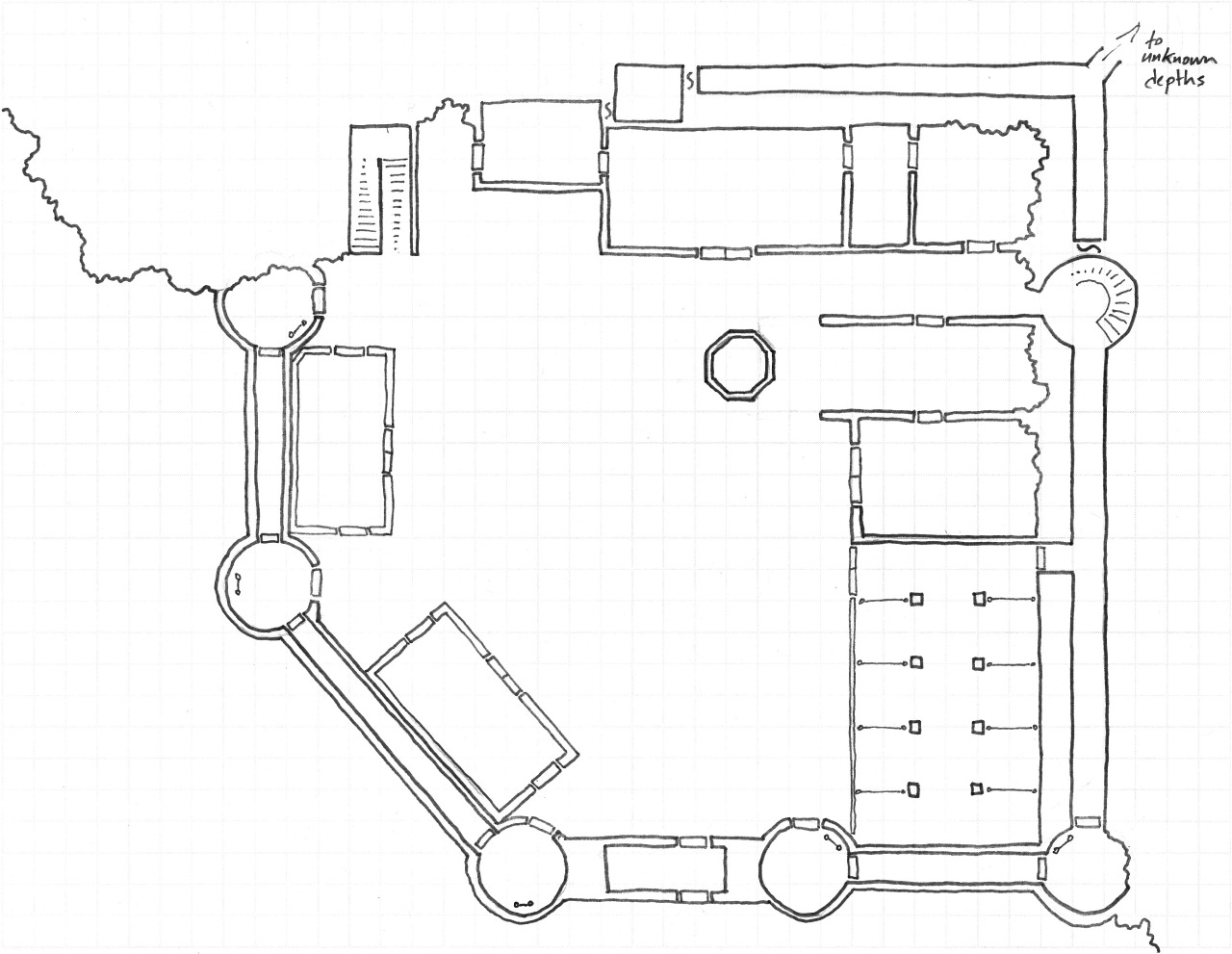
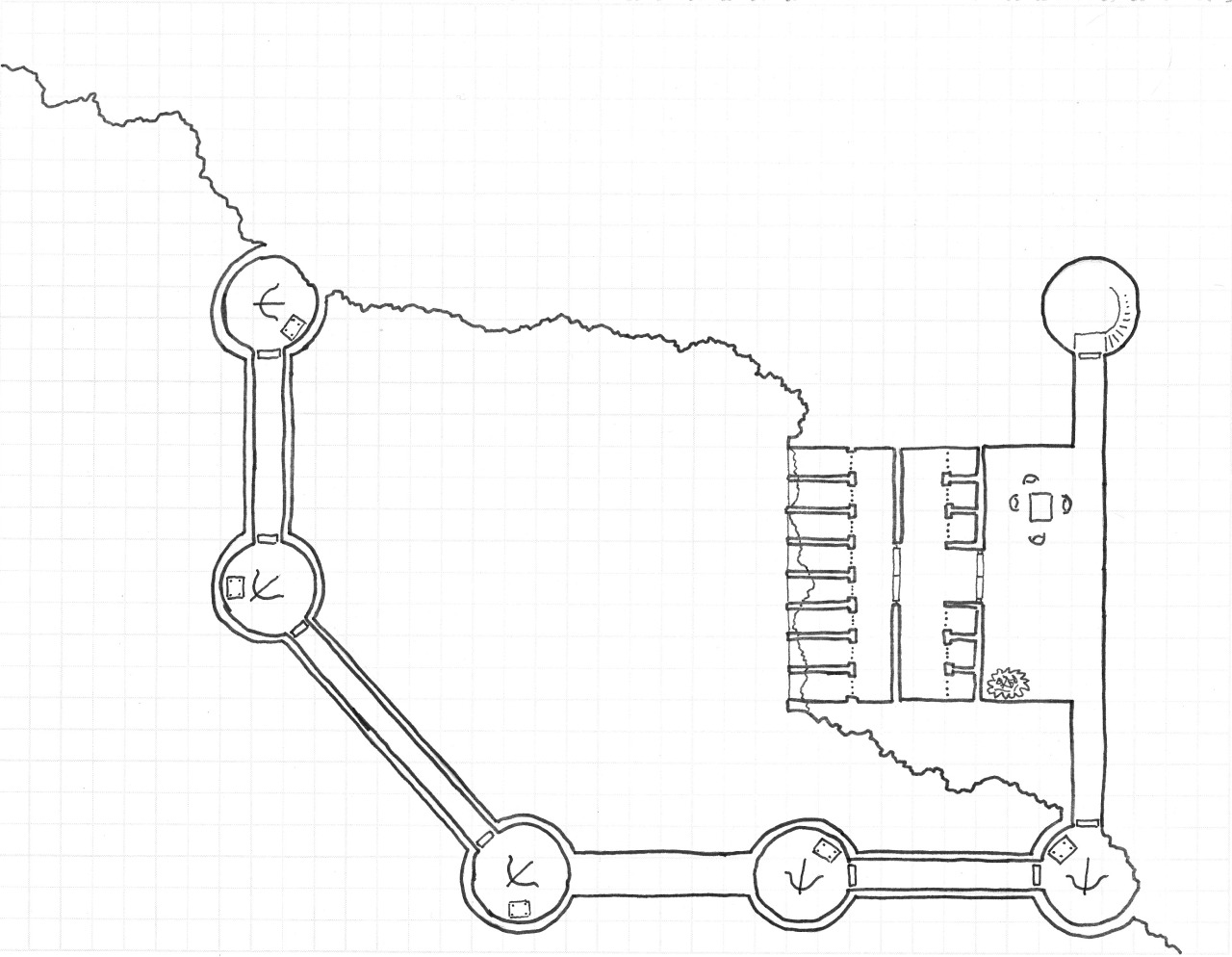
There are plenty of places online to find out how to draw or places that will teach you techniques for drawing, especially for RPG maps. Dyson's Logos immediately comes to mind! But there are scant few places where anybody teaches you how to design a map, how to make it interesting, or how to put a good adventure around it. I had this idea for a castle built into the side of a mountain, and as I worked on it, that's how I came to start calling it the Hidden Fortress.
I wanted to create a defensible castle, but I had no idea what it would be defending. I just had this image in my head of a wall jutting out from the mountainside, so I started drawing a rough outline with some notes about what the different rooms were. I focused a lot more on the names of who would be living there than I did on what to call the place, or the reasons for its existence.
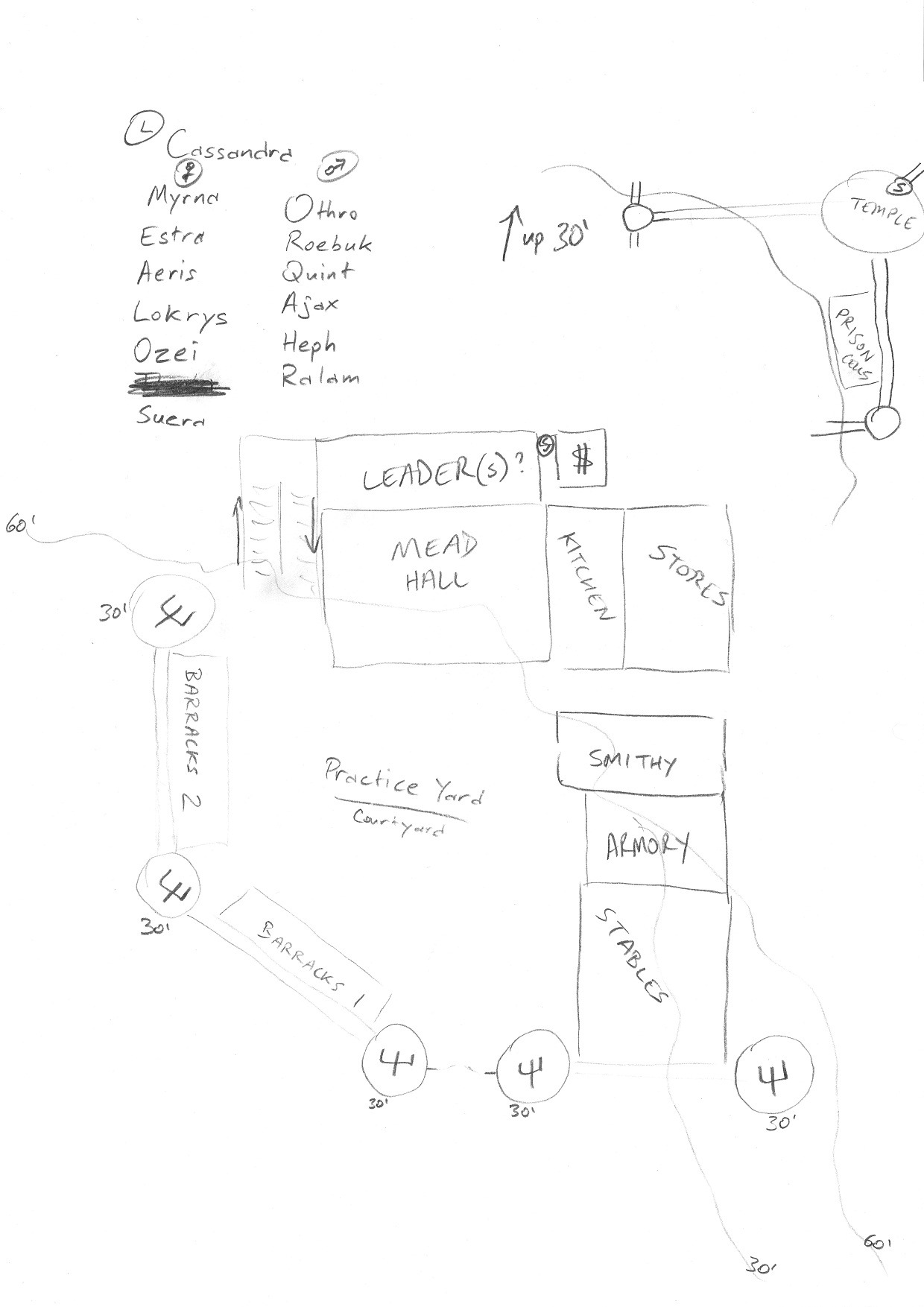
First Floor
Beyond that, I haven't really detailed it. I'm thinking of redrawing it and putting a town around the outside wall.
I wanted to create a defensible castle, but I had no idea what it would be defending. I just had this image in my head of a wall jutting out from the mountainside, so I started drawing a rough outline with some notes about what the different rooms were. I focused a lot more on the names of who would be living there than I did on what to call the place, or the reasons for its existence.
First Floor
Second Floor, 30 yards up
Beyond that, I haven't really detailed it. I'm thinking of redrawing it and putting a town around the outside wall.
Monday, April 7, 2014
three magic items
I entered the OSR Superstar Competition. None of my stuff got picked, but that's okay. When I use magic items I prefer to design them to fit my own game and within the context of whatever the story is. This was an interesting exercise as I tried to write concise entries that could easily be dropped into any GM's world. Here they are:
the Loyal Blade of Death
This is a simple dagger made of iron. It appears to be slightly dull and the handle is made of wrapped leather that appears torn at the ends, as if it may unravel if used too much. The dagger itself is impervious to harm, though the leather wrapping is just the most recently fashioned handle.
If wielded against an opponent it will inflict 1d4 damage. If a sapient (Int 2+) creature is killed with the dagger, the wielder will feel a surge of energy from the blade and the damage will increase to 1d6. Killing a sapient creature continues to increase the die type of damage every time one is slain with the blade itself. Thus 1d6 becomes 1d8, 1d8 becomes 1d10 etc. until it maxes out at 1d100 (if the GM has access to other die types such as d16s and d24s she is encouraged to include those as well). If the dagger is lent to another person, or even touched by a sapient creature other than the current wielder, the damage die type resets back to 1d4.
The dagger will radiate as powerfully magical and resists all forms of divination to reveal its powers, but a Commune or Legend Lore spell might reveal that the blade was not crafted on the mortal plane of reality. Sleeping while having the dagger on one's person, or under their pillow, will cause the owner to dream the deaths of all of the people and creatures the blade has killed, from the dead's perspective. In truth, the blade has recorded all of these experiences, and being so close to the blade causes a mortal mind to share those recorded sensations. Some demon will some day come looking for the blade to drain all of the experiences from the dagger. They may already be looking for it...
Ring of Returning Home
This simple unmarked band of gold was once around the ring finger of a prominent magic-user who was married to another magic-user of some talent. The ring was created so that their spouse would never get lost in their work and always come back to their mutually shared home to rest. The names of these magic-users have been lost to time, but the legend of the ring remains and for many wielders of magic who construct their own towers it would be a valuable prize.
The ring only works for magic-users, and nobody else is capable of getting it to work. It allows the wearer to visualize a place they have been to before and instantly teleport there, but it must be a very familiar place to the wearer. The ring can be used as many times in a day as the wearer wishes, however the second time the ring is used it will always teleport the wearer back to the exact location they teleported from before. In fact, if they haven't returned by midnight of the same day (from where they teleported from) then they are instantly and against their will teleported back.
The ring will not function according to command, or for anybody else who attempts to use it, until the "return trip" has been made by the original wearer. Removing the ring will not prevent the "return" teleport, as both the wearer who used the ring and the ring itself will teleport back to their original location at midnight of that day. If the ring is used and the wearer dies, then at midnight their body and the ring teleport back to where the ring was first used.
Gravity Boots
Across the sea there is a city of towers and buildings that stretch unbelievably high, and to reach these places there are alleys and streets that stretch above and below ground and traverse every corner of the city's impossible heights and fathomed depths. In this city is a thief who can walk on walls and ceilings and jump from any building and land on her feet, and the gravity boots are how she does it.
The boots don't actually break gravity, but they create a localized gravity field around anybody who wears them. Down is always relative to the boots being worn and outside of this localized gravity field momentum and weight mean nothing. The wearer can walk up walls and onto ceilings as if they were solid ground. If the wearer is fighting while using the boots then both they and their attackers suffer -2 penalties to hit each other, due to the weirdness of interacting with localized gravity. This also applies to missile fire directed at the wearer when the boots are allowing them to walk up walls or jump off rooftops, but doesn't apply to missile fire from the wearer.
The boots do not enhance the wearer's ability to jump and if they make a concerted effort to separate from a ceiling or wall they will jump off of it but as long as the wearer can land on their feet they won't take damage from falling any distance of height (resolve a jump as a saving throw with a +4 bonus, a particularly difficult jump would have no bonus). Reverse Gravity spells have no effect on the boots while they are being worn, the localized gravity field trumps external effects.
the Loyal Blade of Death
This is a simple dagger made of iron. It appears to be slightly dull and the handle is made of wrapped leather that appears torn at the ends, as if it may unravel if used too much. The dagger itself is impervious to harm, though the leather wrapping is just the most recently fashioned handle.
If wielded against an opponent it will inflict 1d4 damage. If a sapient (Int 2+) creature is killed with the dagger, the wielder will feel a surge of energy from the blade and the damage will increase to 1d6. Killing a sapient creature continues to increase the die type of damage every time one is slain with the blade itself. Thus 1d6 becomes 1d8, 1d8 becomes 1d10 etc. until it maxes out at 1d100 (if the GM has access to other die types such as d16s and d24s she is encouraged to include those as well). If the dagger is lent to another person, or even touched by a sapient creature other than the current wielder, the damage die type resets back to 1d4.
The dagger will radiate as powerfully magical and resists all forms of divination to reveal its powers, but a Commune or Legend Lore spell might reveal that the blade was not crafted on the mortal plane of reality. Sleeping while having the dagger on one's person, or under their pillow, will cause the owner to dream the deaths of all of the people and creatures the blade has killed, from the dead's perspective. In truth, the blade has recorded all of these experiences, and being so close to the blade causes a mortal mind to share those recorded sensations. Some demon will some day come looking for the blade to drain all of the experiences from the dagger. They may already be looking for it...
Ring of Returning Home
This simple unmarked band of gold was once around the ring finger of a prominent magic-user who was married to another magic-user of some talent. The ring was created so that their spouse would never get lost in their work and always come back to their mutually shared home to rest. The names of these magic-users have been lost to time, but the legend of the ring remains and for many wielders of magic who construct their own towers it would be a valuable prize.
The ring only works for magic-users, and nobody else is capable of getting it to work. It allows the wearer to visualize a place they have been to before and instantly teleport there, but it must be a very familiar place to the wearer. The ring can be used as many times in a day as the wearer wishes, however the second time the ring is used it will always teleport the wearer back to the exact location they teleported from before. In fact, if they haven't returned by midnight of the same day (from where they teleported from) then they are instantly and against their will teleported back.
The ring will not function according to command, or for anybody else who attempts to use it, until the "return trip" has been made by the original wearer. Removing the ring will not prevent the "return" teleport, as both the wearer who used the ring and the ring itself will teleport back to their original location at midnight of that day. If the ring is used and the wearer dies, then at midnight their body and the ring teleport back to where the ring was first used.
Gravity Boots
Across the sea there is a city of towers and buildings that stretch unbelievably high, and to reach these places there are alleys and streets that stretch above and below ground and traverse every corner of the city's impossible heights and fathomed depths. In this city is a thief who can walk on walls and ceilings and jump from any building and land on her feet, and the gravity boots are how she does it.
The boots don't actually break gravity, but they create a localized gravity field around anybody who wears them. Down is always relative to the boots being worn and outside of this localized gravity field momentum and weight mean nothing. The wearer can walk up walls and onto ceilings as if they were solid ground. If the wearer is fighting while using the boots then both they and their attackers suffer -2 penalties to hit each other, due to the weirdness of interacting with localized gravity. This also applies to missile fire directed at the wearer when the boots are allowing them to walk up walls or jump off rooftops, but doesn't apply to missile fire from the wearer.
The boots do not enhance the wearer's ability to jump and if they make a concerted effort to separate from a ceiling or wall they will jump off of it but as long as the wearer can land on their feet they won't take damage from falling any distance of height (resolve a jump as a saving throw with a +4 bonus, a particularly difficult jump would have no bonus). Reverse Gravity spells have no effect on the boots while they are being worn, the localized gravity field trumps external effects.
Wednesday, April 2, 2014
simplified starship travel
One of the dissonant things, for me, about space games is that we've learned a lot about space and the nature of space travel in the last fifteen years and all of it contradicts or deflates many of the old science fiction tropes about charting courses around stars and engaging with other starships that just suddenly appear out of nowhere. The former would be an easy task and the latter would never feasibly happen just with the level of technology we have for spaceships today. A more realistic approach would be that a ship's sensor array could be advanced enough to chart the stars.
The way that Stars Without Number currently works a character must make a successful Navigation/Intelligence roll on 2d6 against a base difficulty of 7. Navigators can attempt to “trim the course” by increasing the difficulty by +2 in exchange for increasing the effective spike drive rating of the ship by +1, but a navigator cannot trim a course by more levels than their Navigation rating. Travelling within a solar system requires Navigation-0 skill, but doesn't require a skill check unless some special hazard is involved or the navigator attempts to trim the course (difficulty 6, +1 for each level of course trimming). This skill check difficulty is increased even more based on the age of navigational charts that the Navigator uses to chart their course, and if they are charting a course into unknown territory the difficulty jumps by +4.
That's the rules as written.
Rather than fiddle with a bunch of difficulty ratings and modifiers, a simpler approach would be:
If a pilot is flying under the spike drive parameters (e.g. flying 1 hex with a drive-2 engine) and not attempting to trim the course then there is no need to roll. Trimming a course means shortening the time in hyperspace by one day. Default is 5 days (my game, it's 6 days by the rulebook).
Navigation+Intelligence, base difficulty 7, difficulty increases by +1 for every level of course trimming.
With no limits placed on the amount of course trimming a player might attempt.
Succeed at the roll and you arrive safely.
Fail the roll, and the player must select two.
Fail the roll by a margin of 4+, the player must select three:
The way that Stars Without Number currently works a character must make a successful Navigation/Intelligence roll on 2d6 against a base difficulty of 7. Navigators can attempt to “trim the course” by increasing the difficulty by +2 in exchange for increasing the effective spike drive rating of the ship by +1, but a navigator cannot trim a course by more levels than their Navigation rating. Travelling within a solar system requires Navigation-0 skill, but doesn't require a skill check unless some special hazard is involved or the navigator attempts to trim the course (difficulty 6, +1 for each level of course trimming). This skill check difficulty is increased even more based on the age of navigational charts that the Navigator uses to chart their course, and if they are charting a course into unknown territory the difficulty jumps by +4.
That's the rules as written.
Rather than fiddle with a bunch of difficulty ratings and modifiers, a simpler approach would be:
If a pilot is flying under the spike drive parameters (e.g. flying 1 hex with a drive-2 engine) and not attempting to trim the course then there is no need to roll. Trimming a course means shortening the time in hyperspace by one day. Default is 5 days (my game, it's 6 days by the rulebook).
Navigation+Intelligence, base difficulty 7, difficulty increases by +1 for every level of course trimming.
With no limits placed on the amount of course trimming a player might attempt.
Succeed at the roll and you arrive safely.
Fail the roll, and the player must select two.
Fail the roll by a margin of 4+, the player must select three:
- drive down, ship cannot be operated until repaired
- computers down, piloting at -1ongoing until repaired
- navigation systems down, courses cannot be plotted until repaired
- off course, GM randomly determines current location
- travel time is twice as long
- life support systems down, crew will die if it is not repaired immediately
Monday, March 31, 2014
my version of Scenic Dunnsmouth
Scenic Dunnsmouth is a sandbox-style horror adventure module, and it requires a bit of legwork and design before being able to run it properly. The author, Zzarchov Kowolski, is having a little map making contest in support of the module. I had already constructed three versions of Dunnsmouth before he announced the contest, but I felt like making an all-new version for the contest.
I consider this my wife's map since she insisted on rolling the dice. To be honest she rolled really well and I think this is the best map I've produced out of the four. The adventure reminds me a lot of the Village of Hommlet so I tried to replicate some of the style of that module's map. All of the rules for building Dunnsmouth from the book were followed with a few exceptions:
1) I put the Time Cube inside a residence by drawing a card for the d4 (automatically infected)
2) I placed Magda in the farthest kicker die from Ivan
To make reference with the pdf easier I just used the card suits for the locations unless a basic description would suffice. Also, the shoreline is left ambiguously straightish because I plan on using this map as a river location within my current game.
Click on the image to make it bigger
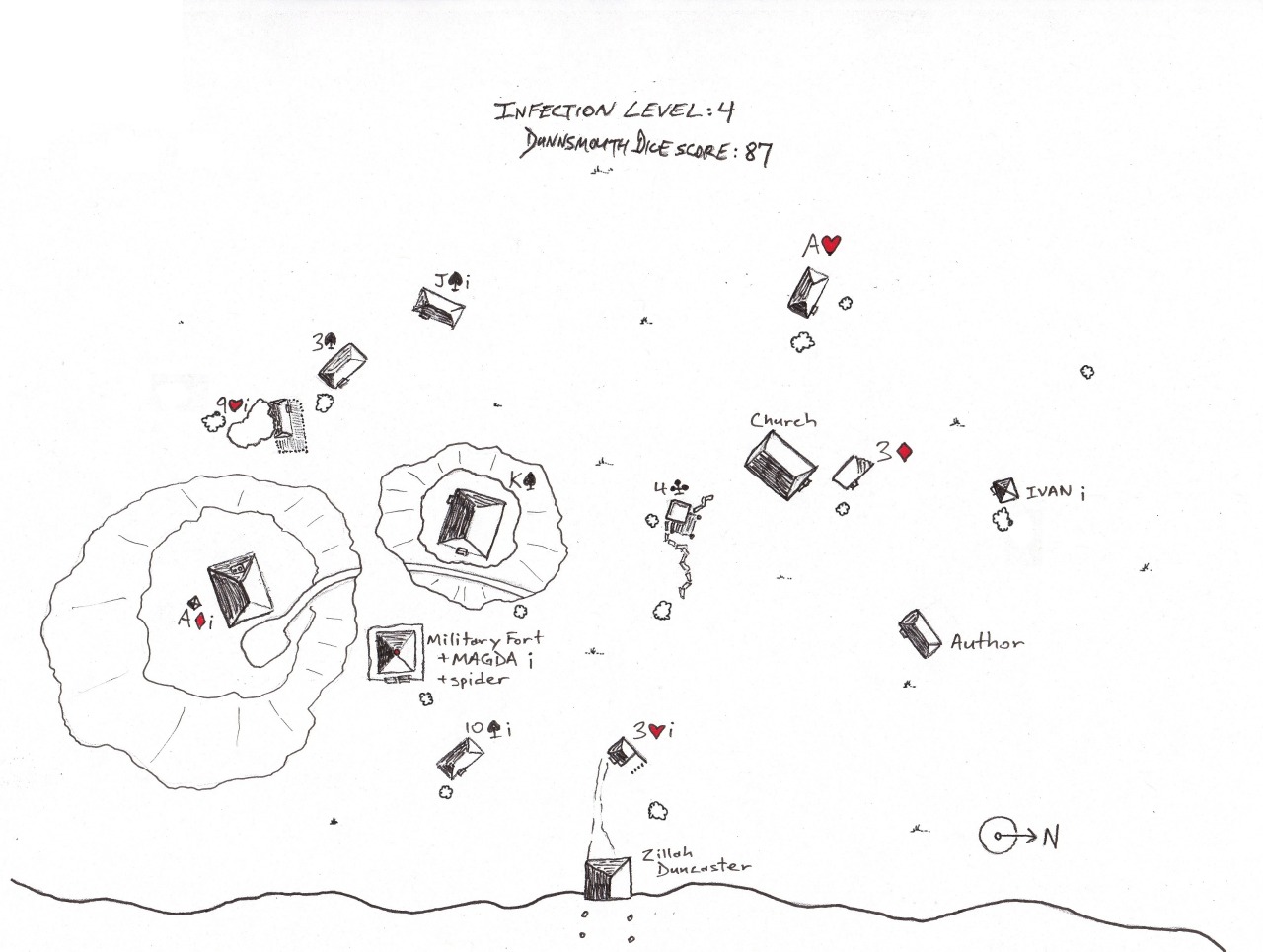
I put the map above as well as a text-free version into this pdf for easy printing: MARIE'S VERSION OF SCENIC DUNNSMOUTH
I consider this my wife's map since she insisted on rolling the dice. To be honest she rolled really well and I think this is the best map I've produced out of the four. The adventure reminds me a lot of the Village of Hommlet so I tried to replicate some of the style of that module's map. All of the rules for building Dunnsmouth from the book were followed with a few exceptions:
1) I put the Time Cube inside a residence by drawing a card for the d4 (automatically infected)
2) I placed Magda in the farthest kicker die from Ivan
To make reference with the pdf easier I just used the card suits for the locations unless a basic description would suffice. Also, the shoreline is left ambiguously straightish because I plan on using this map as a river location within my current game.
I put the map above as well as a text-free version into this pdf for easy printing: MARIE'S VERSION OF SCENIC DUNNSMOUTH
My Ten Favorite RPG Products of All Time
In no particular order, because I can't say one book is better than another, and I'm not going to rate them on a one to ten scale, they're all good in my opinion.
Monster Manual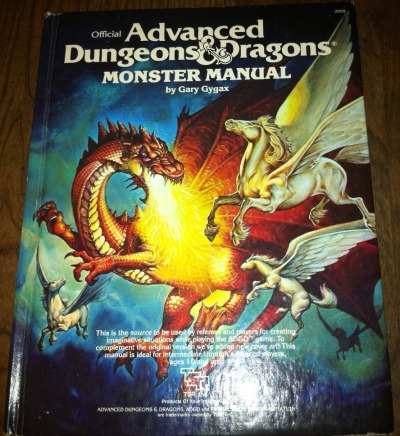
This wasn't my first RPG book but it was definitely the first one I read cover to cover and the first one I wore out the cover from rereading, use, and abuse. The one pictures here is the third copy I've owned. As long as I had my Monster Manual I felt I could GM anything. That kind of "give me some stats and I'll do the rest" attitude still informs my style, though when I was younger I really did not know how to string a plotline together very well.
*sigh*
To be eight years old again. "The wizard is turning everyone into trolls... because he's evil!"
I6 Ravenloft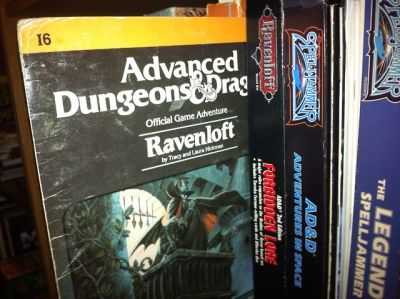
When I was maybe 9 years old I knew this older kid who played D&D. He was like really old though, like 16 or 17 maybe. But anyway, he wouldn't play with me unless he was the GM and I was a PC. He ran Ravenloft as a solo adventure for me and that lasted for a couple of weeks before he got bored and stopped playing with me. But during that short game I haggled with gypsies, escaped wolves in the dark of the forest, explored the town of Barovia, and fought Count Strahd in his own castle. I thought it was the coolest thing, and playing with that older kid was the best D&D got for me until I discovered my friendly local game store. (It's a shame I can't remember his name though.)
This was also the first adventure module I ever purchased.
Birthright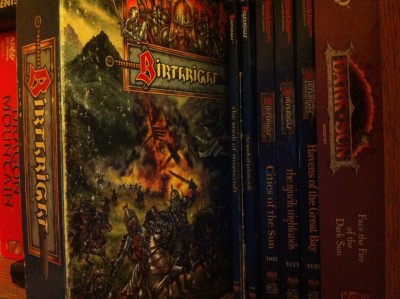
This is my favorite published campaign world and the Ruins of Empire book from the box set is probably the highlight of this set. There are lots of details provided for every single section of land in the world, and yet much of the world itself is left open for GMs and players to define what's going on within each country and around every established character. The rules for Bloodlines and Regency are fairly unbalanced and I've often converted the world to other RPG systems, but there's lots of good ideas and history loaded into a small space. The rules for ley lines, channeling magical power, and controlling sources of power are particularly cool.
Planescape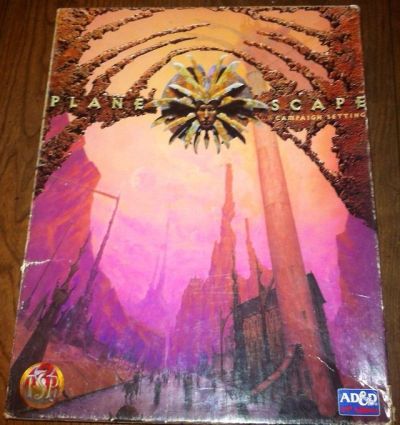
Tony Diterlizzi's artwork does a lot to give Planescape it's edge. When the Deet stopped drawing Planescape books that's when their sales started to fall, I don't think that's a coincidence. It's also probably not a coincidence that the only Planescape books available from WOTC are ones that don't have Tony's artwork.
The rules were just 2nd edition AD&D add-ons, but the setting material is inspired and fun. My first forays into GMing took place within Sigil, the City of Doors.
Mage: the Awakening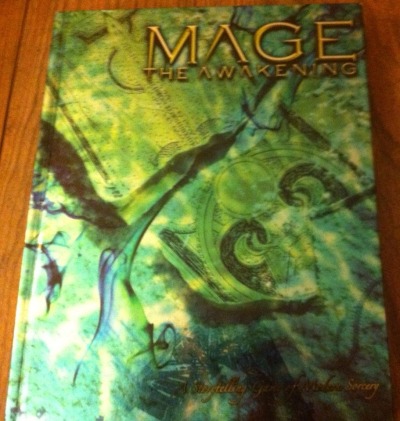
Mage the Ascension was not my first exploration outside of D&D, but the first one that really grabbed me by the imagination and inspired me to play something else. I mention the original version of Mage because it has consistent qualities with the reboot. Sessions of Ascension would often have lengthy debates about how to best use the spheres of magic to accomplish something, and I think Awakening fixed a lot of those problems by making it all relatively straightforward. Awakening didn't have strong central villains like Ascension though, so mixing the setting of Ascension with the rules of Awakening is probably the best way to play this game. I still love both of them, but Awakening moreso.
HOL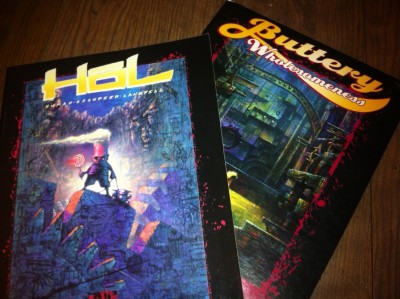
I can't emphasize how much I love this book! Not really a game as much as it is a parody of a game. You can still play it and I have, but it works more as a joke and playing it should never be done seriously. It's sole expansion has rules for an awesome little LARP called "Freebase" that viciously parodies every single anti-D&D screed produced by fear-mongering churchy conservatives in the 1980s. However most gamers I know refuse to even read HOL since it's handwritten, but if you can get past the weird format it is perhaps the funniest piece of RPG writing ever produced.
Stars Without Number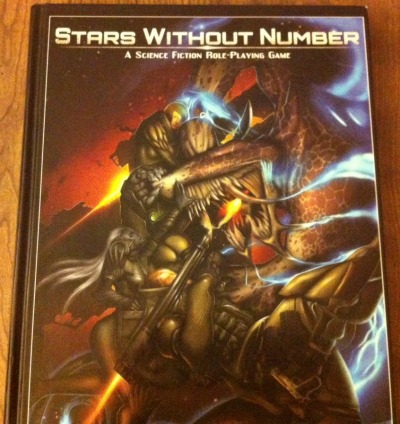
I discovered the OSR by accident because of this book. I was looking for stuff to make a Traveller campaign out of and after reading about the tag system introduced in this book I decided to look for a copy. The no-art pdf is free and after I downloaded it I liked it so much that I bought a hardcover copy. I enjoy the dual familiarity and simplicity of the system presented in the rules, but the tag system is really the best part of this rulebook. Most of Kevin Crawford's other work is equally on par with this title.
Apocalypse World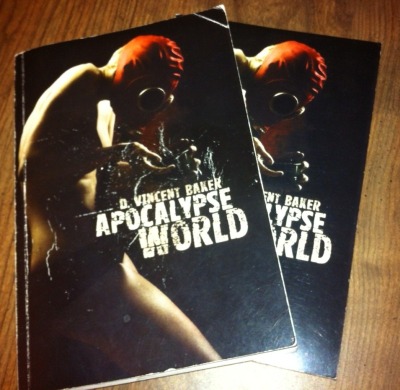
Written in such a way that it tells a complete novice how to play an RPG without ever using the cliched "What is a role-playing game?" kind of introduction that almost every RPG rulebook has. It illustrates and codifies how to GM effectively by giving the GM an agenda with principles to follow and moves to make when the players fail or look to you for more action. Because I learned role-playing primarily in the 1990s I used to be one of those GMs who crafted a story and then thrust it at my players, but since reading this book I have revised my GMing style so thoroughly that whenever I think of running a new game I always default to thinking of the prospective campaign in terminology which is central to Apocalypse World's design. Nothing about the advice in this game is particularly new, but it's presentation and delivery is cut from 100% originality and that makes all the difference.
Deadlands RPG
Rather than a single book I would like to say this whole game is one of my favorite RPG things! I played in an ongoing Deadlands campaign for roughly eight years and spent so much time with the books and the setting that (even though I have only played it three times in the last decade) I can still remember all of the weird and fiddly little rules. The GM who ran our eight-year long campaign passed away in 2005 and I doubt any of us who played it will ever be able to return to the game without remembering our time with him. I can't really call this a favorite game, but it does hold many fond and bittersweet memories for me.
GURPS Illuminati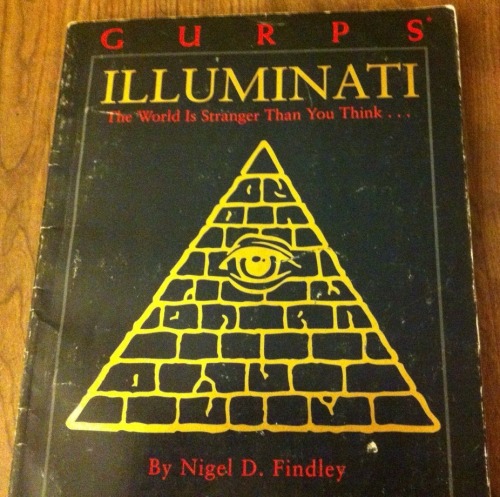
Saving the best for last! So I guess I did end up rating these titles in some way, but this is the only RPG book in my collection which I have adamantly insisted to other GMs that they purchase and read cover to cover. It is the best "How to mess with your players' heads" guide out there. The theories, tips, stories, anecdotes, and ideas in this book are not just good tips for making an Illuminati campaign, but are good tips for making any campaign deep and interesting. It's filled with useful GMing advice, but it's also a treat to read.
Also, I have a lot of gaming books.
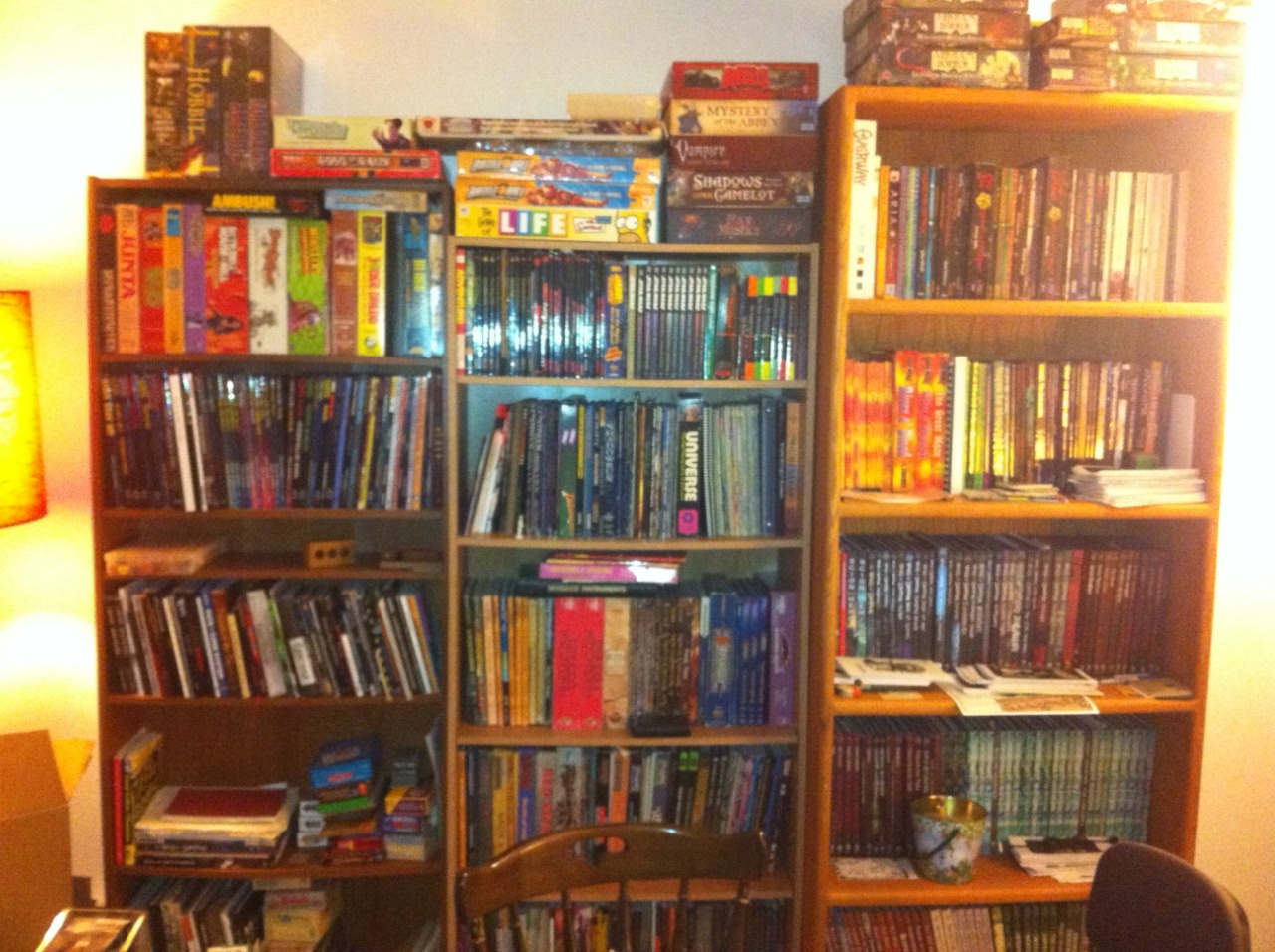
This isn't even everything I've ever owned or read, just the stuff that I still happen to own.
Monster Manual
This wasn't my first RPG book but it was definitely the first one I read cover to cover and the first one I wore out the cover from rereading, use, and abuse. The one pictures here is the third copy I've owned. As long as I had my Monster Manual I felt I could GM anything. That kind of "give me some stats and I'll do the rest" attitude still informs my style, though when I was younger I really did not know how to string a plotline together very well.
*sigh*
To be eight years old again. "The wizard is turning everyone into trolls... because he's evil!"
I6 Ravenloft
When I was maybe 9 years old I knew this older kid who played D&D. He was like really old though, like 16 or 17 maybe. But anyway, he wouldn't play with me unless he was the GM and I was a PC. He ran Ravenloft as a solo adventure for me and that lasted for a couple of weeks before he got bored and stopped playing with me. But during that short game I haggled with gypsies, escaped wolves in the dark of the forest, explored the town of Barovia, and fought Count Strahd in his own castle. I thought it was the coolest thing, and playing with that older kid was the best D&D got for me until I discovered my friendly local game store. (It's a shame I can't remember his name though.)
This was also the first adventure module I ever purchased.
Birthright
This is my favorite published campaign world and the Ruins of Empire book from the box set is probably the highlight of this set. There are lots of details provided for every single section of land in the world, and yet much of the world itself is left open for GMs and players to define what's going on within each country and around every established character. The rules for Bloodlines and Regency are fairly unbalanced and I've often converted the world to other RPG systems, but there's lots of good ideas and history loaded into a small space. The rules for ley lines, channeling magical power, and controlling sources of power are particularly cool.
Planescape
Tony Diterlizzi's artwork does a lot to give Planescape it's edge. When the Deet stopped drawing Planescape books that's when their sales started to fall, I don't think that's a coincidence. It's also probably not a coincidence that the only Planescape books available from WOTC are ones that don't have Tony's artwork.
The rules were just 2nd edition AD&D add-ons, but the setting material is inspired and fun. My first forays into GMing took place within Sigil, the City of Doors.
Mage: the Awakening
Mage the Ascension was not my first exploration outside of D&D, but the first one that really grabbed me by the imagination and inspired me to play something else. I mention the original version of Mage because it has consistent qualities with the reboot. Sessions of Ascension would often have lengthy debates about how to best use the spheres of magic to accomplish something, and I think Awakening fixed a lot of those problems by making it all relatively straightforward. Awakening didn't have strong central villains like Ascension though, so mixing the setting of Ascension with the rules of Awakening is probably the best way to play this game. I still love both of them, but Awakening moreso.
HOL
I can't emphasize how much I love this book! Not really a game as much as it is a parody of a game. You can still play it and I have, but it works more as a joke and playing it should never be done seriously. It's sole expansion has rules for an awesome little LARP called "Freebase" that viciously parodies every single anti-D&D screed produced by fear-mongering churchy conservatives in the 1980s. However most gamers I know refuse to even read HOL since it's handwritten, but if you can get past the weird format it is perhaps the funniest piece of RPG writing ever produced.
Stars Without Number
I discovered the OSR by accident because of this book. I was looking for stuff to make a Traveller campaign out of and after reading about the tag system introduced in this book I decided to look for a copy. The no-art pdf is free and after I downloaded it I liked it so much that I bought a hardcover copy. I enjoy the dual familiarity and simplicity of the system presented in the rules, but the tag system is really the best part of this rulebook. Most of Kevin Crawford's other work is equally on par with this title.
Apocalypse World
Written in such a way that it tells a complete novice how to play an RPG without ever using the cliched "What is a role-playing game?" kind of introduction that almost every RPG rulebook has. It illustrates and codifies how to GM effectively by giving the GM an agenda with principles to follow and moves to make when the players fail or look to you for more action. Because I learned role-playing primarily in the 1990s I used to be one of those GMs who crafted a story and then thrust it at my players, but since reading this book I have revised my GMing style so thoroughly that whenever I think of running a new game I always default to thinking of the prospective campaign in terminology which is central to Apocalypse World's design. Nothing about the advice in this game is particularly new, but it's presentation and delivery is cut from 100% originality and that makes all the difference.
Deadlands RPG
Rather than a single book I would like to say this whole game is one of my favorite RPG things! I played in an ongoing Deadlands campaign for roughly eight years and spent so much time with the books and the setting that (even though I have only played it three times in the last decade) I can still remember all of the weird and fiddly little rules. The GM who ran our eight-year long campaign passed away in 2005 and I doubt any of us who played it will ever be able to return to the game without remembering our time with him. I can't really call this a favorite game, but it does hold many fond and bittersweet memories for me.
GURPS Illuminati
Saving the best for last! So I guess I did end up rating these titles in some way, but this is the only RPG book in my collection which I have adamantly insisted to other GMs that they purchase and read cover to cover. It is the best "How to mess with your players' heads" guide out there. The theories, tips, stories, anecdotes, and ideas in this book are not just good tips for making an Illuminati campaign, but are good tips for making any campaign deep and interesting. It's filled with useful GMing advice, but it's also a treat to read.
Also, I have a lot of gaming books.
This isn't even everything I've ever owned or read, just the stuff that I still happen to own.
Thursday, March 20, 2014
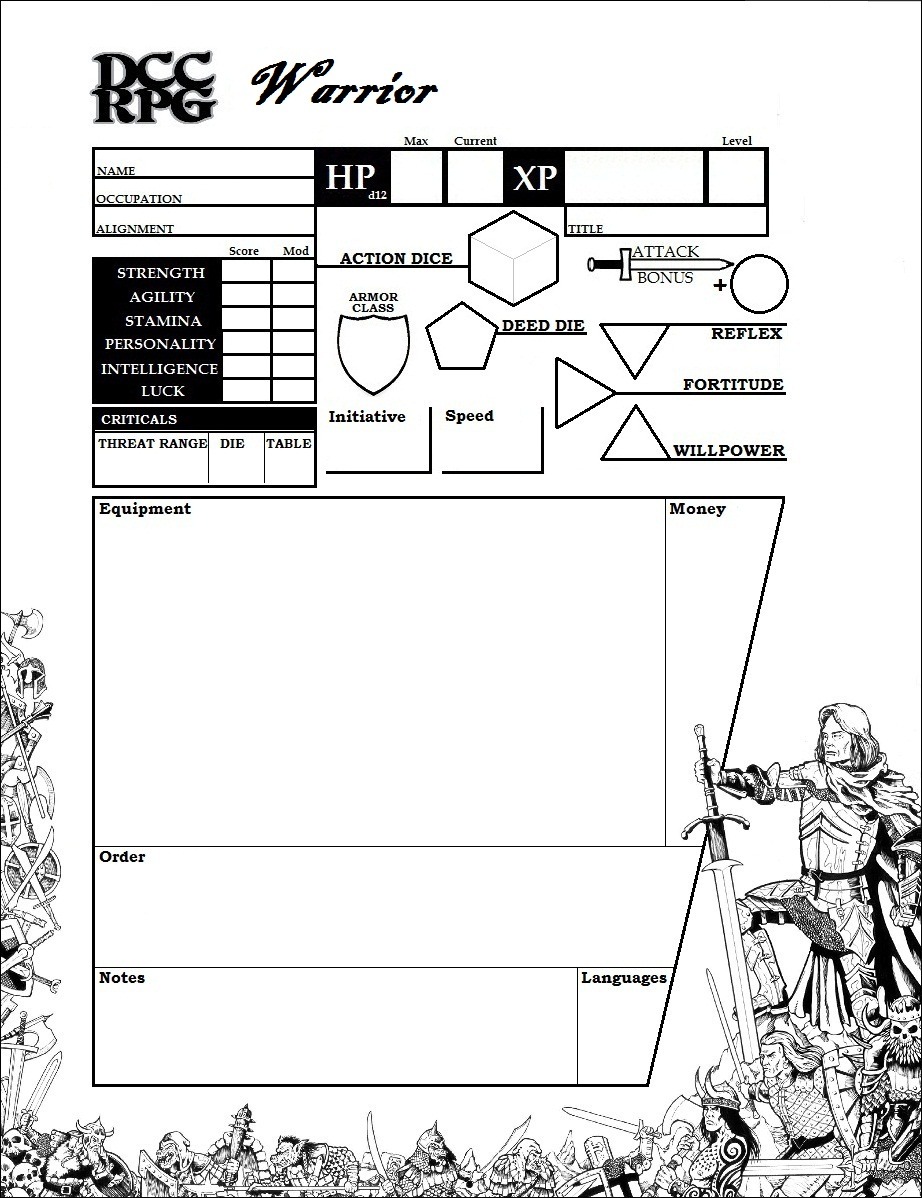
Dungeon Crawl Classics character sheets
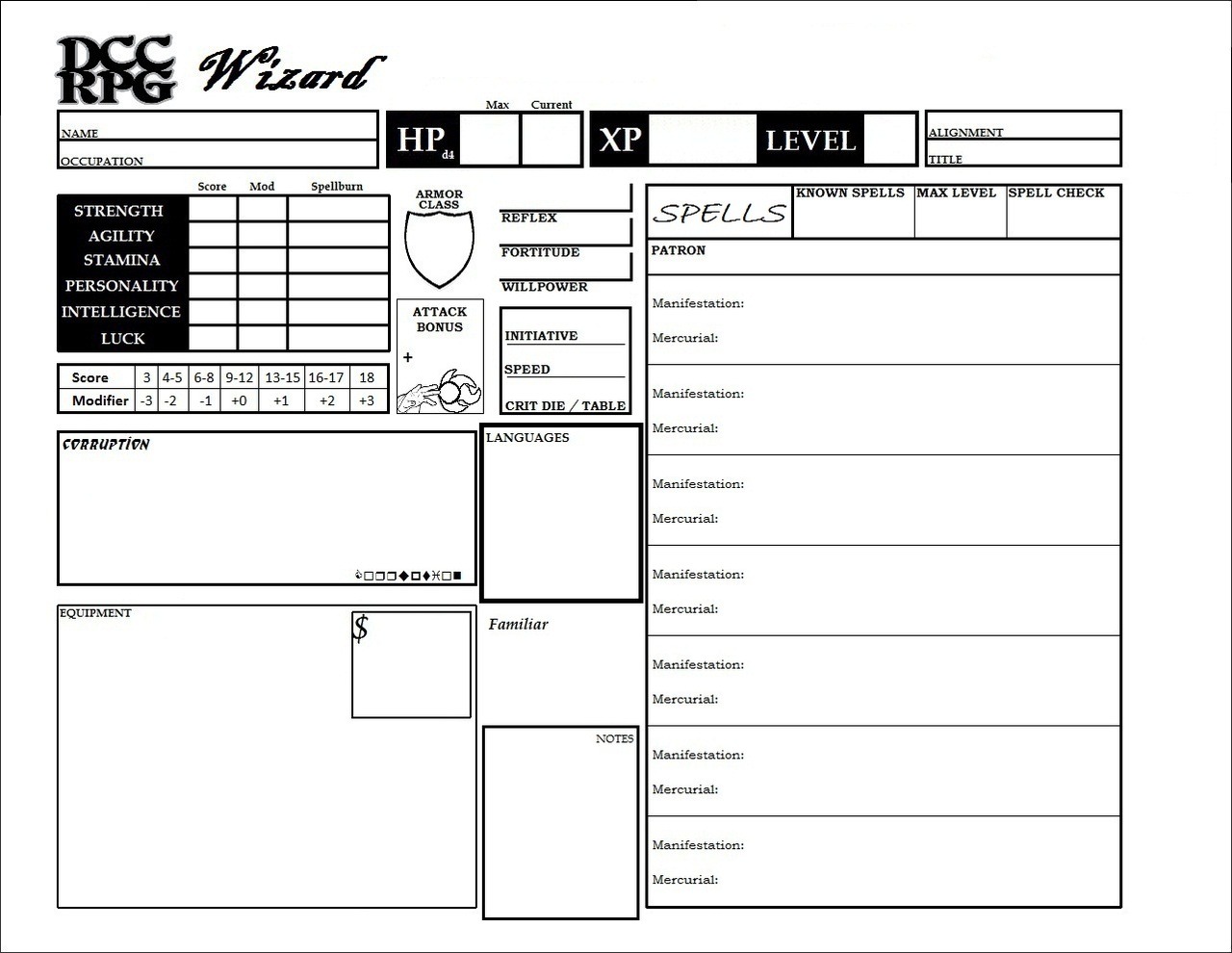
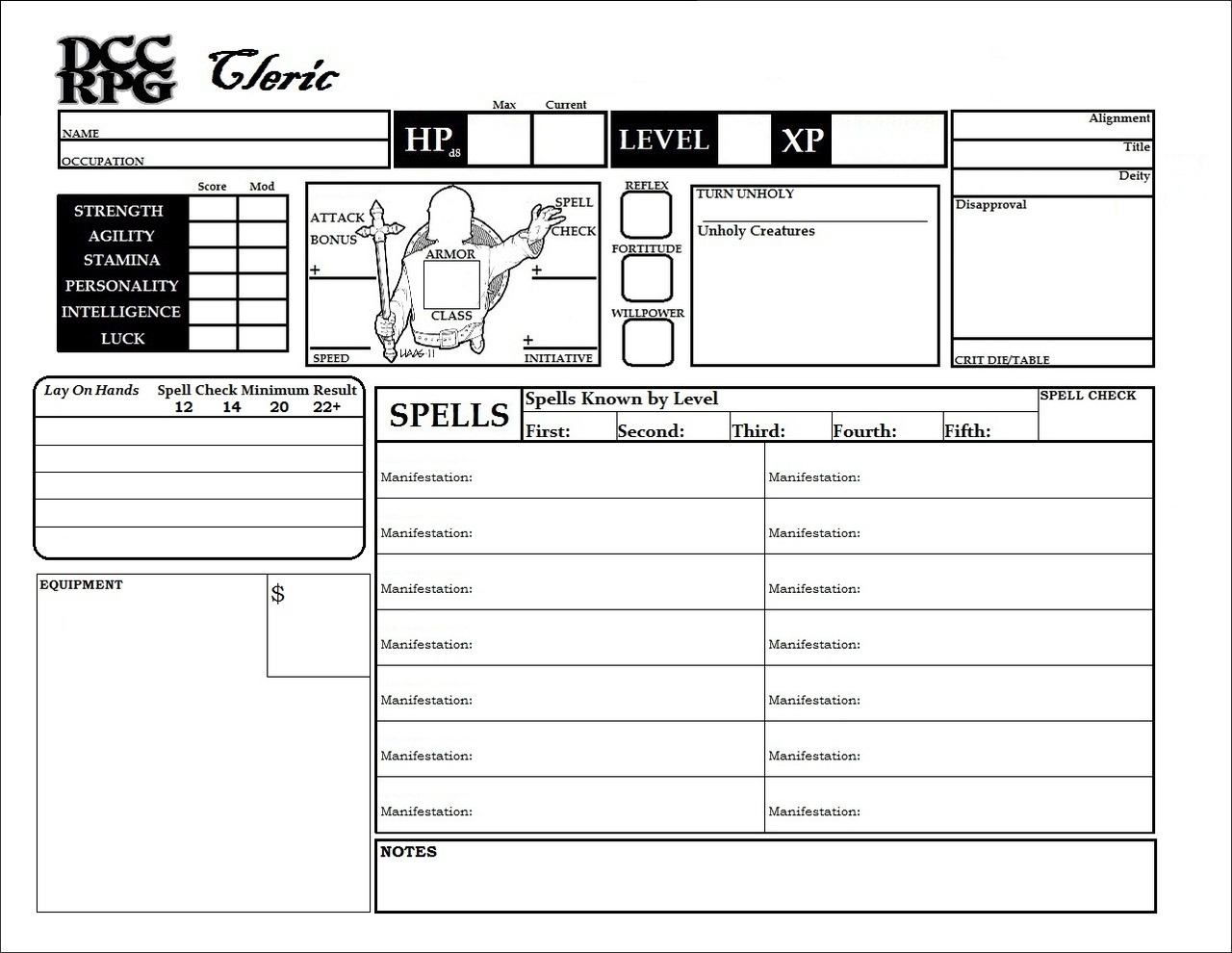
When I first discovered Dungeon Crawl Classics I designed a few custom character sheets for "the basic 4" classes. I never got around to doing the demihuman classes because when I was first GMing I didn't include the demihuman races as classes. This was also before I had a pdf editor and so I made them entirely as jpgs that need to be printed as full-page images. I kept thinking I'll get around to remaking them as pdfs but honestly, my enthusiasm for finishing a project is directly related to how likely I am to using the finished product. These days I'm not playing DCC and I don't see that changing any time soon.
Click on the image to make it bigger (the big version is what you want to print if you choose to use these)


Click on the image to make it bigger (the big version is what you want to print if you choose to use these)

Wednesday, March 19, 2014
lamentation of the gamer without a regular game
games I've recently played
Dungeon World (using Adventures on Dungeon Planet rules)
Hollow Earth Expeditions
Night's Black Agents
Sagas of the Icelanders
Itras By
Gamma World (by way of 4th edition D&D)
playtested a friend's game in development
Torchbearer
Dungeon Crawl Classics
games I would like to GM
Stars Without Number - with my Fallout-inspired Perks and Traits
Lamentations of the Flame Princess (with some other OSR rules added) - set in Kosranon
Apocalypse World (with some custom moves from Tremulus) - post-apocalyptic horror set in Nova Scotia
Dungeon World (with heavy hacking) - set in Birthright
Shadowrun (4th edition) - ignore all 'official' information about the setting
games I want to play
Apocalypse World
games I would like to GM
games I want to play
Sunday, March 16, 2014
Success!
I've been thinking a lot about what a dice roll really means within a role-playing game. What it is meant to convey and how it is applied are usually two different things. Dice usually means risk of failure, not just chance of success. If there is a risk that something bad could happen then the dice come out, or if there's a chance that something really good could happen the dice come out. Or both.
Consider a player who says "I want to climb a nearby tree and try to get a better look at this valley."
GMs would handle this request differently, some might require a roll, and some might just let the PC climb a tree and draw a crude map without a roll. I'm going to focus on GMs who require rolls, and what that roll would mean.
First, there is a simple question of success or failure. Success is "you climb the tree" and failure is "there are no decent handholds, you don't climb the tree."
GURPS uses this method, though it also uses a complex skill system to determine where that success is achieved.
Second there is the chance of extra benefit or complications. Extra benefit might be "you climb the tree and make a rough map quickly and efficiently" and complication might be "you fall out of the tree and take some damage."
In D&D, and many of it's variants, this is frequently represented by rolling an unmodified result of '1' or '20'
This is usually where most dice rolling conventions end. But there's additional possibilities within the dice roll.
Consider the partial success, which I enjoy using. A partial success might be "you can climb the tree and make a map, but there is no safe way down and you'll have to fall most of the way" or "if you climb the tree, you'll expose yourself to pterodactyls circling overhead" or "you can only make it halfway, the branches above are thin and weak, if you climb any farther you risk breaking the branches and falling to the ground."
Apocalypse World explicitly uses the partial success.
Then there's extending the outcomes into an exacting range of "success with extra benefit," simple "success," "success with complication," "failure with extra benefit," simple "failure," and "failure with complications."
Venger Satanis' VSd6 system accomplishes this.
The results and methods of achieving them are diverse. The results however are almost always determined by the GM. The players drive the action forward but the GM lays down the roads that they follow. I think the best players are the ones who forget the roads exist, and that the best GMs are the ones who say "Where we're going, we don't need roads."
Consider a player who says "I want to climb a nearby tree and try to get a better look at this valley."
GMs would handle this request differently, some might require a roll, and some might just let the PC climb a tree and draw a crude map without a roll. I'm going to focus on GMs who require rolls, and what that roll would mean.
First, there is a simple question of success or failure. Success is "you climb the tree" and failure is "there are no decent handholds, you don't climb the tree."
GURPS uses this method, though it also uses a complex skill system to determine where that success is achieved.
Second there is the chance of extra benefit or complications. Extra benefit might be "you climb the tree and make a rough map quickly and efficiently" and complication might be "you fall out of the tree and take some damage."
In D&D, and many of it's variants, this is frequently represented by rolling an unmodified result of '1' or '20'
This is usually where most dice rolling conventions end. But there's additional possibilities within the dice roll.
Consider the partial success, which I enjoy using. A partial success might be "you can climb the tree and make a map, but there is no safe way down and you'll have to fall most of the way" or "if you climb the tree, you'll expose yourself to pterodactyls circling overhead" or "you can only make it halfway, the branches above are thin and weak, if you climb any farther you risk breaking the branches and falling to the ground."
Apocalypse World explicitly uses the partial success.
Then there's extending the outcomes into an exacting range of "success with extra benefit," simple "success," "success with complication," "failure with extra benefit," simple "failure," and "failure with complications."
Venger Satanis' VSd6 system accomplishes this.
The results and methods of achieving them are diverse. The results however are almost always determined by the GM. The players drive the action forward but the GM lays down the roads that they follow. I think the best players are the ones who forget the roads exist, and that the best GMs are the ones who say "Where we're going, we don't need roads."
Tuesday, March 11, 2014
short and sweet: Qelong and Scenic Dunnsmouth
It is rare for me to read a role-playing game and feel awed. I don't gush about my favorite games or game authors the same way I do about my favorite comic books, movies, or video games. Today I'm being uncharacteristic.
These are spoiler-free reviews.
Qelong, by Kenneth Hite
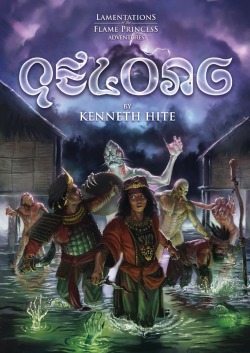 For the first time in years I simply could not put a book down, and it was an adventure module. I lost track of time while reading it, and was even late for work because I found myself wanting to read just one more page. Fans of Kenneth Hite are probably nodding sagely and wondering why I am so surprised. Outside of his Suppressed Transmission articles, which I found fun to read but never very useful for gaming, I haven't read anything else written solely by him. That changed after reading Qelong. I've slowly been collecting his work now that I know how good it is. Qelong is brilliant and engrossing! If you don't find inspiration from within this adventure module then you should start letting somebody else GM.
Buy it from DTRPG!
Buy it from LOTFP store!
Scenic Dunnsmouth, by Zzarchov Kowolski
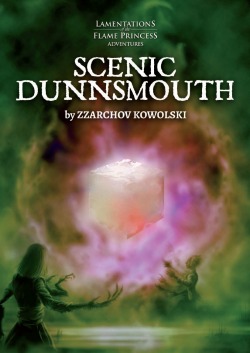 I was completely gobsmacked by this module. The premise is pretty simple: mix one secluded village with a cult, sprinkle a powerful artifact into the middle, garnish with PCs and hijinks are bound to ensue. But the execution is where this seemingly cut-out scenery truly shines! The cooking metaphor above is apt given there is a lengthy set-up before the module can be used, but the random generation of key elements insures this module will never be played the same way twice. It's truly inspired work, and Scenic Dunnsmouth has made me an instant fan of Kowolski! He has crafted an adventure and setting all-in-one that oozes with menace, and I can't wait to play it.
Buy it from DTRPG!
Buy it from LOTFP store!
These are spoiler-free reviews.
Qelong, by Kenneth Hite
 For the first time in years I simply could not put a book down, and it was an adventure module. I lost track of time while reading it, and was even late for work because I found myself wanting to read just one more page. Fans of Kenneth Hite are probably nodding sagely and wondering why I am so surprised. Outside of his Suppressed Transmission articles, which I found fun to read but never very useful for gaming, I haven't read anything else written solely by him. That changed after reading Qelong. I've slowly been collecting his work now that I know how good it is. Qelong is brilliant and engrossing! If you don't find inspiration from within this adventure module then you should start letting somebody else GM.
Buy it from DTRPG!
Buy it from LOTFP store!
Scenic Dunnsmouth, by Zzarchov Kowolski
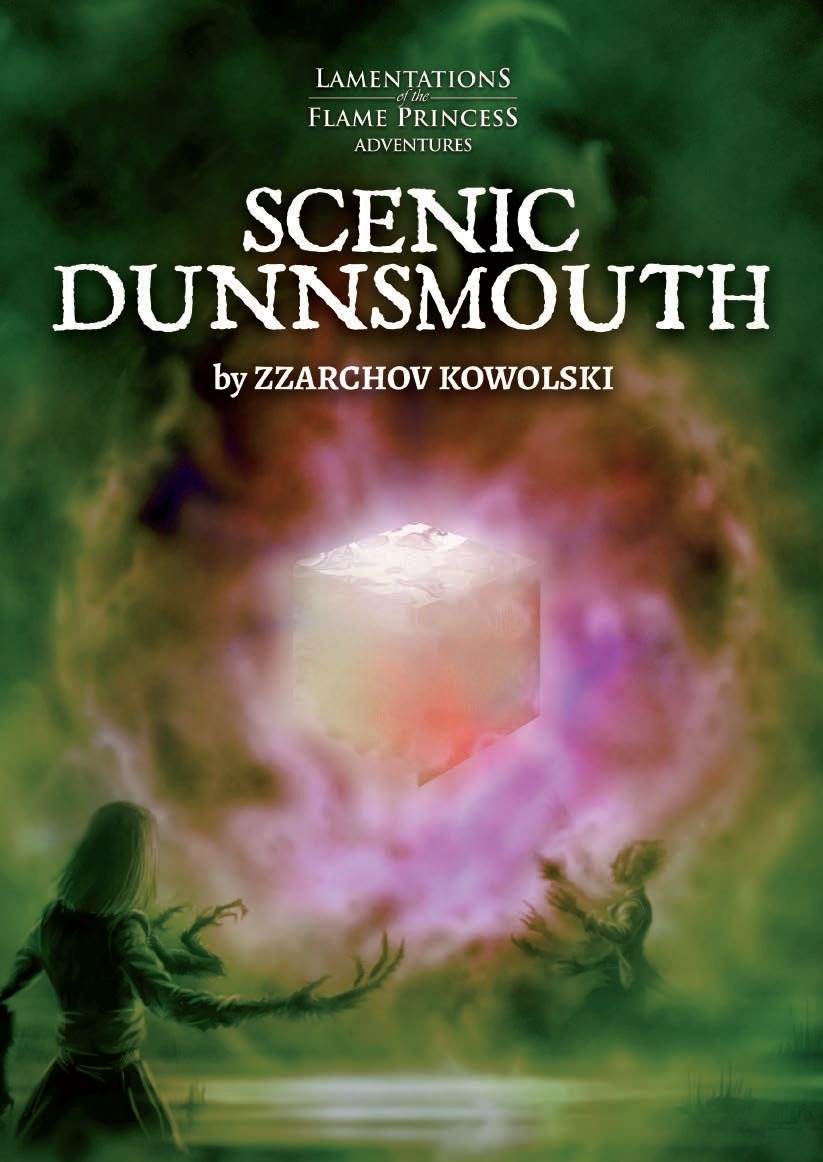 I was completely gobsmacked by this module. The premise is pretty simple: mix one secluded village with a cult, sprinkle a powerful artifact into the middle, garnish with PCs and hijinks are bound to ensue. But the execution is where this seemingly cut-out scenery truly shines! The cooking metaphor above is apt given there is a lengthy set-up before the module can be used, but the random generation of key elements insures this module will never be played the same way twice. It's truly inspired work, and Scenic Dunnsmouth has made me an instant fan of Kowolski! He has crafted an adventure and setting all-in-one that oozes with menace, and I can't wait to play it.
 Buy it from DTRPG!
Buy it from LOTFP store!
Wednesday, March 5, 2014
Jetsam Village
This scenario was inspired by the map of Ravenson's Landing. When I first saw the map I thought of a game in which I had played where there were these abandoned military towers along the coastline, and that immediately led me to thinking about it as a place that could go into my Kosranon setting. Except the region I'm focusing on right now is along a northern coastline. I flipped the map, and adjusted a little bit of the artwork to make it look right, but otherwise the image is unchanged from how Dyson first posted it.
Because I'm using it for Kosranon everything written below references that world, many of the monsters have insectile features, but all of it should be easy to adapt to an OSR game, and where applicable I've included generic OSR stats or an OSR-friendly version of each location (inside parentheses). This scenario was written for 1st-level characters.
Legalese: the map on this page is copyright 2013 by Dyson Logos

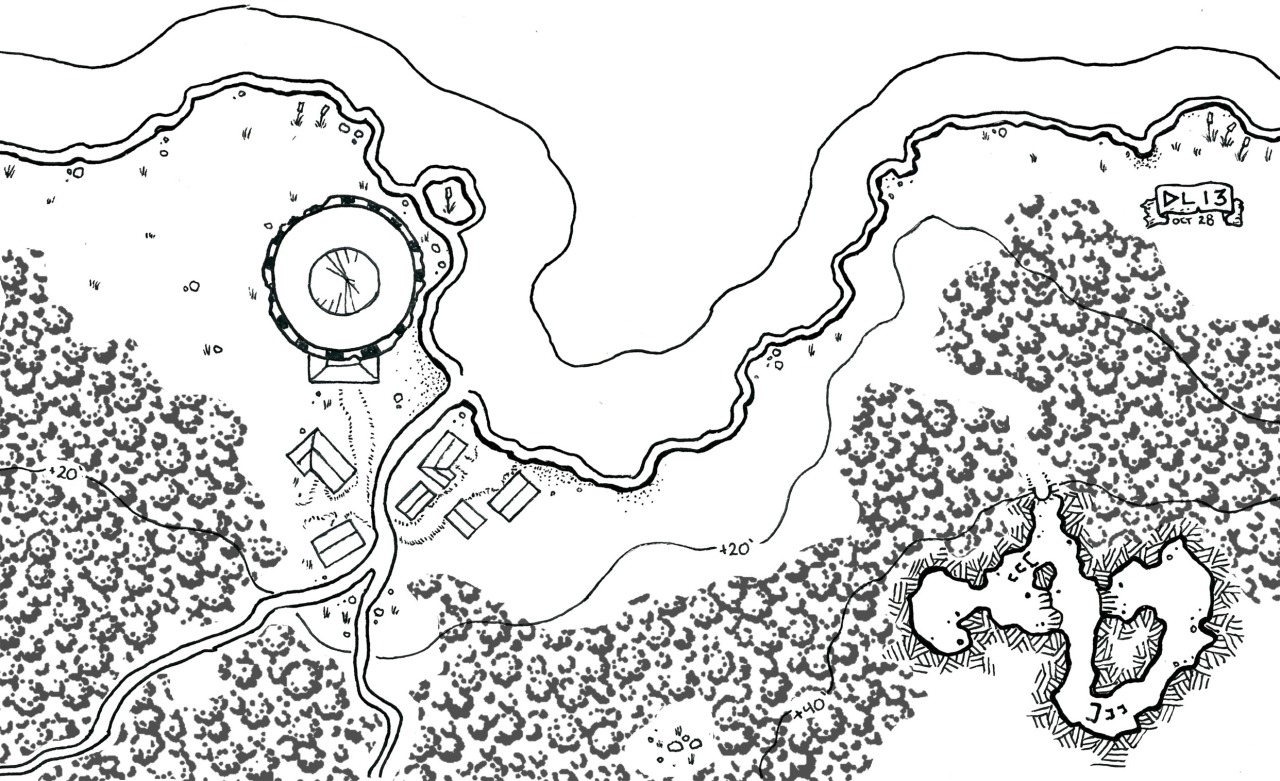
While not a part of any established local governance, Jetsam Village is assumed to be uninhabited by neighboring lords due to the abandoned military tower that lies in partial ruins. The collection of small buildings next to the tower were once used to store supplies and house soldiers for a war that nobody remembers. The closest villages and cities have made no claim on the tower or the grounds surrounding it, and many do not even know it exists.
Currently the village is being used by a small group of smugglers who are the main suppliers for the black market in Marakāven and the Hidden Fortress to the south. Marakāven is the closest city, roughly 20 miles to the east of Jetsam Village. The smugglers make regular trips to the Hidden Fortress, and if the pirates are not doing well then the smugglers will turn to banditry to keep themselves supplied.
The Tower:
The northern side of the tower has collapsed and the interior is exposed to the wind from the ocean, and any sailing ships passing by can see inside well enough. The smugglers don't camp inside the tower at all, but instead use the ground floor as a trash receptacle and lavatory. There are two levels below the tower, including a modest number of dungeon cells, most of which are currently occupied by fist-sized maggots that are feeding off the carcass of an orsect. The orsect was drawn to the site by the feces being dumped by the smugglers, but got trapped on the lower level and starved to death. Any day the fist-sized maggots will transform into quilids (2d6 quilids, 1 HD each, and each is about 3 feet long), and the village will become infested with the pests.
(instead of an orsect being feasted on by quilid maggots, treat as an ogre corpse being feasted on by giant ant maggots)
The Village:
Most of these buildings are in a foul state of disrepair. The largest happens to be both the most damaged and the current residence of the smugglers' leader, Varim. Every building has had it's windows boarded up and covered in heavy cloth to prevent any accidental light from spilling out onto the water and revealing to passing ships at night that any of the buildings might be inhabited. However there is not enough traffic to maintain a constant presence at the village, and pirates only bring stolen goods to the village once every two or three months. When PCs encounter the village a shipment should either be about to arrive or have just been traded and ready to load up in wagons for a trip south.
Varim is a Junian from Marakāven. He has a deal with the ruler of the Hidden Fortress to the south, Captain Cassandra, that allows him to sell contraband and stolen goods in her town. Varim has two lieutenants; Set, a Junian from Cliffwater, who negotiates with pirates that make landfall near the village, and Dai, an Athomian, the thug of the group who keeps any other guards or hirelings in line and probably the most dangerous. They will always have people helping them, assume they have two more criminal thugs with them for every PC in your group.
Sometimes the smugglers sell slaves to Captain Cassandra, but these are always Oukek or Kcaltsim Dwarves that were captured wandering near the village.
(treat Oukek like halflings; treat Kcaltsim Dwarves like regular dwarves; treat Varim and Set like 2nd-level thieves, and Dai as a 3rd-level fighter, treat anybody working for them as 1st-level fighters)
The Wreck:
Beneath the waters of the inlet lies the split apart bow and stern of an old ship, the Prideful Princess. The remains of the vessel has never been properly searched, and many salvageable items remain in the ship's hold. The heavy water damage will have destroyed most objects, but there is plenty of silver and gold to be scrounged if anybody can find a way of diving to the innards of the ship. Detecting magic may reveal that there are at least two items of note still resting within the bow of the wreckage. Vicious GMs could stock the wreckage with a large octopus, but getting to the magic items should be challenging enough for a low-level party.
A Bottle of Lightning will be found in the pockets of a dead body just underneath the main hold in the bow. This bottle is made of pristine and clear glass, stoppered with a simple cork. When broken (or opened) will release a 5d6 lightning bolt that strikes anybody within 15 feet of the bottle.
The Silver Platter can be found in the Captain's quarters, it is a food platter made of finest silver and looks like it was once part of a set of silverware for fine dining. Any food or drink that is left to rest on the plate will never spoil or decay. Further, any food or drink left on the plate for longer than a few seconds becomes unspoiled and freshened as if it were freshly prepared, and any poisons in the food or drink are also purified and removed.
The Cave:
Despite it's close proximity to the village, this cave is unknown to the smugglers living there. If the PCs approach from the east along the coast they can easily see the entrance to the cave before approaching the village. Recently a pregnant aurymite sought shelter here during a storm and gave birth to six babies. She is desperate to find a way to carry her daughters to an aurymite camp to the west, but doesn't want to become exposed to the smugglers. She has been camped here for over a week and many of the edible flora nearby has been consumed by her and her children, but the time spent here has also allowed her to spy on the smugglers. She knows their routines and can guess at some of the activities they are up to, she is a reliable source of information for the PCs and will gladly exchange her knowledge for an escort home, or another suitable course of action. If pressed into combat she will fight with a battleaxe and attempts to defend her daughters by leading attackers away from them or the cave.
(instead of an aurymite use a troll, this encounter no longer becomes one where information can be gleaned but the six troll babies should make for a perplexing predicament)

Because I'm using it for Kosranon everything written below references that world, many of the monsters have insectile features, but all of it should be easy to adapt to an OSR game, and where applicable I've included generic OSR stats or an OSR-friendly version of each location (inside parentheses). This scenario was written for 1st-level characters.
Legalese: the map on this page is copyright 2013 by Dyson Logos
While not a part of any established local governance, Jetsam Village is assumed to be uninhabited by neighboring lords due to the abandoned military tower that lies in partial ruins. The collection of small buildings next to the tower were once used to store supplies and house soldiers for a war that nobody remembers. The closest villages and cities have made no claim on the tower or the grounds surrounding it, and many do not even know it exists.
Currently the village is being used by a small group of smugglers who are the main suppliers for the black market in Marakāven and the Hidden Fortress to the south. Marakāven is the closest city, roughly 20 miles to the east of Jetsam Village. The smugglers make regular trips to the Hidden Fortress, and if the pirates are not doing well then the smugglers will turn to banditry to keep themselves supplied.
The Tower:
The northern side of the tower has collapsed and the interior is exposed to the wind from the ocean, and any sailing ships passing by can see inside well enough. The smugglers don't camp inside the tower at all, but instead use the ground floor as a trash receptacle and lavatory. There are two levels below the tower, including a modest number of dungeon cells, most of which are currently occupied by fist-sized maggots that are feeding off the carcass of an orsect. The orsect was drawn to the site by the feces being dumped by the smugglers, but got trapped on the lower level and starved to death. Any day the fist-sized maggots will transform into quilids (2d6 quilids, 1 HD each, and each is about 3 feet long), and the village will become infested with the pests.
(instead of an orsect being feasted on by quilid maggots, treat as an ogre corpse being feasted on by giant ant maggots)
The Village:
Most of these buildings are in a foul state of disrepair. The largest happens to be both the most damaged and the current residence of the smugglers' leader, Varim. Every building has had it's windows boarded up and covered in heavy cloth to prevent any accidental light from spilling out onto the water and revealing to passing ships at night that any of the buildings might be inhabited. However there is not enough traffic to maintain a constant presence at the village, and pirates only bring stolen goods to the village once every two or three months. When PCs encounter the village a shipment should either be about to arrive or have just been traded and ready to load up in wagons for a trip south.
Varim is a Junian from Marakāven. He has a deal with the ruler of the Hidden Fortress to the south, Captain Cassandra, that allows him to sell contraband and stolen goods in her town. Varim has two lieutenants; Set, a Junian from Cliffwater, who negotiates with pirates that make landfall near the village, and Dai, an Athomian, the thug of the group who keeps any other guards or hirelings in line and probably the most dangerous. They will always have people helping them, assume they have two more criminal thugs with them for every PC in your group.
Sometimes the smugglers sell slaves to Captain Cassandra, but these are always Oukek or Kcaltsim Dwarves that were captured wandering near the village.
(treat Oukek like halflings; treat Kcaltsim Dwarves like regular dwarves; treat Varim and Set like 2nd-level thieves, and Dai as a 3rd-level fighter, treat anybody working for them as 1st-level fighters)
The Wreck:
Beneath the waters of the inlet lies the split apart bow and stern of an old ship, the Prideful Princess. The remains of the vessel has never been properly searched, and many salvageable items remain in the ship's hold. The heavy water damage will have destroyed most objects, but there is plenty of silver and gold to be scrounged if anybody can find a way of diving to the innards of the ship. Detecting magic may reveal that there are at least two items of note still resting within the bow of the wreckage. Vicious GMs could stock the wreckage with a large octopus, but getting to the magic items should be challenging enough for a low-level party.
A Bottle of Lightning will be found in the pockets of a dead body just underneath the main hold in the bow. This bottle is made of pristine and clear glass, stoppered with a simple cork. When broken (or opened) will release a 5d6 lightning bolt that strikes anybody within 15 feet of the bottle.
The Silver Platter can be found in the Captain's quarters, it is a food platter made of finest silver and looks like it was once part of a set of silverware for fine dining. Any food or drink that is left to rest on the plate will never spoil or decay. Further, any food or drink left on the plate for longer than a few seconds becomes unspoiled and freshened as if it were freshly prepared, and any poisons in the food or drink are also purified and removed.
The Cave:
Despite it's close proximity to the village, this cave is unknown to the smugglers living there. If the PCs approach from the east along the coast they can easily see the entrance to the cave before approaching the village. Recently a pregnant aurymite sought shelter here during a storm and gave birth to six babies. She is desperate to find a way to carry her daughters to an aurymite camp to the west, but doesn't want to become exposed to the smugglers. She has been camped here for over a week and many of the edible flora nearby has been consumed by her and her children, but the time spent here has also allowed her to spy on the smugglers. She knows their routines and can guess at some of the activities they are up to, she is a reliable source of information for the PCs and will gladly exchange her knowledge for an escort home, or another suitable course of action. If pressed into combat she will fight with a battleaxe and attempts to defend her daughters by leading attackers away from them or the cave.
(instead of an aurymite use a troll, this encounter no longer becomes one where information can be gleaned but the six troll babies should make for a perplexing predicament)
Tuesday, March 4, 2014
the Oukek
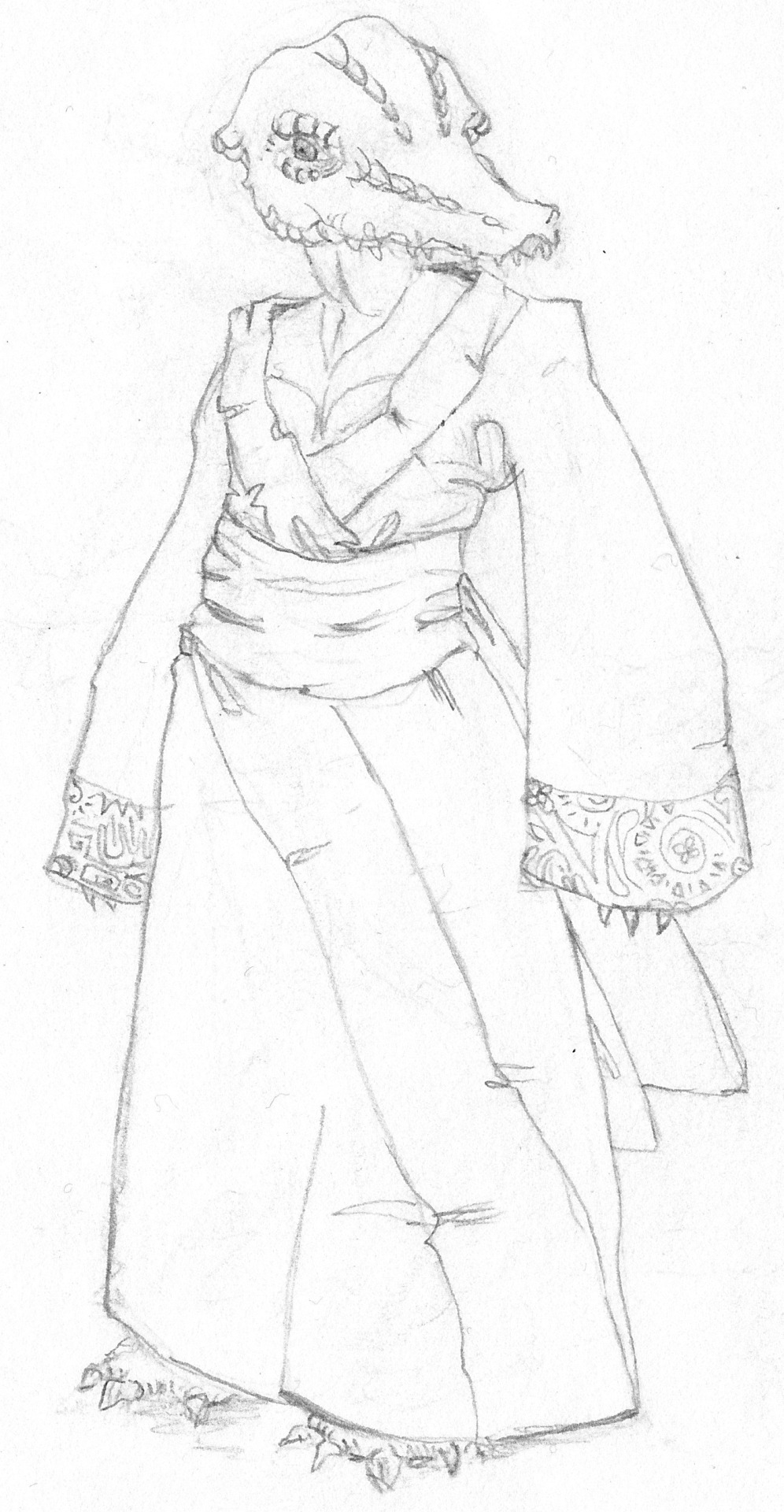 Oukek are a short, lithe people, very much like small humans but reptilian in appearance. Their faces are thin and long, and their lizard-like skin ranges in color from vibrant green or bright turquoise to dull brown or muted orange. Their typical life expectancy is approximately 50 years.
Oukek society is rigidly defined by a caste social structure that seems impenetrably complex to outsiders. The distinctions seem to be a form of feudal nobility based on birth order, and Oukek of the same family can sometimes have wildly different roles in Oukek society. "Noble" Oukek are allowed to own weapons and property, and in general the lower castes of Oukek work for the "nobles" and do not own anything of value themselves.
Those who have visited the Oukek homeland speak of nearly incomprehensible social orders and a rigidly martial society. An Oukek's place in society is determined by who is birthed from a clutch of eggs first, the first to emerge is the highest-born, or noble, and the last to be born are the laborer caste. The "noble" castes are in charge and consider their place a divine right, but they also consider their role to be duty bound to protect and care for the lower castes. Oukek seem to be able to tell each other apart by their keen sense of smell.
The caste social structure is also their law, and those who rebel from the castes are no longer considered Oukek. Outsiders are not considered part of the social structure, and any who visit Oukek lands should expect to be met with disdain if not outright hostility. Masadhi are the only known outsiders who Oukek welcome with curiosity or goodwill, because they "have no smell," and thus many Masadhi can be found traveling the Oukek lands. The short stature of the Masadhi also probably doesn't hurt.
Oukek see wealth and property as symbols of status, and members of the lower Oukek castes will refer to money and belongings not as their own but rather to a member of a higher caste whom they answer to. Oukek individually are industrious workers, generally peaceful, and eerily quiet. They enjoy physical humor and storytellers, and many outcasts will travel with Troupers.
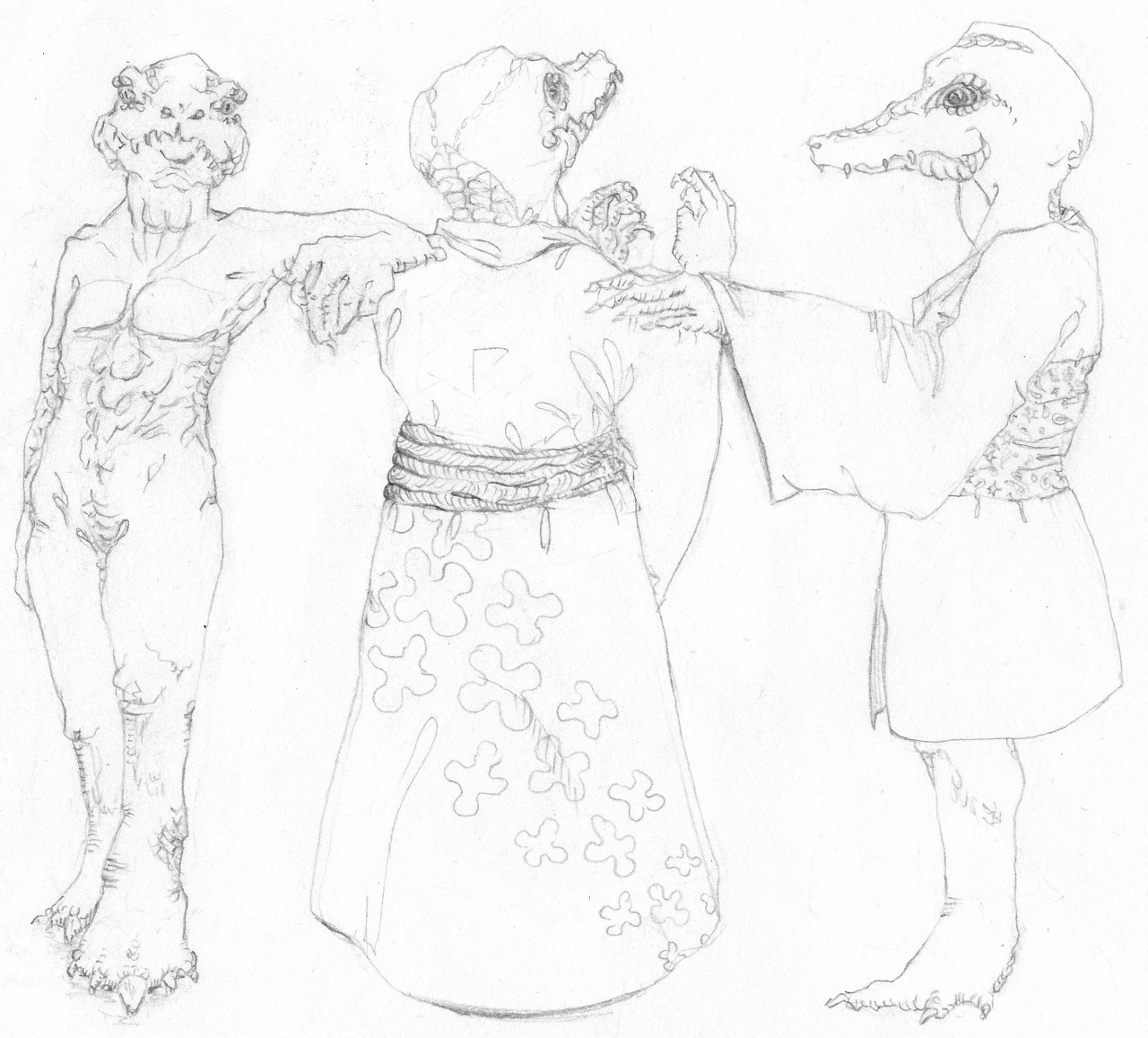 Most Oukek homes are burrows, usually in dirt or loamy hills, and are often surrounded by large gardens and farms which the Oukek tend diligently. In their homeland they build squat wooden homes and tall stone towers. Because Oukek are honest, friendly, and deferential they tend to get along with other races. Junians tolerate the Oukek, and they are generally considered to be somewhat soft and harmless. Dwarves enjoy Oukek company, and their Weargs have been known to act as mounts or guards for Oukek villages. Aurymites are less tolerant and they have been known to hunt and eat Oukek.
Thursday, February 27, 2014
the Junians
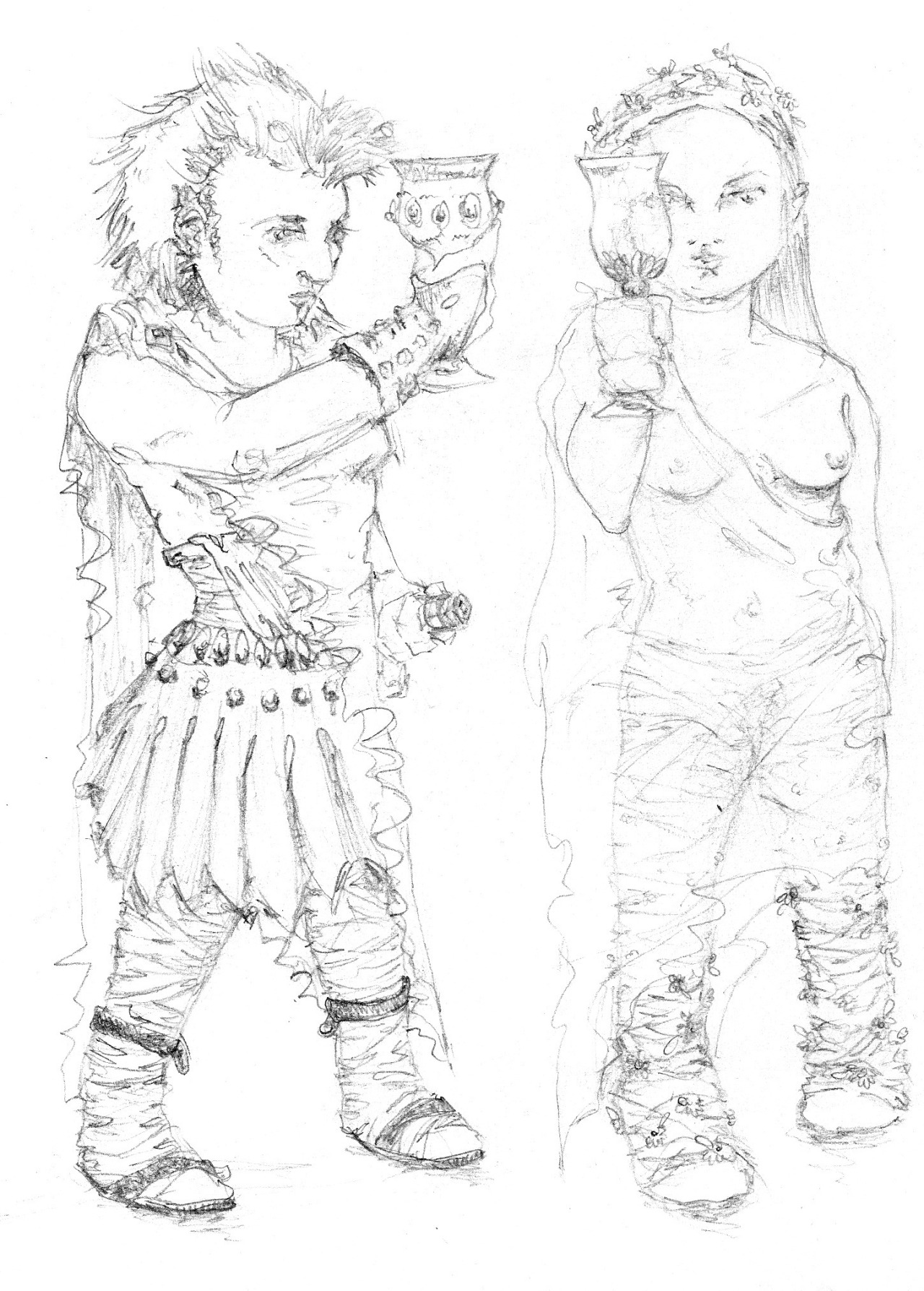 When the last Turning happened and humanity fled to the northern lands, the Junians weathered the turmoil the best and were the most successful group of humans that survived. They retained much of their old culture when they resettled in the north, and this has allowed them to thrive over the last 200 years. They are a difficult people to interact with given their mercurial natures, but they can always be counted on to put considerable value on earthly pleasures.
 The Junians are the only people who still openly worship Sanglorious, the old god who is said to have created (and bred with) most of humanity, despite the fact that their own theology states he abandoned the physical realm for other interests. Junians hold several feast days in remembrance of Sanglorious, and an annual fighting competition is held in city arenas. It is said that Sanglorious honored (and slept with) the most skilled fighters amongst the first race of humans, and there are many legends and stories of skillful warriors dating all the way back to the first Turning.
Junians have thrived as merchants, artisans, and architects. They rebuilt cities along the northern coastline and created a barter system for interacting with their neighbors. The Junians have begun to expand and have satellite cities across the northern continent. As their influence expands, Masadhi and Nymenians have stopped being the only non-Junian visitors to their cities, and the north coast has become a warren of competing cultural differences and bickering city-states. The Junians accept this, as they are still (mostly) the ones in charge. However, the bureaucratic governments they built have grown too large too quickly, and all are beginning to strain and buckle against one another from their own successes and labyrinthine protocols.
The Junians value honor and integrity over all else, and will flatly refuse to deal with outsiders who have betrayed their safety and wealth. This curt refusal to interact with those who are known to detract from personal interests means they only see prosperous relationships grow, and others are left out of mutually beneficial dealings. This has, perhaps, helped the Junians but has prolonged the suffering of some Eldragoth tribes. Some city-states have grown more prosperous simply by being inviting and open to outsiders, the largest and most successful of which is Marakāven. As Junians thrive, their population perfects skills as artisans and craftsmen. Schools have begun to open, and the Junians are currently the only human culture with a written language.
Monday, February 17, 2014
the Athomians
 Athomian lives are rigidly dictated by social status, measured by both strength and artistic talent. Athomians are presumed to be descended from the Noblei, as their clans migrated north along with the Junians and the Eldragoths. Their society spread further north following the last Turning. Forced to compete with the Beastmen of the northern hills and plains, they have become fiercely barbaric and truly anarchic.
 Athomians do not have a traditional family structure, nor do they perform weddings. When Athomians have children they form families that last only until the child, or children, are capable of taking care of themselves. However, they are not as divided as outsiders believe them to be, there is little to no rivalry between clans. Conflicts are always resolved by individual warriors, and clan members respect the outcome of the battle or contest.
Athomians are rarely encountered as single individuals. Outcasts from the Athomian clans are scarred or branded in some way so that other Athomians will know them and reject them as well. The most important thing to an Athomian is their place in the clan. To be cast out is to be dead in the eyes of their goddess, because of this many outcasts would rather commit suicide than try to integrate into other cultures.
Athomians value both skill with a weapon and artistic ability. The leader of a clan is often both the best fighter and the one who spends most of their time working a trade for the benefit or glory of the clan. Athomians have perfected the art of swordfighting, as well as swordmaking. Their intricate but sturdy weapons are highly prized and sought after. Disputes that are not settled by dueling are resolved by a comparison of talent by the two opponents, this usually entails both parties forging a sword and allowing other members of the clan to inspect them, but it can also involve skills as decorative as embroidery or as practical as woodworking.
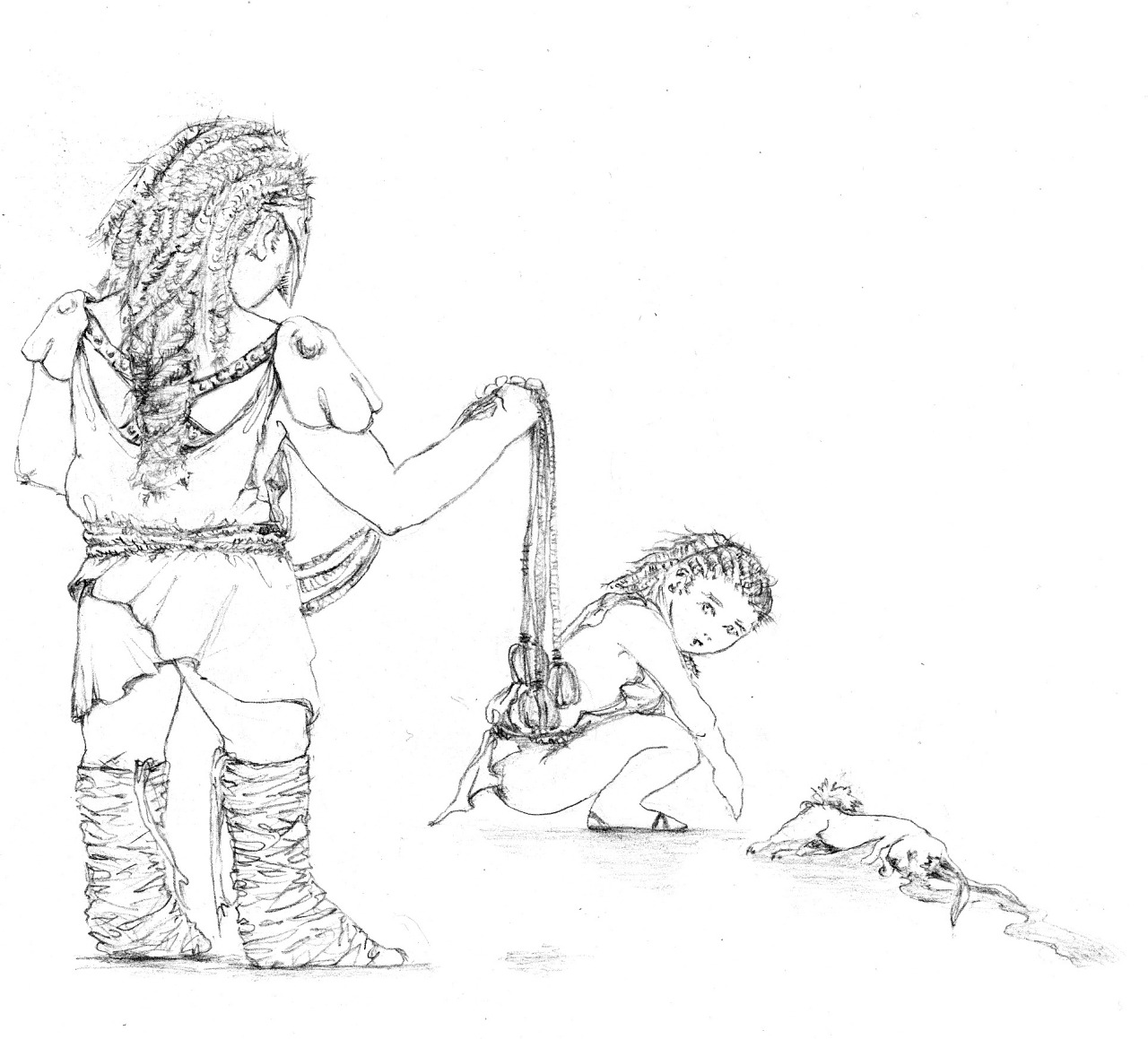 An Athomian always keeps their personal equipment immaculately clean and weapons are kept perfectly maintained and oiled. Athomians prefer to wear vivid colors that many consider unpleasant, such as vibrant orange, bright green, and deep purple. They will also tattoo their entire bodies in these colors. Paradoxically, their grooming habits are awful and their focus on outward appearance means they are actually very dirty and unkempt, and many jokes have been made about how their awful color coordination cannot mask their awful body odor. Athomians do not prize bodily hygiene as much as their fashion sense or a perfectly balanced blade.
Every clan worships the same vicious and secretive goddess. Her name is never revealed to outsiders, and she grants power to a very select few. Sacrifices to her are common among all Athomian clans. The formal rituals and ceremonies performed in her esoteric name last for hours and sometimes climax in a brutal death, of a member of the clan if an outsider hasn't been acquired.
Friday, February 14, 2014
the Eldragoths
The Eldragoths represent a competitive culture that exalted fighting, but they have turned their savagery inward and suffered as a result. The Eldragoths are the poorest of the five major human cultures, and also the most savage. Their society spread to the far north following the last Turning, and rather than compete with Athomians and Beastmen for resources they fell into raiding and pillaging most of the settlements they encountered.
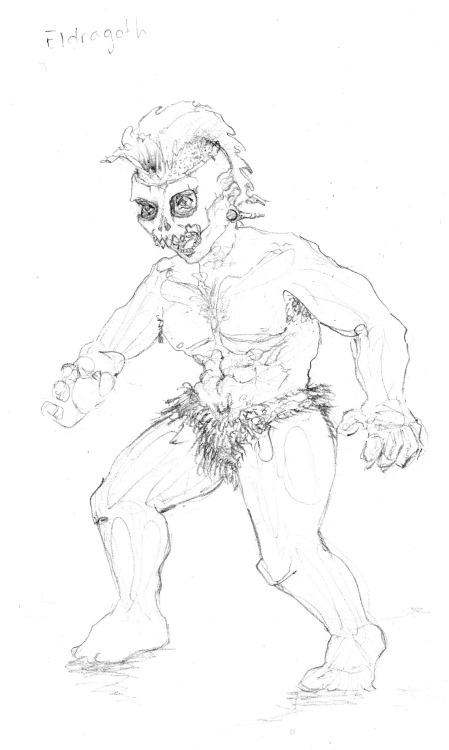 The Eldragoths are a divided people, clustered together into nomadic tribes that will hunt game in one area until the population withers, then forced to move on to more populous lands. Whole tribes frequently compete with other Eldragoth tribes for the best resources. A single Eldragoth, either an outcast or one who was dislodged from a role of command, will often fight as a mercenary for other races. The most important thing to an Eldragoth is food, and if fighting for gold or silver brings them food than that is what they do, even though they disdain the use of money as a sign of weakness.
Might makes right in their eyes, and the leader is always the strongest of the tribe. He or she may take whatever they like from the weaker members of the tribe, including life and property. All forms of disputes, as mundane as personal grudges or as inevitable as challenges to leadership, are settled by contests of physical strength - usually fights - and serious grievances involve bloody and prolonged fistfights that don't end until an opponent is bludgeoned to death.
Eldragoths always prefer to fight with their fists and they disdain large weaponry, an Eldragoth will never use a weapon to kill another Eldragoth, even in a tribal conflict. But outsiders should always be wary as Eldragoths have no disdain for picking up knives or bows to slay outsiders. An Eldragoth with a knife is a foe to be feared!
Anyone who is unable to fight or hunt is considered useless and will become an outcast. One who fights and loses is not considered dishonorable, but just of a lower station than one who wins. The children of these Eldragoth tribes learn how to fight at an early age, or they die. A few tribes will abandon their weaker children, these few usually become slaves to other tribes, or in worse cases become victims of the Beastmen.
No single tribe worships a god or pantheon of deities, but each seems to have their own form of religion revolving around the worship of nature spirits. These spirits often have elaborate names that are never pronounced the same way twice. The spirits across various tribes all have one thing in common, they respond to blood. The greater the sacrifice of blood, the greater the boon.
Eldragoths have spread out farther from the northern plains, and have not localized to one area for at least 140 years. Some tribes are spotted as far west as the Black Plateau. They hunt anything with meat on it, and it is an acknowledged fact that a few tribes have turned to cannibalism, willing to hunt other humans or dwarves when food is scarce. They don't ever seem to eat each other, just as they don't kill each other. An important facet of Eldragoth culture that must be remembered by anybody who wishes to hire one as a bodyguard or soldier.
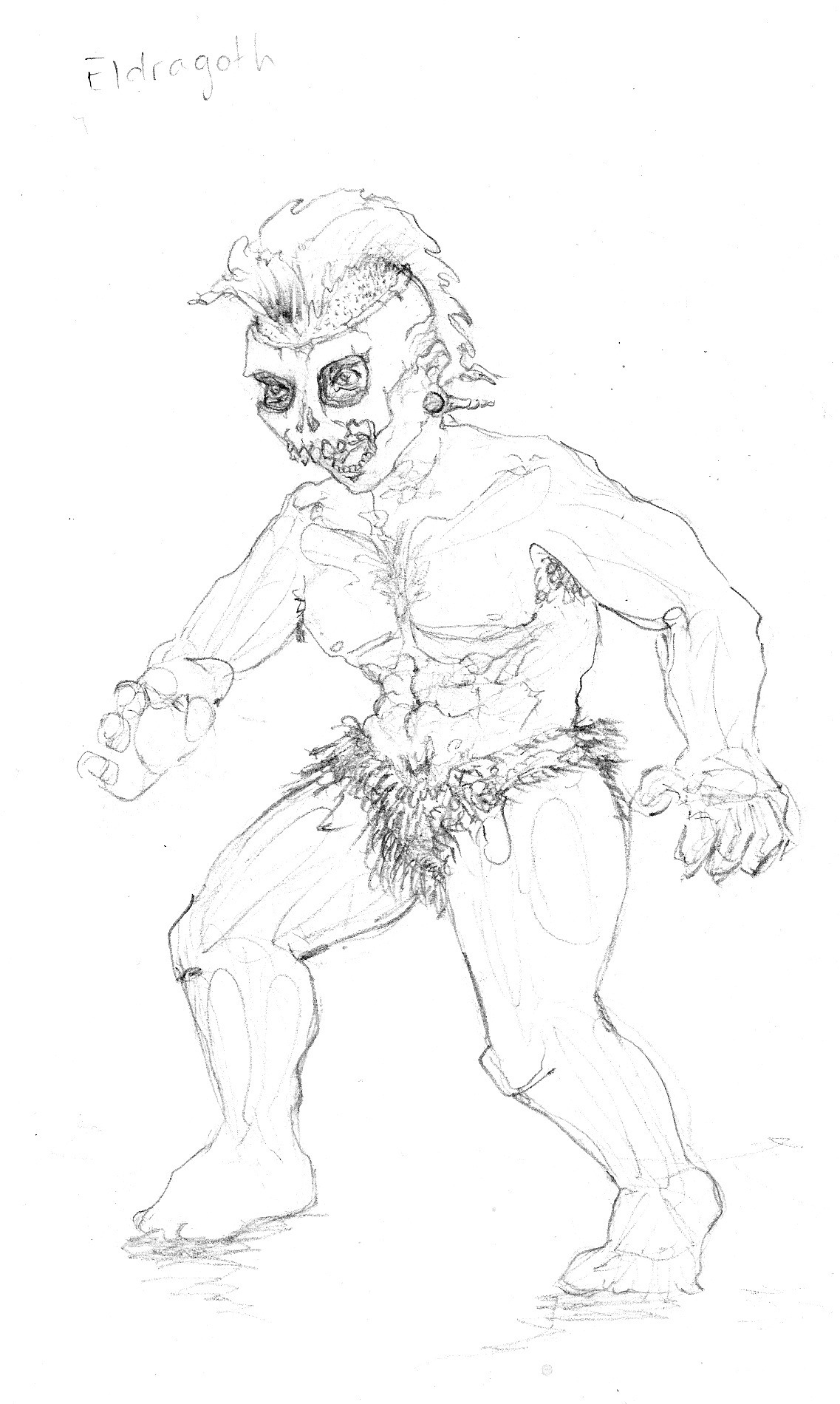 The Eldragoths are a divided people, clustered together into nomadic tribes that will hunt game in one area until the population withers, then forced to move on to more populous lands. Whole tribes frequently compete with other Eldragoth tribes for the best resources. A single Eldragoth, either an outcast or one who was dislodged from a role of command, will often fight as a mercenary for other races. The most important thing to an Eldragoth is food, and if fighting for gold or silver brings them food than that is what they do, even though they disdain the use of money as a sign of weakness.
Might makes right in their eyes, and the leader is always the strongest of the tribe. He or she may take whatever they like from the weaker members of the tribe, including life and property. All forms of disputes, as mundane as personal grudges or as inevitable as challenges to leadership, are settled by contests of physical strength - usually fights - and serious grievances involve bloody and prolonged fistfights that don't end until an opponent is bludgeoned to death.
Eldragoths always prefer to fight with their fists and they disdain large weaponry, an Eldragoth will never use a weapon to kill another Eldragoth, even in a tribal conflict. But outsiders should always be wary as Eldragoths have no disdain for picking up knives or bows to slay outsiders. An Eldragoth with a knife is a foe to be feared!
Anyone who is unable to fight or hunt is considered useless and will become an outcast. One who fights and loses is not considered dishonorable, but just of a lower station than one who wins. The children of these Eldragoth tribes learn how to fight at an early age, or they die. A few tribes will abandon their weaker children, these few usually become slaves to other tribes, or in worse cases become victims of the Beastmen.
No single tribe worships a god or pantheon of deities, but each seems to have their own form of religion revolving around the worship of nature spirits. These spirits often have elaborate names that are never pronounced the same way twice. The spirits across various tribes all have one thing in common, they respond to blood. The greater the sacrifice of blood, the greater the boon.
Eldragoths have spread out farther from the northern plains, and have not localized to one area for at least 140 years. Some tribes are spotted as far west as the Black Plateau. They hunt anything with meat on it, and it is an acknowledged fact that a few tribes have turned to cannibalism, willing to hunt other humans or dwarves when food is scarce. They don't ever seem to eat each other, just as they don't kill each other. An important facet of Eldragoth culture that must be remembered by anybody who wishes to hire one as a bodyguard or soldier.
Tuesday, February 11, 2014
promoting kickstarters for a change
I usually only post about kickstarters when I'm complaining about their tardiness. I've grown really selective with what I invest my money into, and recently a few projects have come up that are really cool and I want to see them succeed.
LotFP Free RPG Day 2014
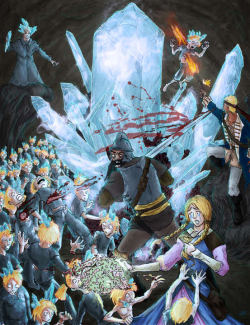
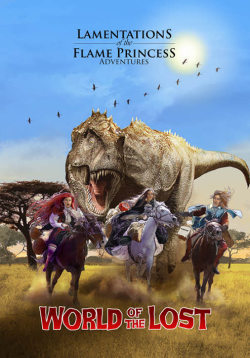
(left image is the cover for Doom Cave of the Crystal-Headed Children, art by Gennifer Bone; right image is the cover for World of the Lost by Rafael Chandler, art by Malcolm McClinton)
He's cutting it close to the wire to release for Free RPG Day this year, but I could see James Raggi doing a funding project like this every year now. I'm expecting the next project he throws up might be a "LotFP Free RPG Day 2015" project, and I would back that one too because I've only ever been disappointed by one of Raggi's projects (and it's one I never hear people talking about). This project is particularly interesting because it's set up to put some responsibility into the hands of the donor, you have to email James to tell him what rewards you want. One of the rewards is an adventure written by Rafael Chandler and the only way it will ever be published is through this campaign!
The Islands of Purple-Haunted Putrescence (an OSR module)
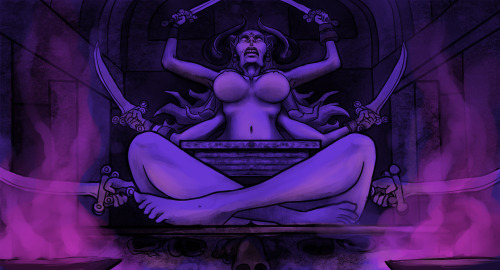
(art by Faustie)
A modest little kickstarter campaign from an accomplished self-publisher and a gamer in my neck of the woods. Seriously, he lives about 5 minutes away from me. He and I have the same haunts though we've never played a game together. I'd like to see him succeed both because he's a local and judging from his work we have similar tastes. I'm not sure where he comes up with his titles but I wish I had that same level of crazy creativity.
Darkest Dungeon

I think anybody who is an OSR gamer will want to take a look at this one even though it's a video game. I've been on their mailing list for a couple of months now and I knew this kickstarter campaign was coming. After one day of being live they're already very close to funding, because it's a video game I expect feature creep to potentially be an issue but this is one game that I would love to see hit some stretch goals.
And that's it. Go forth and spend some of your money to help make these projects happen and get cool games in return!
He's cutting it close to the wire to release for Free RPG Day this year, but I could see James Raggi doing a funding project like this every year now. I'm expecting the next project he throws up might be a "LotFP Free RPG Day 2015" project, and I would back that one too because I've only ever been disappointed by one of Raggi's projects (and it's one I never hear people talking about). This project is particularly interesting because it's set up to put some responsibility into the hands of the donor, you have to email James to tell him what rewards you want. One of the rewards is an adventure written by Rafael Chandler and the only way it will ever be published is through this campaign!
A modest little kickstarter campaign from an accomplished self-publisher and a gamer in my neck of the woods. Seriously, he lives about 5 minutes away from me. He and I have the same haunts though we've never played a game together. I'd like to see him succeed both because he's a local and judging from his work we have similar tastes. I'm not sure where he comes up with his titles but I wish I had that same level of crazy creativity.
And that's it. Go forth and spend some of your money to help make these projects happen and get cool games in return!
Friday, February 7, 2014
monster: the Quilid
the Quilid
Initiative: +3
Attack: +6
Bite (2d8+poison, save or stunned for 1 round)
Armor Class: 14 (ascending)
HD 6d6 (hp 24)
MV 80' (wall-crawling)
Save Fort +2 Ref -1 Will -1
Morale: nil
Special: attackers must Reflex save or get poked with spines taking 2d4-1 damage
Tactics: always attacks person with most magical items, failing that attacks spellcasters, wizards before clerics
monster: the Orsect
the Orsect
 Alien insectile humanoids, they are sometimes found in nests where they number in the hundreds. They are larger than the average human at full maturity, but their torso is fragile and spindly. Their muscles are thin and lithe. Orsects have underdeveloped retractable wings that lie under a carapace, they can glide short distances and even hover momentarily, but the wings are too frail to support their size for long. Orsects can crawl along walls and ceilings, and their faces have large venomous fangs reminiscent of a spider's cephalothorax. Their chitinous skin often has stocks of black or brown hair sticking out between the plates.
 Initiative: +1
Attack: +1
Claw x2 (1d6+1) or Bite (1d6; save vs poison/Fort, 1d6 damage over next 2 rounds)
Armor Class: 13 (ascending)
Hit Dice: 1d8 (hp 4)
Move: 30' (wall-crawling) / 60' (flight, once per four rounds)
Saves: Fort +0 Ref +2 Will -1
Morale: 8
Tactics: attacks smallest/weakest PC first
Wednesday, February 5, 2014
Bargaining, or The Partial Success
My favorite part of the Apocalypse World rules is the partial success. The feature of the partial success is most illustrative with the "acting under fire" move. "Acting under fire" is trying to do something that requires unusual discipline or concentration or with reserves of willpower or under threat of violence or something like that. AW hacks have reinterpreted this move as "Defy Danger" "Act Under Pressure" "Strive Against Peril" etc. When you "act under fire" and you get the partial success, it specifically states that the MC (the GM) might offer you a worse outcome, an ugly choice or a hard bargain. The rulebook implies that the MC should pick one and offer it as the result, but during play this usually comes down to more than one option offered to the player who then chooses which result occurs.
Worse Outcome. Ugly Choice. Hard Bargain. It sounds like three things, but it's actually four. Let me give you a few examples to illustrate this:
We're going to follow Cyril for a bit. He's a bit of an untalented goon with no real skills to speak of, but he's got a knack for being in the right place at the right time and he's got a tongue that's as sharp as a cleaver. One big thing he has going for himself is that he's a Hocus, so he's got his own personal cult of about 15 devotees who worship him, hang on his every word, and follow him around like lost puppy dogs.
A biker gang is moving through the town where Cyril preaches to his flock and before they leave town they've decided to have a little fun. The gang's leader is trying to lasso Cyril with an old plastic rope that looks hand woven. When Cyril tries to escape he's acting under fire and rolls a 9. The MC can offer...
The gang makes camp in a grassy ravine near town and Cyril, upon learning that 2 of his flock have been kidnapped, decides to sneak into their camp to liberate them. The closest thing to a sneak move in Apocalypse World is acting under fire so that's what Cyril is doing, and he rolls a 9 again. The MC offers...
Cyril takes the ugly choice this time and tells the MC that his enthusiastic followers get caught. The MC declares them dead, but Cyril is in the camp and his other followers who were kidnapped are there, and relatively unharmed.
The MC declares that the whole gang's encampment is now on high alert, it's going to be pretty tough sneaking out of here so Cyril is going to need to do something tricky to get his kidnapped followers to safety. Cyril is now keenly aware that 4 of his people got killed today and he might get 2 more killed, he's resolved not to let anybody else from his cult die. Cyril frees his followers and instructs them to get out of the camp and back home while he creates a distraction. Cyril runs out of hiding straight for the gang leader with his staff, and declares he wants to use the focusing power of the staff to heel the leader of the gang to Cyril's will. The MC decides that this isn't a manipulation and it doesn't fall under Cyril's normal use of his Hocus powers, she declares that this is another use of acting under fire but Cyril is being inventive and taking a huge risk, she lets him roll his best stat this time, but he still rolls a 9. The MC offers...
Regardless of where you're sitting at the table, this is my favorite mechanic. As a player it gives you a brief moment of control, like rolling with a punch or flipping between two choices in a Choose Your Own Adventure novel. As an MC, it offers a challenging moment of looking at ugly/hard/worse options and offering them up as a meal. It is really hard to pull off well as a MC, since a partial success is still fundamentally a success, but I believe that mastering this on-the-spot thinking is what can make or break GMing properly.
Worse Outcome. Ugly Choice. Hard Bargain. It sounds like three things, but it's actually four. Let me give you a few examples to illustrate this:
We're going to follow Cyril for a bit. He's a bit of an untalented goon with no real skills to speak of, but he's got a knack for being in the right place at the right time and he's got a tongue that's as sharp as a cleaver. One big thing he has going for himself is that he's a Hocus, so he's got his own personal cult of about 15 devotees who worship him, hang on his every word, and follow him around like lost puppy dogs.
A biker gang is moving through the town where Cyril preaches to his flock and before they leave town they've decided to have a little fun. The gang's leader is trying to lasso Cyril with an old plastic rope that looks hand woven. When Cyril tries to escape he's acting under fire and rolls a 9. The MC can offer...
- a worse outcome: Cyril will take 4 harm as he runs into another biker and gets knocked down to the ground, unconscious, but he will get left alone afterward as the gang laughs their asses off in the assumption that he got accidentally killed.
- an ugly choice: Cyril will dive through a window, taking 2 harm, and escape through the back of the building losing sight of the gang and his followers, or get away down an alleyway but drop something important/valuable, like the wrought iron staff that he uses to focus his followers' attention during his sermons.
- a hard bargain: Cyril will get away, but his loyal followers will definitely not avoid the gang's attention.
The gang makes camp in a grassy ravine near town and Cyril, upon learning that 2 of his flock have been kidnapped, decides to sneak into their camp to liberate them. The closest thing to a sneak move in Apocalypse World is acting under fire so that's what Cyril is doing, and he rolls a 9 again. The MC offers...
- a worse outcome: Cyril is caught and captured, but not harmed, by the gang.
- an ugly choice: Cyril was followed by some of his enthusiastic cultists and they get caught but the distraction will allow him to sneak in undetected, or Cyril is spotted by the camp lookout and gets shot, taking 3 harm, but his enthusiastic followers make it into the camp from his distraction.
- a hard bargain: Cyril sneaks in, but his kidnapped followers have been tortured and killed and there's nothing he can do for them now.
Cyril takes the ugly choice this time and tells the MC that his enthusiastic followers get caught. The MC declares them dead, but Cyril is in the camp and his other followers who were kidnapped are there, and relatively unharmed.
The MC declares that the whole gang's encampment is now on high alert, it's going to be pretty tough sneaking out of here so Cyril is going to need to do something tricky to get his kidnapped followers to safety. Cyril is now keenly aware that 4 of his people got killed today and he might get 2 more killed, he's resolved not to let anybody else from his cult die. Cyril frees his followers and instructs them to get out of the camp and back home while he creates a distraction. Cyril runs out of hiding straight for the gang leader with his staff, and declares he wants to use the focusing power of the staff to heel the leader of the gang to Cyril's will. The MC decides that this isn't a manipulation and it doesn't fall under Cyril's normal use of his Hocus powers, she declares that this is another use of acting under fire but Cyril is being inventive and taking a huge risk, she lets him roll his best stat this time, but he still rolls a 9. The MC offers...
- a worse outcome: Cyril is shot, point-blank, by the gang's leader. 5-harm. His followers will get away clean.
- an ugly choice: He creates enough of a distraction that his followers get away, but they've been seen fleeing and he's captured, or he has the full attention of the gang leader but his followers won't leave without him and all eyes in the camp are on Cyril right now.
- a hard bargain: Cyril has the gang's leader under his command, but that doesn't sway the rest of the gang at all.
Regardless of where you're sitting at the table, this is my favorite mechanic. As a player it gives you a brief moment of control, like rolling with a punch or flipping between two choices in a Choose Your Own Adventure novel. As an MC, it offers a challenging moment of looking at ugly/hard/worse options and offering them up as a meal. It is really hard to pull off well as a MC, since a partial success is still fundamentally a success, but I believe that mastering this on-the-spot thinking is what can make or break GMing properly.
Tuesday, February 4, 2014
Apocalypse World of Darkness (brainstorming)
Apocalypse World, from now on AW. World of Darkness, from now on WoD
AW has playbooks, WoD has splats; I'm ambivalent about both but recognize the value for players to have easy choices
AW has 5 stats and a plethora of moves, WoD has 9 attributes and 21 skills; I like a simple system, so let's keep WoD's attributes but get rid of the skills
AW has countdown clocks, WoD has dots and points; I like dots and points
AW rolls 2d6, WoD rolls pools of d10s; I like pools of dice, but let's use d6s because this isn't WoD, this is AWoD
AW has complications and partial successes, WoD has exceptional successes and dramatic failures; I like complications and varying levels of success
Trying to fuse the Apocalypse World moves dynamic with the standard World of Darkness stat blocks: Everything is kept the same, roll dice pools and only count the highest number on any rolled dice.
Any result of '5' or higher can be used as a success for the roll.
All dice rolling at 4 or less means the GM can make a hard move, or mark a hard move for use later.
A dice that comes up a '6' allows you to roll another dice.
I'm not sure how the math would work out. Combat and damage would have to be tweaked slightly anyway. For now, let's see how it works.
From the WoD core rulebook: Perception
Dice Pool: Wits + Composure
Roll Results
Dramatic Failure: Your character notices something strange or out of place, but it’s not what has actually occurred, or he makes a dangerous assumption about the event. A picture hanging at an odd angle indicates that someone has moved it, but your character assumes that a door has been slammed, shifting the piece of art.
Failure: Your character notices nothing amiss or out of place.
Success: Your character recognizes that something has happened.
Exceptional Success: Your character not only recognizes when something unusual or quick happens nearby, he sees it all happen and gets a good look. Or he notices a variety of things that are amiss in his surroundings, just by entering the room.
My interpretation: Perception when you roll Wits+Composure, spend successes to ask questions.
• what does this mean?
• what happened here recently?
• what is about to happen?
• what here is not what it appears to be?
• what here is useful or valuable to me?
• what is this?
• where’s my best escape route / way in / way past?
• which enemy is most vulnerable to me?
• which enemy is the biggest threat?
• who’s in control here?
• is __ telling the truth?
• what does __ intend to do?
• what does __ wish I’d do?
• what’s __ really feeling?
I think that works but I'm not sure how partial successes would work out, because that's my favorite thing about AW. I'd be curious to figure out how combat would work, but that would require more work and I have to shelve this idea for now. I want to get back to working on... a few other things. I've got two D&D scenarios I'm writing, two maps I'm drawing, a new playbook for AW, rules for Fantasy Heartfucker or whatever I'm going to call it. I've got too many projects that I keep working on a little bit at a time, I need to focus on one and finish it sometime soon.
AW has playbooks, WoD has splats; I'm ambivalent about both but recognize the value for players to have easy choices
AW has 5 stats and a plethora of moves, WoD has 9 attributes and 21 skills; I like a simple system, so let's keep WoD's attributes but get rid of the skills
AW has countdown clocks, WoD has dots and points; I like dots and points
AW rolls 2d6, WoD rolls pools of d10s; I like pools of dice, but let's use d6s because this isn't WoD, this is AWoD
AW has complications and partial successes, WoD has exceptional successes and dramatic failures; I like complications and varying levels of success
Trying to fuse the Apocalypse World moves dynamic with the standard World of Darkness stat blocks: Everything is kept the same, roll dice pools and only count the highest number on any rolled dice.
Any result of '5' or higher can be used as a success for the roll.
All dice rolling at 4 or less means the GM can make a hard move, or mark a hard move for use later.
A dice that comes up a '6' allows you to roll another dice.
I'm not sure how the math would work out. Combat and damage would have to be tweaked slightly anyway. For now, let's see how it works.
From the WoD core rulebook: Perception
Dice Pool: Wits + Composure
Roll Results
Dramatic Failure: Your character notices something strange or out of place, but it’s not what has actually occurred, or he makes a dangerous assumption about the event. A picture hanging at an odd angle indicates that someone has moved it, but your character assumes that a door has been slammed, shifting the piece of art.
Failure: Your character notices nothing amiss or out of place.
Success: Your character recognizes that something has happened.
Exceptional Success: Your character not only recognizes when something unusual or quick happens nearby, he sees it all happen and gets a good look. Or he notices a variety of things that are amiss in his surroundings, just by entering the room.
My interpretation: Perception when you roll Wits+Composure, spend successes to ask questions.
• what does this mean?
• what happened here recently?
• what is about to happen?
• what here is not what it appears to be?
• what here is useful or valuable to me?
• what is this?
• where’s my best escape route / way in / way past?
• which enemy is most vulnerable to me?
• which enemy is the biggest threat?
• who’s in control here?
• is __ telling the truth?
• what does __ intend to do?
• what does __ wish I’d do?
• what’s __ really feeling?
I think that works but I'm not sure how partial successes would work out, because that's my favorite thing about AW. I'd be curious to figure out how combat would work, but that would require more work and I have to shelve this idea for now. I want to get back to working on... a few other things. I've got two D&D scenarios I'm writing, two maps I'm drawing, a new playbook for AW, rules for Fantasy Heartfucker or whatever I'm going to call it. I've got too many projects that I keep working on a little bit at a time, I need to focus on one and finish it sometime soon.
Subscribe to:
Posts (Atom)