Grand Theft Auto III
"I'm gonna get a gun. Guns don't kill people. People kill people. Guns help though."
At the beginning of
Grand Theft Auto III (GTA3) you are asked by a fellow escaped prison inmate, his name is Eight-Ball, to take him to a safehouse he knows about. His hands are broken and burned, he can't drive so you must do it for him. Arriving at the safehouse you and Eight-Ball get a change of clothes and he asks you to take him to his old boss'es nightclub. It's your first mission in the game and it's relatively simple. Drive to point A, then drive to point B. When the mission is over there is a character who tells you to go around to the back of the nightclub where your next mission awaits, but there is nothing stopping you from getting back into your stolen car and driving off into the city and never coming back.
When I first played GTA3 I completed the first few missions for Luigi, the mafia nightclub owner who gives you the first simple missions and sets up your other contacts, and then his missions ran out and I got lost. It's hard for me to imagine now, but I couldn't find my way in the city blocks around his nightclub. I drove down a street that looked familiar and then found the elevated train that led back to the front of my safehouse alley. As I pulled my car into that alley I was annoyed and thinking "What kind of game is this? It's not telling me where to go and what to do."
That was the moment where I realized what that actually meant, and it was a revelation!
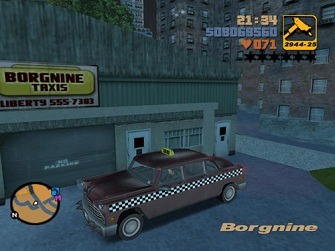
Can I just run down pedestrians on the street? Yes. Can I blow up this car? Yes. Can I jump my car off this cliff? Yes. Can I drive on the train tracks? Yes. Can I just stand on this street corner and listen to the pedestrians? Yes. Can I steal this Taxi? Yes. Can I pick pedestrians up and take them to their destinations? YES! This was the kind of video game I had always wanted, it gave the player what most games only cheat at giving: freedom.
The story in GTA3 is virtually nonexistent, and consists of taking a series of jobs from psychopaths and criminals, whose allegiances pit the player against former allies throughout the course of the game. This isn't where the game shined, instead it was in the world and the freedom of testing what would happen by interacting with it, usually violently. The more I played, the more I explored the limits of what the game was capable of, and the longer I stayed in this world the more I became acutely aware of the game world's limitations. In truth, it really doesn't give you complete freedom, but it gave enough of illusion of freedom that testing the limits of what could be done within the game seemed like it would never run out. The boundaries of the world can only stretch so far, and the game could only give so much. The talk radio station, Chatterbox, featured a roughly hour-long loop of dialogue that breathed life into the setting, but it only left me craving more.
Grand Theft Auto: Vice City
"...it's obvious that Diaz is the one who busted our deal, so why in the hell are we still running errands for him?"
Grand Theft Auto: Vice City was the first video game I ever pre-ordered. I remember checking
the preview website every week, waiting for a new screenshot or a new update from the fictional Kent Paul. When the game neared release I checked it every day. I re-started GTA3 and finished it to 100% completion twice in the time I waited, so great was my anticipation.
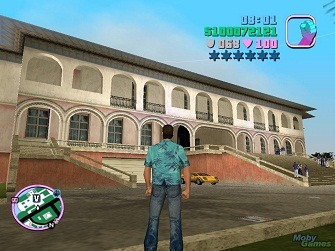
Delving into the 1980s Miami-inspired Vice City, a deeper story was told and a broader picture of this world emerged, despite the fact that the only things linking this game to the previous one were a few weak references to Liberty City and the appearance (but not the voice) of Donald Love, a major character from GTA3. The main character of Vice City (I would be remiss if I referred to him as a protagonist) was given a voice and the story was told from his perspective, this could give context and narration for the more ambiguous missions.
Serving as a prequel of sorts for GTA3, Vice City put the player into the shoes of Tommy Vercetti, an old-fashioned mobster put in charge of a drug deal turned bad. Vercetti's first goal is to get revenge for the game's opening betrayal, and when I first encountered the mission that sent me after the top criminal of Vice City I thought "I'm at the ending already?" The game seemed short, but the story continued on after I had defeated Ricardo Diaz. The revelation of this game was discovering that I was taking over the criminal empire and could now purchase property and run businesses in Vice City. My mind boggled! Discovering the businesses and unlocking the profits from them was more exciting than playing through the story.
This game wasn't just about revenge, it wasn't just telling the story of Tommy Vercetti, it was built around the idea that the player could build and run a criminal empire. This is the charm of what the game really held, but you don't discover this until you're halfway through the story. It was a one-two punch for anybody expecting just more of the same GTA.
Manhunt
"You've had an unexpected reprieve. Do exactly as I say, and I promise this will be over before the night is out."
I can't talk about GTA without mentioning
Manhunt, it's an ultra-violent stealth-based video game where you play the role of James Earl Cash, a convicted murderer who has been secretly kidnapped from his execution to "star" in a snuff film where he has to sneak past various gangs that are all getting paid to hunt him down through a dilapidated section of the fictional stand-in for Philadelphia known as Carcer City.
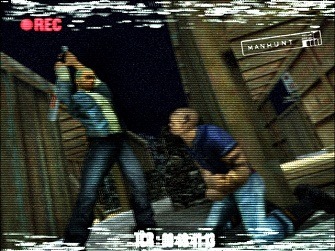
Anybody who has played Manhunt alongside any of the GTA games will instantly see the links connecting the two. Every iteration of GTA makes references to Carcer City, and many of the fictional brand names that were created for Manhunt have carried over to the GTA games in different ways. There is a literal connection on one of the radio stations of GTA3 as an announcer broadcasts a news story about the events of Manhunt, placing the game in the GTA timeline as a prequel to GTA3.
This game, rather than being a world to explore, is challenging and tense. It was a punch to the gut for anybody expecting more of the bawdy and twisted humor from GTA to find a seedy and profane world of criminals and deviants. GTA is a punchline about atrocity, Manhunt is the cold rebuttal. Despite the fact that Manhunt is not
officially part of the GTA universe, it's the best game in the series!
Grand Theft Auto: San Andreas
"That was my last motivational speech, understand? Am I being too spiritual for you, Carl?"
The opening of
Grand Theft Auto: San Andreas sees our new protagonist, Carl Johnson, getting pulled over and harassed by two dirty cops. The entire game is four times bigger and three times longer than anything that has come before in the GTA series, but Carl spends most of his time getting kicked down and pushed around by all of the people in his life. This was the first game that featured a traditional story arc and feature five distinct acts coordinated with the location of missions within the terrain of the west coast state, San Andreas - which actually acts as a hybrid of southern California and Nevada.
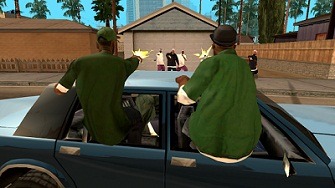
In the first act we see Carl rejoining his old boyhood gang, the Grove Street Families, and trying to rebuild their influence and control over east Los Santos, the game's parody of Los Angeles. At the end of the first act Carl is betrayed, and those two dirty cops from the beginning force Carl to start working for them, all in the name of keeping his brother safe while he's stuck in prison. During this second act Carl is forced to kill people and run drugs in the lush countryside and farmland of San Andreas. Soon Carl has set his sights on taking down the drug lords who betrayed his brother and the story shifts gears, Carl finally starts to call some of the shots in San Fierro, a stand-in for San Francisco, but this doesn't last long. When Carl catches up with one of the supposed drug kingpins he quickly learns the man is a government agent who has been watching his every move. Still a pawn as the fourth act opens, Carl is now forced to work for the agent in the deserts between San Fierro and Las Venturas, i.e. Las Vegas.
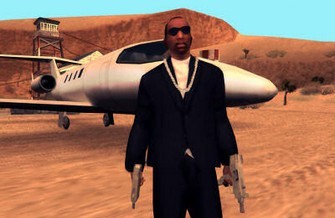
The final act revolves around Carl pulling a casino heist and returning to his hometown city with his ill-gotten gains. Along the way Carl has become a licensed pilot, won illegal street races, escaped ambushes, destroyed a drug cartel, and made permanent enemies of the mafia bosses who all get killed in GTA3.
If GTA3 was a the lightning bolt that ushered in a new kind of video game, San Andreas was the storm that followed. It gave everything that first title had, but there was simply more of it and depending on what part of the state you were in the game played differently. Honestly, it was difficult to describe how playing San Andreas in 2005 felt, but it was impossible to imagine how much better the GTA games could get.
Grand Theft Auto IV
"Wonderful! You're here on some revenge mission for something that happened ten years ago. And you don't care whose life you ruin on the way?"
Grand Theft Auto IV (GTA4) opens with all of the grandiosity and pomp of a large-scale Hollywood production. The music swells, the credits pop through the scenery, and we are introduced to Niko Bellic, our new main character, through a short conversation he is having with a shipmate as he disembarks from a cargo vessel into the industrial harbor of Liberty City, the same city from GTA3 but now it looks more real, more alive, more dirty.
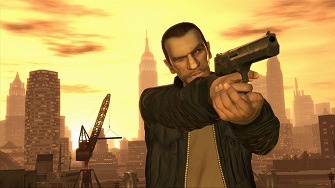
In this game we lose much of what made the previous iterations so much fun to play at the benefit of a huge sprawling storyline with relationships. The graphics are excellent and the physics are a marked improvement from the first few games, but hinging so much of the game on an uninteresting story about a hypocritical sociopath while simultaneously removing all of the side missions that fueled most of the exploration from previous games means that this is the least interesting game in the series. I made my own game of running over pedestrians and seeing how long I could survive with huge levels of cops chasing after me. At one point I even abandoned GTA4 for one of it's predecessors.
GTA4 had two DLC packs which breathed a bit more life into the game, the most interesting of these was one focusing on a biker gang in GTA4's equivalent of New Jersey. But both of the tacked-on stories were too short and neither one brought back the missing side missions or activities from previous games.
Grand Theft Auto V
"You cool? Cool what? Slinging dope and throwing up gang signs?"
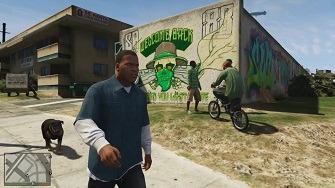
You will probably hear other people tell you that
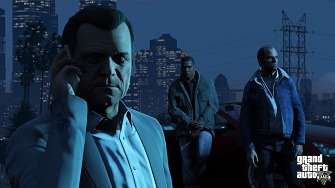
Grand Theft Auto V (GTA5) features three characters that you can play as, and the story is about how their lives intersect. And while most of the story hinges around Michael's mid-life crisis, and the character I found myself playing the most was Trevor, the main character of GTA5 is obviously Franklin Clinton, the black car thief and hustler. Franklin has the best abilities, the best car, the best home, and his story is the one that decides the fate of the other two characters.
This game features a strong story that doesn't contradict itself or try to rise above the underhanded premise of the game you are playing, and the game features the southern end of the state of San Andreas again. There is no Las Venturas or San Fierro, which is mildly disappointing as the game is still huge. There is almost too much area to explore, especially since not everything in the game takes you into every area of the game. The old and familiar side missions are still missing, instead you get tennis.
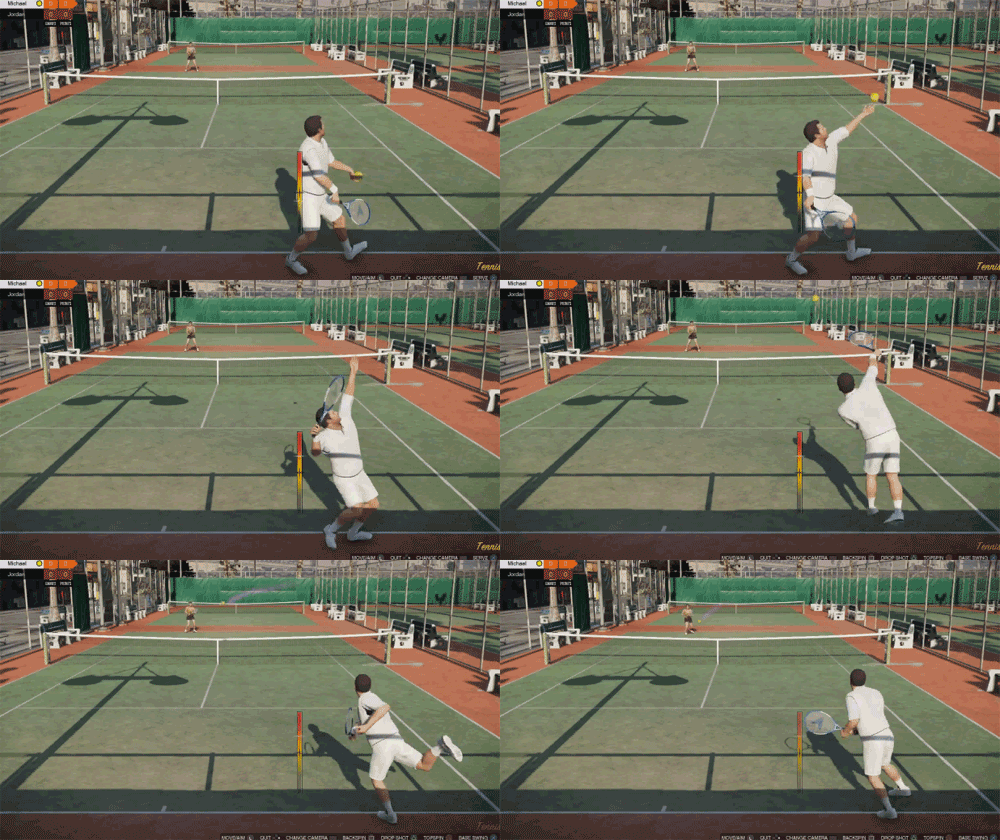
I just don't find myself
wanting to play these games anymore. They've changed, and some of those changes are awesome, but they aren't really games anymore. They're exercises in achievement hunting. The GTA series has become a part of the cultural identity it used to mock. When I play GTA3 I feel like I'm one of the jokesters making fun of the stupid and crazy world, when I play GTA5 I feel like I'm part of the joke.