Wednesday, January 21, 2015

Ratkin for 5e

(Skaven with the serial numbers filed off, and a playable race for 5e)
(inspired entirely by Skaven from Warhammer Fantasy)
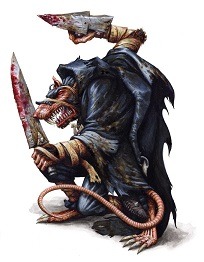

Warrens carved beneath sprawling municipalities, wickedly sharpened blades scavenged from centuries of corpses, the squeaks and scrabbling echoes of a language born of rodents, the musty and fetid scent of a black market hidden within the sewers, and the overflowing contempt of those who think they are better than the dwellers in the underdark - the ratfolk have always lived side by side with humanity, but only as cities grow have they become more noticeable, and harder to ignore.

SHORT AND FURRY
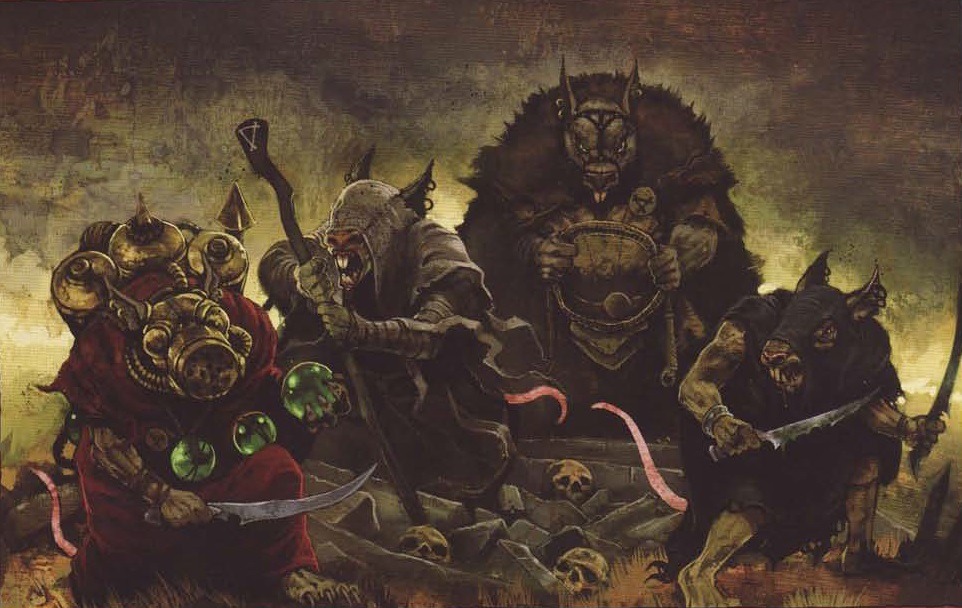
Ratkin are small, rodent-like humanoids; native to subterranean areas under cities and in dry regions. Typical ratkin average between four and five feet in height and weigh roughly 100 pounds. Most have brown fur, although this can vary greatly. Black fur is looked upon as the sign of true strength, and in most cities a ratkin of black fur that is born on the night of a new moon is often taken by the Cult of Thanskachak to be raised as an assassin in service to all ratkin. It is not uncommon for lighter colored ratkin to dye their fur black. Albino ratkin are rare and considered a good omen. Albino, and white-furred, ratkin almost exclusively become clerics, sorcerers, and rulers over other ratkin.

Ratkin have large fangs in the upper jaw structure, their eyes are commonly red, they all have over-grown claws, and a naked tail growing to almost a meter in length. With scrawning arms and legs, and lackly greatly in terms of strenght, ratkin are naturally faster, more agile, and natural diggers. Due to their cowardly nature, ratkin will most likely run then engage in direct conflict. Only when cornered will a ratkin fight with a reckless abandon.
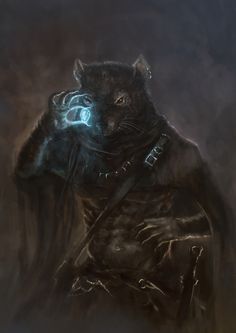
Ratkin are hoarders by nature, and as a whole are masters of commerce, though some are shrewd merchants who carefully navigate the shifting alliances of black markets and bazaars, many ratkin love their stockpiles of interesting items far more than money, and would rather trade for more such prizes to add to their hoards over mere coins. It's common to see a successful crew of ratkin traders rolling out of town with an even larger bundle than they entered with, the whole mess piled precariously high on a cart drawn by giant rats.

They often wear robes to stay cool in the desert or conceal their forms in cities, as they know other humanoids find their rodent features distasteful. In the cities ratkin cling to the shadows and rarely venture out during the daytime, and in the bigger metropolitan areas there is always a secret ratkin marketplace which is literally underground. Ratkin have a strong attraction to shiny jewelry, especially copper, bronze, and gold, and many decorate their ears and tails with small rings made of such metals.

CONSISTENTLY INCONSISTENT CLANS
Ratkin thrive within the sewers underneath most human cities and larger towns, where they tend to maintain black markets for the seedier sides of humanity. Larger population centers house entire secondary communities of ratkin living side by side with humans. Many civil engineers have found extra tunnels and passageways added to their handiwork months, and sometimes only days, after finishing construction. Whatever wealth doesn't come to ratkin through trade arrives from scavenging or thievery. They dislike daylight, so many enterprising ratkin forge alliances with humans or halflings to handle larger or more legitimate trade negotiations above ground. Humans and halflings are always welcomed in ratkin warrens, but other races are given a cold shoulder or asked to prove their friendship, if not outright denied entry.
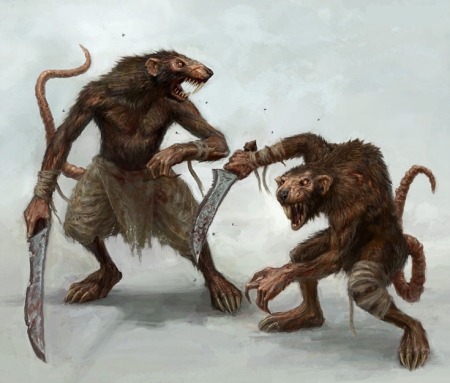
Ratkin are extremely communal, and live in large families where the mother is almost always the head of household. Ratkin share both a high birth rate and infant mortality rate, a typical litter can range anywhere between 6 to 18 infants, roughly half of whom will die during infancy. Women amongst the ratkin think of childbirth and motherhood as a solemn duty, to be unable to bear children is the worst fate to befall a female ratkin. Most ratkin are lucky to survive birth and childhood, and the rest are lucky to know who their father is. Any ratkin who can accumulate vast wealth is often given a kind of governorship over other ratkin, and while trade is important for ratkin survival they don't regard it as a very honorable profession. Warriors are valued over all, and the ratkin who protect their tunnels are always honored with free food and celebratory greetings.

It is rumored that the ratkin have tunneled passageways between every major city on the continent, and have ways of traversing these burrows faster than non-ratkin would be able to. Each ratkin community is autonomous and doesn't answer to any other ratkin leader elsewhere, or refuses to. It would be common to see ratkin traveling either on their own or in small packs. The ratkin population is constantly growing, only to decrease drastically during times of starvation. However, in times of plenty, when a ratkin warren grows overcrowded and the surrounding city won't support a larger community, young ratkin instinctively begin to fight against their elders rather than seek out new places in which to live. These ratkin revolutions are often bloody but brief as new and younger ratkin dethrone the established elder ratkin. As such, ratkin society cannot be trusted to remain stable, but it can be relied upon to be present.

Ratkin are often driven by a desire to seek out new opportunities for trade, both for themselves and for their warrens. Ratkin adventurers may seek potential markets for their clan's goods, keep an eye out for sources of new commodities, or just wander about in hopes of unearthing enough treasure to fund less dangerous business ventures. Ratkin battles are often decided by cunning traps, ambushes, or sabotage of enemy positions.
GLORY TO THE THIRTEEN
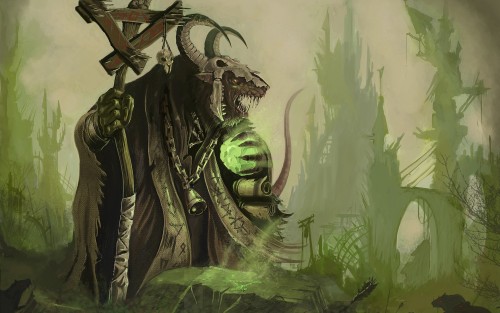
"The Thirteen" is a misnomer since Ratkin have fourteen gods they venerate. The Horned Mother is the first ratkin, and she is never openly worshipped, nor are shrines or temples ever dedicated to her, but every ratkin will speak her name in reverence and those that blaspheme the Horned Mother are often brutally killed. The thirteen other gods are her children, and the most prominent to be offered prayers or servitude and often referred to as "the Siblings" having been birthed by the Horned Mother.

The thirteen gods the ratkin worship are:
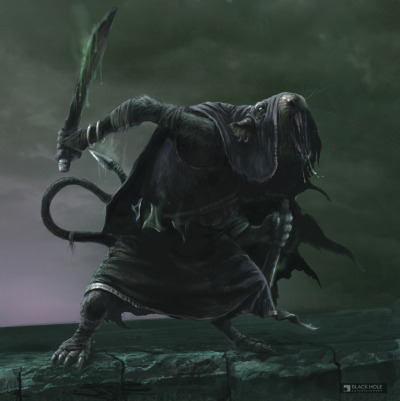
  • Thanskachak, the god of darkness and silence, prayers are often offered to Thanskachak during funerals (there are never priests for Thanskachak, ratkin who honor him become assassins)
  • Arrassi, the goddess of gems and trade, Arrassi's symbol appears wherever a ratkin is trying to buy a thing or has a thing for sale and due to this many non-ratkin erroneously believe that Arrassi's symbol means "marketplace" (priests of Arrassi are the most common and specialize in the domain of Trickery)
  • Vasdra, the goddess of legends and lore, any ratkin who tells a story or shares knowledge is honoring Vasdra (priests of Vasdra run their temples like libraries and specialize in the domain of Knowledge)
  • Gnawdrak, the god of death and curses, no ratkin openly worships Gnawdrak but his name is invoked when fighting non-ratkin
  • Durhakk, the god of storms and winter, ratkin who brave long overland adventures or spend time in harsh climates worship Durhakk (clerics of Durhakk specialize in the domain of Tempests)
  • Thrahisk, the god of mischief and sleep, often depicted as a slothful drunk who plays pranks, there are many stories and folk tales that involve Thrahisk tricking non-ratkin, especially deities (priests of Thrahisk specialize in the domain of Life, most non-ratkin interact with these clerics)
  • Malkzarr, the god of warfare and strength, the only god depicted as having black fur, Malkzarr is not often worshiped openly but his name is always invoked before a fight occurs (priests of Malkzarr specialize in the domain of War)
  • Skrer, the goddess of sunlight and moonlight, worshiped by few ratkin but present in any community where ratkin need to venture above the ground (priests of Skrer specialize in the domain of Light)

  • Khaktabak, the god of justice and time, whenever ratkin must punish one of their own Khaktabak is invoked
  • Varski, the god of travel and art, ratkin who are learning their way in a city or journey between kingdoms or travel by boat offer prayers to Varski (priests are always wandering mendicants)
  • Chatiskikk, the god/goddess of magic, sometimes depicted as a hermaphrodite and sometimes as being sexless Chatiskikk has a presence in every ratkin community even if only superficially (there are no priests of Chatiskikk, but ratkin who become wizards or sorcerers venerate him/her)
    Morsarr, the goddess of gardening and childbirth, always invoked by ratkin who become farmers and expectant mothers (clerics of Morsarr specialize in the domain of Nature)
  • Ichikittar, the god of beauty and poison, a vain and selfish deity whose name is often used as an insult (there are no priests of Ichikittar)

    RATKIN NAMES
    Male Names: Azock, Belig, Bilik, Buchak, Cro, Curz, Garuk, Glarek, Gorbuck, Gorzun, Irksiz, Kutx, Lizkaz, Mroxk, Murz, Nagrat, Naszuss, Nirkz, Nitz, Niz, Orz, Puzz, Rirag, Shurz, Skeetz, Sorzek, Vedex, Yurt, Yurz
    Female Names: Blorg, Bresh, Crone, Dozz, Fralen, Girch, Haalesh, Hirta, Kalba, Kirat, Kourkr, Molal, Mori, Murz, Olg, Pru, Rir, Rurdu, Ur, Xaort, Zas, Zuul
    Family Names: Azhak, Azaraz, Bazassik, Burmatz, Gaznagar, Gezarr, Prazth, Razel, Tzartar, Vozer

    RATKIN TRAITS
    Ability Score Increase: Your Dexterity score increases by 2.
    Age: Ratkin age at the same rate as humans.
    Size: Ratkin are shorter than most humans but are still considered Medium sized.
    Speed: Ratkin have a walking speed of 25.
    Darkvision: Ratkin have superior vision at night and underground. You can see in dim light within 60 feet of you as if it were bright light, and in darkness as if it were dim light. You can't discern color in darkness, only shades of gray.
    Ratkin Senses: You have proficiency in the Perception skill.
    Languages: You can speak Common and Ratkin. If there is a written Ratkin language in your region then you can read it as well. The Ratkin language has as many dialects and variations as Common might, and the two often mimic each other in regions where both are spoken. As a rule of thumb, if the humans of an area speak a variation of Common that counts as a separate language then the ratkin of that area also have their own separate version of Ratkin.
    Swarming: Ratkin are adept at swarming over foes during combat. When Ratkin fight alongside an ally, they can Help their ally as a bonus action.
    Ratkin Tenacity: Ratkin gain advantage on any rolls to resist poison or disease.

    Base Height: 4'
    Height Modifier: +2d8
    Base Weight: 100 lb.
    Weight Modifier: x (3d8) lb.

    INSPIRATIONAL READING
    the Wikipedia page for Skaven (Warhammer)
    the Warhammer Wikia for Skaven
    Children of the Horned Rat - Skaven sourcebook for Warhammer Fantasy
    an OGL book about "ratmen" (circa 3e/d20)
    a Skaven name generator - I used this for the deity and family names
  • Wednesday, January 7, 2015

    review of Dwimmermount, and notes for adapting it to 5e D&D

    Dwimmermount is a megadungeon designed by James Maliszewski, who is the author of the (now seemingly abandoned) Grognardia blog.

    I funded Dwimmermount on kickstarter, but when it came to his silence after his production delays and apparent disappearance from the internet I became one of James' harshest critics. At the time of his silence I genuinely worried that he had passed away and when it was revealed that he had retreated from interacting or communicating with anybody I was upset. Now, in the wake of Dwimmermount's release, I have read many reviews online and I have discovered that most reviewers seem to be unable to separate Maliszewski's mistakes with the content of his megadungeon. There is also some speculation about how much of the dungeon is actually his, and how much of it was written by Alexander Macris or Tavis Allison. I think a lot of people just simply still have sour grapes for James' disappearance. While some of his ideas have also been criticized for being simplistic, James Maliszewski once had the most popular OSR blog for some time before the problems with his Dwimmermount project arose.

    At this point, criticizing James for things that happened over two years ago is a cheap shot. It's uncalled for, it's unnecessary, and it's insulting. He handed his project off to others who were ready to carry the torch for him, and the project was finished into what is now a huge 400-plus page volume. It's a colossal piece of work, and regardless of who wrote the finishing touches for the printed book it wouldn't have been possible without James' vision and inspiration.

    I have greatly enjoyed reading through my copy of the book. The world of Dwimmermount is called Telluria, and the lore and history of the setting are tied inextricably with the history for the megadungeon. There are many oddities to the dungeon that appealed to me, and every level is designed consistently with the history that is provided. What James Maliszewski has done is write an adventure that mimics discovering everything there is to know about a fantasy setting. I suspect that the real joy of playing this adventure is in uncovering the history of this world, and anybody who tries to file the serial numbers off and place Dwimmermount within their own campaign will be stuck doing a lot of work. In tone and theme, Dwimmermount is Silmarillion-as-dungeoncrawl.

    However, the book is badly organized. I'm sure there was some form of logic that caused the chapters to be arranged the way they were, but looking up information is difficult and keeping track of everything is nightmarish. There is no index, and many details are left vague. If I want to know who the leader of the gnolls is, or where the orcs make camp, or how these two groups feel about one another, then I am stuck looking in three different places that I can only look up from the contents if I've memorized what sections of the book that information is in. If I want to know where the different pieces of Dwimmermount's secret history can be found I'm also out of luck, as the book says "It is up to the Judge to read the lore in the referenced section and decide how best to describe it to his players." There are several passages with that same kind of "make it up as you go along" style of advice that you don't expect to find in a 400-page adventure where many things are meticulously described in exacting detail.

    It's absorbing but at the same time frustrating to read. It excels at providing a cryptic Appendix N style atmosphere, but it falls flat when presenting how to approach the adventures locked within. The book is, overall, a mixture of good and bad. However, the pdf is priced at only $10 and I find that, frankly, amazing. When many publishers and authors try to sell their work (which has considerably less personal investment from the author) for almost the same cost as the print book, it's refreshing to see that Autarch wants to try and put this adventure into your hands at a reasonable price. Even if you never plan on GMing a Tellurian megadungeon, if you have the $10 to spare then you should pick it up and give it a read. You may find you can at least use something from it, or best case scenario it will inspire you to try playing in James' world.


    Last weekend I was offered the opportunity to GM a 5th edition D&D game and since it would require a lot less work to adapt Dwimmermount to 5e, I decided to hold off on continuing with adapting Dwimmermount to my weird science-fantasy setting. Now I just need to apply Dwimmermount to 5th edition rules, which seems pretty easy to do and I'm basing that assessment off of comparing and contrasting some NPC stats between the Labyrinth Lord and ACKS versions of Dwimmermount.

    1) Raise Dead, Resurrection, etc.
    A lot of effort is spent describing how dwarves and elves can't receive healing from raise dead or resurrection spells, but then the main "villain" of Dwimmermount is a man who believed he could achieve immortality by making himself a god and resurrection spells have always been a strange (and hypocritical) thing to have in a campaign where the "bad guys" are trying to evade death.
    For this game, raise dead, resurrection, and spells of that nature simply do not exist on Telluria.

    2) Races
    Dwarves and Gnomes are exclusively male. Dwarves reproduce by "carving" sons and Gnomes are produced from "mistakes" made during the carving process.
    Players who want to play a...
    Dwarf: use the Mountain Dwarf subrace exclusively.
    Elf: use the High Elf subrace exclusively.
    Halfling: there are no halflings on Telluria!
    Dragonborn: no mechanical changes, but Dragonborn are magically created by a dragon whose Ancestry they match. A Dragonborn character can start with proficiency in one Int-based skill of their choice, or one additional language, due to their early childhood education from the dragon who made them.
    Gnome: starting languages are Common and Dwarvish. The Gnomish language doesn't exist.
    Half-Elf: there are no half-elves on Telluria!
    Half-orc: there are no half-orcs on Telluria!
    Tiefling: no mechanical changes, but Tieflings gain advantage on any skill checks involving knowledge about planar travel or demons.

    3) Languages of Telluria
    Common: there are many variations of Common but all humans around Montburg and Dwimmermount speak the same dialect.
    Low Thulian: largely unwritten, non-standard form of Thulian spoken by the lower classes and conquered subject peoples of the Thulian Empire.
    High Thulian: elegant, highly-inflected language with a rich vocabulary and literature, High Thulian was the language of the literary class during the Thulian Empire. It is spoken by aristocrats and scholars in the City-States, and preserved in the liturgy of the Great Church.
    Ancient Thulian: The ancestor of High Thulian, Ancient Thulian has a relatively small vocabulary but an exceptionally complex grammar. Spoken by the first Thulian barbarians who conquered the Eld, it is today the preserve of sages and the Great Church, whose earliest holy books are scribed in it.
    Bestial: The various beast-men (gnolls, orcs, lizard-men, etc.) all share this rough dialect of the Common language descended from the barracks argot of Thulian soldiers.
    Elven: Sages who have closely studied elven have found it bears faint similarities in grammar and vocabulary with Ancient Thulian and Dwarven. The elves claim this is because Ephemerals learned to speak from their betters.
    Dwarven: The workman-like language of curt words with a highly regular, efficient grammar spoken by the dwarves. Some of its vocabulary has a faint similarity to Ancient Thulian and Elven, although dwarves maintain this is because the superiority of their language was mimicked by the other races.
    Goblin: The fast and guttural language of the goblins bears no resemblance to any other language on Telluria, including bestial. Goblin’s strange, transpositional grammar is difficult for even sages to learn, although the dumbest goblin masters it easily.
    Precursor: Sages theorize that there may be a precursor language underlying the similarities of Ancient Thulian, Dwarven, and Elven, perhaps the tongue spoken by the Great Ancients. If so, no one knows how to speak it.

    4) Classes of Dwimmermount
    Barbarians: The island of Thule is still inhabited by humans descended from the seat of the ancient Thulian Empire, but they have fallen back into barbarism and insular clan hierarchies. Nonhuman barbarians would come from isolated pockets of civilization which have lost touch with the rest of the world in the aftermath of the Thulian Empire's decline.
    Bards: no changes
    Clerics: Clerics either worship one of the deities of the Great Church or a demon prince (Orcus is the only one listed below). At present, no known divine spells exceed the 5th level of power, and no living Cleric has ever exceeded 14th level of ability.
    The Great Church was a religious institution of the Thulian Empire, formed from an amalgamation of the nine most influential faiths among the Thulians. Eight of the original deities honored by the Great Church are shown on the table below. The ninth “deity” was called Anyastos, who was, according to orthodox interpretation, not a deity at all, but rather an abstract concept (The Divine) representative of the power above and beyond all the other gods. Anyastos had no priesthood or temples of his own, instead being revered by all of the Church’s constituent faiths. Of course, there
    have always been tales of secret societies and esoteric orders devoted to him. Later, Turms Termax identified himself with The Divine and his worship eventually supplanted that of Anyastos within the Great Church.
    Chaotic clerics possess the ability to cast divine spells, although they serve neither Law nor the deities of the Thulian Great Church. Such men and women have – knowingly or unknowingly - thrown in their lot with the various demon lords and princes of the Great Void.
    Clerics of the Knowledge Domain worship Asana (Lawful) or Tenen (Lawful)
    Clerics of the Life Domain worship Caint (Lawful Good) or Donn (Lawful)
    Clerics of the Light Domain worship Typhon (Lawful Evil)
    Clerics of the Nature Domain worship Anesidora (Lawful Good)
    Clerics of the Tempest Domain worship Tenen (Lawful) or Donn (Lawful)
    Clerics of the Trickery Domain worship Orcus (Chaotic Evil) or Tyche (Lawful)
    Clerics of the War Domain worship Mavors (Lawful Evil)
    Druids: At present, no known divine spells exceed the 5th level of power, and no living Druid has ever exceeded 14th level of ability.
    Fighters: no changes
    Monks: these are rare in the region around Dwimmermount.
    Paladins: fighters in the service of Law. Unlike clerics, paladins serve no known god. Indeed, they generally consider all gods to be, at best, merely powerful otherworldly beings and, at worst, demons masquerading as divinities. Paladins serve only Law, and some have surmised that “Law” is simply another manifestation of the abstract Thulian deity, Anyastos.
    Rangers: no changes
    Rogues: no changes
    Sorcerers, Warlocks, and Wizards: At present, no known arcane spells exceed the 6th level of power, and no living magic-user has ever exceeded 14th level of ability.

    5) Backgrounds of Dwimmermount
    Courtney Campbell has written a few backgrounds that I would add to this setting:
    Brewer / Drunk
    Farmer
    Prisoner
    Gravedigger

    6) Skills and stuff
    In the Dwimmermount adventure there are many calls for skill rolls involving knowledge of Ancient Lore, Eld Lore, Thulian Lore, and Termaxian Lore. In my mind, it seems unnecessary to have four separate skills for the history of one location. Each type of lore will fall under History and the base default will be directly related to how long ago each period lasted. Termaxian Lore defaults to DC 10, Thulian Lore defaults to DC 15, Eld Lore falls under DC 20, and Ancient Lore is DC 25.

    DC 15 is my default for most Int-based skills, but characters from other worlds have severe penalties to History (+15 DC) and Religion (+10 DC) rolls. These penalties lessen as the characters learn more about Telluria. Every 10 hours spent studying each subject, or every level gained after arriving on Telluria, reduces the DC by -1. Learning something unique about Dwimmermount will also help lower these penalties.

    And then there's Azoth!

    Azoth does a lot of weird and random stuff that I'm just going to ignore most of. Raw azoth will still inflict damage, and if it's improperly handled refined azoth will trigger spell effects that can potentially become permanent.

    All of the uses of azoth for constructing magical devices (as well as creating new races or the alchemical processes for creating undead) remain intact.

    Wednesday, December 31, 2014

    games I didn't get to play in 2014

    let's make this short & sweet

    Curse the Darkness - a kickstarted game that I've owned for a while and still haven't put a game together of, not for lack of opportunity as people have suggested playing it, it's probably my own fault as I received the game at the same time that I was super excited about playing and GMing Apocalypse World and it's just been sitting on my bookshelf ever since

    Poison'd - the gamers I know who have heard of this game have stated they don't want to play a game that includes rape as part of the rules, whatever

    Our Last Best Hope - another kickstarter I funded, it's a GM-less storygame RPG about impending disaster porn, I read through the rules when I first received the print book but have yet to even actually attempt to scrounge together players to give it a go, totally my fault

    Dogs in the Vineyard - I don't get it, what's it about? mormons and the old west and really violent conflicts that spring out of necessity, that seems to be what people are able to accurately explain to me, I want to try it but nobody I know seems to want to play it (regardless of whether they've played it or not)

    Time Lord - an out of print RPG about timelords and time travel and Doctor Who, and shit! I love Doctor Who so why haven't I put together a game of this? no idea

    Numenera - another goddamn kickstarted game! I have read the rules and I don't like them, but the setting is fucking amazing and I want to play in this world, I just don't want to use that stupid scaling difficulty system that feels like another version of d20

    Murderous Ghosts - a 2-player game that my wife and I keep intending to play, but every time we make an attempt we just end up having sex instead


    I just realized that most of these games were designed by Vincent Baker

    Monday, December 29, 2014

    thE aLicE class for 5e

    THE ALICE

    You will need a copy of the 5th edition Player's Handbook to fully utilize this class.
    CLASS FEATURES
    HIT POINTS
    Hit Dice:
    1d4 per alice level
    Hit Points at 1st Level: 4 + your Constitution modifier
    Hit Points at Higher Levels: 1d4 (or 2) + your Constitution modifier per alice level after 1st

    PROFICIENCIES
    Armor:
    Light armor
    Weapons: Simple weapons, hand crossbows, longswords, rapiers, shortswords
    Tools: Thieves' tools

    Saving Throws: Dexterity
    Skills: Choose two from Acrobatics, Athletics, Deception, Insight, Intimidation, Investigation, Perception, Performance, Persuasion, Sleight of Hand, and Stealth

    Equipment
    You start with the following, in addition to equipment granted by your background:
  • (a) a rapier or (b) a shortsword
  • (a) a shortbow and quiver of 20 arrows or (b) a shortsword
  • (a) a burgler's pack, (b) a dungeoneer's pack, or (c) an explorer's pack
  • Leather armor, two daggers, and thieves' tools

    EXASPERATION
    In times of unusual stress Alices may become Exasperated. This Exasperation causes fate to take notice of the Alice, and then to aid her. The Alice says or thinks something like “Oh I can’t conceive how I ever fell into this deplorable circumstance!” or “We are indeed doomed and now birds will gnaw our eyes.”

    Practically speaking, an Alice may express Exasperation once every real-time game hour (as games focus almost exclusively on stressful times, these represent the periods during which the gods are most likely to take notice).

    When this happens, the Referee should roll the dice on the Exasperation Table...

    At 1st thru 5th level roll d4, at 6th-7th level roll d6, at 8th-9th level roll d8, at 10th-11th roll d10, at 12th level and higher roll d12:

    1-A secret door is revealed where none had previously been detected. If the GM has made no provision for a secret door, it leads to the nearest unexplored area.

    2-The Alice realizes she has something in her pack, her hair, or otherwise secreted about her person. The object can be anything non-magical and generic (a key, not the key) that exists in the setting and that is small enough that the Alice could reasonably have it hidden it in her current condition or smaller than a breadbox, whichever dimensions are smaller at the time. The Alice may choose what this is.

    3-An ordinary animal--cat sized or smaller--appears. The Alice cannot directly control it but it will not under any circumstances hurt the Alice.

    4-A fact about the situation at hand occurs to the Alice--a piece of local or monster lore, perhaps something she read or was once told in a parlor or a lesson or in a kitchen.

    5-Someone of the Alice's choice falls down. (Line of sight.)

    6-The weather in the immediate area changes in a way decided by the Alice--the change is general and may not be targeted (no aimed lighting bolts or gusts of wind).

    7-A nearby creature is charmed by the Alice for an hour. (Line of sight.)

    8-An inorganic device or object of the Alice's choice breaks. (Line of sight.)

    9-Something not ordinarily able to talk (GM's choice) begins to speak to the Alice.

    10-Creatures present complete forget the Alice is there for as long as the Alice keeps making saves vs spell.

    11-Someone is sent to fetch the Alice out of her current predicament. If there is an obvious candidate from among the local NPCs (giant eagles, a friendly knight...), that's who it is. If there isn't, then: hey GM, time to make up a weirdo. The NPC does not automatically have the ability to extricate the Alice from the situation, s/he merely appears as close as is plausible.

    12-Someone or something of the Alice's choice begins to shrink at 1 foot per round down to playing-card size. (Line of sight.)

    These effects are magical and can be countered as magic.


    EXPERTISE
    At 1st level, choose one of your skill proficiencies (or your proficiency with thieves' tools). Your proficiency bonus is doubled for any ability check you make that uses the chosen proficiency.

    SNEAK ATTACK
    At 1st level, you know how to strike subtly and exploit a foe's distraction. Once per turn, you can deal an extra 1d6 damage to one creature you hit with an attack if you have advantage on the attack roll. The attack must use a finesse or ranged weapon.

    LEVELING UP
    Every time you level up beyond 1st level, roll twice on the table below. When you roll a result, cross it off and treat re-rolls as the next result UP the table unless a thing tells you not to cross it off, it will also tell you what happens when you re-roll the same result instead.

    1-10 This seemed to Alice a good opportunity... Increase your SNEAK ATTACK ability by +1d6. Re-rolls increase the damage dice as described by the ability on pages 95 and 96. Cross this result off if you manage to raise your SNEAK ATTACK to 10d6.

    11 She could be very charming when she needed to be. You gain proficiency in Deception. If you already have proficiency in Deception then you gain EXPERTISE with Deception and cross this result off. If you already have EXPERTISE with Deception then cross this result off and use the next result on the table (12).

    12 Alice liked pies, although sometimes people did not want her to have them. Add your proficiency bonus to any attempt to locate any foodstuff of any kind. Do not cross this result off! Re-rolling this gives you EXPERTISE in finding food, then cross this result off.

    13 They kept talking as though Alice was a rhododendron in a pot. You gain proficiency in Stealth. If you already have proficiency in Stealth then you gain EXPERTISE with Deception and cross this result off. If you already have EXPERTISE with Stealth then cross this result off and use the next result on the table (14).

    14 She tried to remember what she knew about stoats. You gain proficiency in the Animal Handling skill. If you already have proficiency then you gain EXPERTISE with Animal Handling and cross this result off. If you already have EXPERTISE with Animal Handling then cross this result off and use the next result on the table (15-20).

    15-20 Falling down wells really improves the hand-eye coordination Pick up EXPERTISE for a skill proficiency of your choice (your proficiency with thieves' tools counts as a choice, but you may not make the same choice twice). Do not cross this result off! If all of your skill proficiencies have acquired EXPERTISE then re-rolling this gives you a new skill proficiency.

    21-70 Alice was then reminded of something she'd noticed before... Take the CUNNING ACTION Rogue ability. Do not cross this result off! Re-rolling this raises your Hit Points by +2.

    71-75 Alice felt that if there was to be any conversation at all, she must manage it herself. You can increase one of your ability scores by 1 point. Do not cross this result off!

    76 You're very perceptive, if nothing else. For each combat round you spend just watching someone (i.e. you're not doing anything except maybe moving and you are not being attacked yourself) you get +d10 to hit and +d10 to damage or +d10 to any attempt to trip, grab, or otherwise mess with the target when you finally do decide to attack. This only works on targets that are engaged in combat while they are being observed. The ability can only be used once per fight on anyone smart enough to notice what you're doing. Also: only works on things with organs (like, not on oozes). Do not cross this result off! Re-rolling this raises the die to d12 then d20. After that you start getting 2d10 then 2d12 then 2d20 etc.

    77 Her aunt had mentioned them and this made Alice wary You gain proficiency in Intelligence saving throws. After that, you gain proficiency in Wisdom saving throws, then Charisma, then Constitution. If you manage to roll this result a fifth time then take proficiency in Strength saving throws then cross this result off.

    78-79 She did seem to offend people (and animals) wherever she went. You've become adept at dueling. You gain the UNCANNY DODGE ability (page 96) and the DUELING Fighting Style (page 72). If you already have either or both of these then you don't get replacement abilities or a re-roll.

    80 They began to throw stones, and Alice began to avoid them You gain the EVASION ability (page 96)

    81 She was not such a mouse as she used to be. You gain the RELIABLE TALENT Rogue ability (page 96)

    82 She listened attentively in the dark, Alice knw she was being surrounded. Gain the BLINDSENSE ability (page 96)

    83 "It really was curious," she thought--"How many times could this kind of thing happen?" You gain the ELUSIVE ability (page 96)

    84 She began to feel somewhat neglected. You gain the STROKE OF LUCK ability (page 97)

    85 Alice quite liked drawing, and had an impressive box of crayons at home. You gain the IMPOSTER ability (page 97)

    86 Oh, I do so apologize... You can super-easily trip any basically human-sized creature that is otherwise engaged with someone or something else on a successful attack roll (apply your Dexterity bonus to the roll). This only works once per fight unless the enemy is mindless like zombies or for some reason can't see you pull off this tactic.

    87 It was very shiny and stuck out like a soup spoon... On a successful melee hit, you may immediately make a Sleight of Hand attempt to grab an item (other than the target's weapon) off a target. This won't work twice on anyone above zombie-intelligence who sees it.

    88 Alice then did something quite astonishing... You are surprising. Use your entire charisma score as an attack roll bonus to hit with any suddenly improvised weapon the first time you strike against any intelligent foe (who knew what you could do with a gingerbread man?) and add your whole charisma score to the damage. This trick only works once per fight.

    89 The blue one certainly did make you taller, of that Alice was sure... When you use potions or substances with drug-like qualities, you can choose to double the effects or cut them in half.

    90 She knew to curtsey at times like this, and so she did. Despite the low company you keep, you've been working on your manners. Members of the upper classes instinctively recognize you as one of their own. You gain advantage on Charisma skill checks or saving throws when dealing with them.

    91 She had not known her mother's cousin very well, and decided that it was a bad thing that she had died... You have been willed 5000 units of the local currency (GP? SP? Kroner?) worth of random mundane (nonmagical) objects. Here's how it works: you have exactly ten seconds real time to say what you bought. You now have all that stuff, assuming it adds up to less than 5000gp.

    92 She thought it might be a saltcellar, or at least that seemed like the right word for it. You can appraise treasure to a nontrivial and nonboring degree: you can estimate the value of nonmagical things flawlessly and if a piece of treasure is not what it seems on any level you will get an inkling. As in, you'll go "Is this not what it seems?" and the GM will go "Yeah, you've seen a lot of jade urns in your day and this is not what it seems somehow--you're not sure how." If a treasure has some unusual or hidden feature of a mechanical or physical nature you will sense that it is there on a successful Intelligence saving throw. You won't know what it is, but you'll sense that it is there. If you re-roll this result you gain the USE MAGIC DEVICE ability (page 97), after that cross this result off.

    93 She closed her eyes and said the words as she'd been taught... You have learned one magic-user spell. It functions as if cast by a 15th level wizard or your level whichever is higher. Determine the spell randomly (d8 for level). It works once, that's it. Do not cross this result off! Same result always applies.

    94 Alice learned that nearly everything was dangerous if handled properly. You've become very skilled with weapons. Choose a Fighter's FIGHTING STYLE (page 70) for yourself. Re-rolling this result allows you to choose another FIGHTING STYLE from the same list. If you manage to acquire all six FIGHTING STYLES then cross this result off.

    95 All that hiding in the dumbwaiter has finally paid off. You know a secret. One of two kinds of secret, to be precise: either a piece of useful lore about a legendary treasure or magic item that you encounter or an embarrassing fact about an NPC. Mechanically: once per session you may astound your party's condescending wizard by pulling this lore or rumor out of your petticoat or pantaloon by making a successful Intelligence saving throw. If you fail, screw it, you can't do it this session. Re-rolling this means you try for this twice per session, then 3 times, etc

    96 It was so lovely, and--according to the book--it was right there. The dress made of manticoreflesh, the house full of lilacs, the magical fishgutting knife---whatever the thing that you always wanted is, it's there. 4 sessions worth of adventure away or less. Tell your GM, who then must place it.

    You must have a fair shot at it--like any other reward, but there's no guarantee you will get it. If you don't get it by the fourth session you can keep trying or let it go and roll again on this table. However if you choose to roll again and then you do get the thing somehow anyway, you lose whatever gimmick you rolled. GM think up some clever reason why.

    97 She knew from school what the word meant, but did not know if it was rude or not. Choose a new language to read and speak. Do not cross this result off! Re-rolls give new languages.

    98-99 Alice had seen so many unusual things lately, it had become usual. You've seen and done so much that nothing phases you--you are immune to insanity or confusion in any form. Even mind-altering cosmic horrors from the far edge of the cosmos are like whatever. You still do fear. Fear is good. Fear keeps you alive. Re-rolling this means any allies who can see you likewise get a bonus (+2) to their saves on account of your steady eye. Then cross this result off.

    00 Alice kept, through all her riper years, the simple and loving heart of her childhood. You may choose any one result from this table for yourself, but it is crossed off afterwards even if it says not to cross it off! Do not cross this result off!
  • Saturday, December 27, 2014

    Undead PCs, a decade of gaming later...

    Ten years ago I started GMing a 3rd edition D&D game set in the Forgotten Realms. One of my players had the crazy idea of playing this guy called "The General" who had been turned undead by a lich and could now remove his head from his body and use it to spy on people or search around corners. In truth, he confessed, the character was the lich but had been driven insane from his many years of lichdom and now was coping by denying that he himself was the lich. "The General" was just a fiction he had created for himself, or maybe it was somebody who had served him at one time but was now long dead and in his madness had adopted the identity.

    Back then, I allowed the character.

    I created secret caveats though. The player was already playing with madness and I used that to mess with him. I made the character a secret psionicist who didn't know how to cope with his powers, and rather than being an undead creature who could detach his own head, the General carried around a sock puppet head with buttons sewn on that he believed was his detachable head. At some point I retconned that he telekinetically flew around the sock puppet head and used clairvoyance/clairaudience upon it. But the first time he threw that head the other players were confused as hell, I let the player describe what the General was doing then said "Okay, that's what you believe you're doing" then turned to the other players and described what the other characters actually saw him do. It was a hilarious moment.

    Today, I would still allow the character but would create no secret caveats.

    The character would simply be as the player described, unless he gave me free reign to muck about with his backstory. But more than likely, I wouldn't. It's a unique and novel idea, and I rarely encounter players who have highly detailed ideas about what they want their characters to be. There are plenty of people who just play straight up classes with few eccentricities or no uniqueness, but it's a real treat to find a player who wants their character to have depth and a layered history before they even start playing. It gives reasons right away for a GM to engage that character into a story, and easy hooks to pull on.

    This is a rule that every GM should live by: If a player comes to you with a character concept that they really want to play, let them play it.

    .

    .

    .

    Now I'm thinking about all of the times I had some rules-lawyering or campaign-minded GM who didn't let me play some unique character I had come up with, or found a way to cripple my concept within a session or two.
    I don't play with any of those assholes anymore.

    call it a rough draft


    I started fleshing out the idea of a campaign world based on the idea that I wanted Death Mountain (from Death Frost Doom) to be right next to the Deep Carbon Observatory (of Deep Carbon Observatory) on my map. Once the Stars Without Numbers game comes to a conclusion this is the game I'm going to run.

    Why am I doing it like this?

    I want to create random rumors that could spread across the region and draw players into different events, or potentially keep them away from others. I don't know if I'll actually use Vornheim since it's not an adventure, but I plan on using the book as a reference and I also want to seed portals to A Red & Pleasant Land all over the place.

    The only adventure I'm weakly familiar with is Dwimmermount. Oh yeah! That reminds me, the Dwimmermount kickstarter finally delivered! The book arrived some time ago... I want to say at the beginning of November. Honestly, when it arrived I flipped through the pages then put it on my game shelf and kind of forgot about it. I opened it up last night and started reading it, then started mentally rewriting some of the secret history to fit in with the campaign world I was already building. Anyway, I'm not all that familiar with it because I only just started reading it. It's suffered a lot of criticism and it's huge delay didn't help matters, but the work itself is solid and it is definitely inspirational. James Maliszewski has been silent for so long I had forgotten how intriguing his ideas were.

    I'll write a review for it once I finish delving through the material.

    Joesky Tax
    New cantrip: Annoying Question
    When a wizard asks a question of another person, outside of combat, and the topic is one of a basic, simple, or easy to answer nature, the person asked must answer the question if they know it, they must also make a saving throw vs spells (or vs Will). If they don't know the answer they automatically succeed on their saving throw. If their saving throw succeeds, they can answer the question however they wish. If they fail the saving throw, they lose their shit and throw an angry tantrum, answering the question but also really fucking pissed off that the wizard couldn't just figure this out on his own.

    Friday, December 26, 2014

    Jason the Morningstar

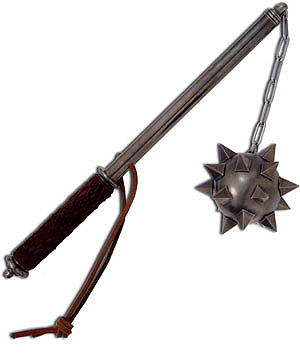
    This is an otherwise unremarkable morningstar in good condition, but anyone who sees the weapon instantly knows that the weapon's name is Jason. Upon learning this, the viewer must make a save (vs Will, vs Wisdom, vs Spell, vs whatever is appropriate) or be consumed with the burning desire to own and wield Jason the Morningstar as their signature and preferred weapon. This compulsion is as great and terrible as the compulsion to own an artifact.

    Monday, December 22, 2014

    A Red & Pleasant Land, by Zak S.

    If you buy the pdf but never hold the physical version of this book in your hands, then you are missing a key facet of the experience. Much like how Vornheim excels as a physical tool, the ambiance of owning A Red & Pleasant Land is in holding the finished tome in your hands.

    This book has a very distinct smell. Maybe mine was dropped into a canal beside a garden in Venice, the red-cloth cover is a little warped and bows outward, as if the book itself is trying to open up and invite me to flip through its pages. The pages have a distinct off-white look to them, which adds to the otherworldly and unusual nature of both the contents of the title and the method by which this volume saw publication. The gold text on the cover has flaked slightly, giving the red cloth a glitteriness which I am not sure is intentional. My fear is that with use the gold will eventually flake off and I'll be left with just a red cloth book, but that would still look cool.

    A Red & Pleasant Land takes place in Voivodja, which might be a stand-in for Transylvania, or it might be an alternate dimension lurking behind mirrors. Whatever it is, the land of Voivodja is ruled by families of vampires who identify themselves by card suits. They have an intricately complex society yet many of them seem to suffer from dementia or schizophrenia.

    The very first section of the book is called "How to Use This Book" and it suggests using the book as a whole setting, use parts of it, read it and not use it at all, or use it as a weapon. I think the author forgot to suggest that you could also use it as kindling, may you never be so cold that you resort to that option. I plan to use the book as a demiplane of madcapped grotesqueries & violent whimsy to cajole my players with.

    The first chapters throw all of the basic information about Voivodja at your game head. You'll learn about the strange nature of the landscape, the bloody customs and traditions of the locals, and Voidvodja's own mirror universe called the Quiet Side. There is even a custom class to work into your gaming group that seems suitable for a campaign set in Voivodja: the Alice. (Yes, that bit is free.)

    Roughly 1/4th of the book is composed of monster and NPC descriptions and this is the biggest highlight of the book, with many strange and wondrous versions of creatures to bedevil and bemuse players with. The spine has a red cloth bookmark and I'm currently keeping it on the page with my personal favorite, the Colorless Rooks.

    The next 1/4th of the book details two major castles for two of the vampire clans battling one another; Castle Cachtice, the Card Castle, and Castle Poenari, the Looking Glass Palace. There is a lot of information here and it's so dense with oddities and distortions that I know I haven't really absorbed all of it. The beauty of these locations is that each room has a minimal bullet point description that evocatively describes each area without bogging you down in text to read aloud. The weirdness of the castles are largely left to an individual GM's judgment on how to resolve bypassing a room.

    The other 1/4th (more like 1/5th, let's just call it 36 pages) comprises "Tables & Resources" at the back of the book and that is where a lot the fun stuff is. 'No Voivodja Required' is what I call it because several of the tables can be used independently of the setting and those that can't can easily be hacked for use in your own campaign. The best part of the "Tables & Resources" section is, in my opinion, the "Relationships Between NPCs" d100 table. Page 174. Go buy the book and look at that page first. I think it's a thing of beauty!

    So that's also my final verdict: buy this book.

    alternate magic idea for 5e

    What if arcane magic was corrosive to the body of the caster? Like smoking cigarettes, or chronic acid reflux?

    Casting a spell requires roll + Constitution modifier vs DC 15 + spell level
    Success = no Con loss. Failure = reduce Con by an amount equal to the spell level.
    Recover Constitution from sleeping or resting.
    Rest 2 hours = 1 Con. Sleep 1 hour = 1 Con.
    New skill = Meditation (Con-based), after resting for 2 hours roll+Con(+Proficiency) vs DC 20 to recover 2 Con.

    Crystal shards from the island of Kapuo are sometimes referred to as Kapuo, or Blueglass, shards.
    Blueglass shards are used to power internal forces, as a blueglass shard is used it's essence pours into the caster's body and causes strange effects.
    Consuming a Blueglass shard is more powerful, but will solidify the organs over time.


    Holding Blueglass during casting gives +5 to casting roll, on a natural 1 the Blueglass fades to a black color is now a worthless, brittle gemstone.
    Consuming Blueglass requires Con saving throw.
    Failure = Permanently lose 1 Constitution. Success = Permanently lose 1 Hit Point but can cast # of spell levels = Constitution without rolling for Con loss

    New Spell: Detect Blueglass
    works like Detect Magic but only detects presence of Blueglass

    alternately
    make Blueglass magical so the wizard has one less spell to cast (by default Blueglass is not magical)


    Inflicting pain and bloodletting can power internal forces, and sacrificing life can be the most powerful form of personal enchantment.

    Spellcaster can inflict wounds on self to power spells.
    If wounding self with weapon they are proficient with, caster can declare how much damage they inflict up to the weapon's normal maximum.
    If wounding self with weapon they are not proficient with, caster must roll weapon damage.
    Damage inflicted on self = bonus to spellcasting roll
    Caster can inflict damage on others with a weapon to get a bonus to spellcasting as long as spell is cast on the next round
    (spells that inflict damage do not allow for this same bonus, caster must be the one to inflict damage)
    Every 2 hp damage inflicted on others = +1 bonus to spellcasting roll

    New Spell: Dedicate Blade
    2nd-level spell, cast on any edged weapon, permanent
    if the caster uses the blade to kill a creature then the next spell he casts doesn't require a spellcasting roll

    LotFP version
    all rules same as above, except
    Casting a spell requires Spellcasting skill roll, a 1d6 roll. Only arcane spellcaster classes have access to Spellcasting skill.
    Skill = level divided by 4 (round down) +1
    Wizard level 1 thru 3 have skill of 1, Wizard level 4 thru 7 have skill of 2, etc.
    No meditation skill, allow Poison save to recover 2 Con after resting 2 hours
    Holding Blueglass gives +1 to skill, rolling 6 causes Blueglass to fade
    Consuming Blueglass requires Poison save with same results.
    Every 2 hp damage inflicted on self = +1 bonus to spellcasting roll
    Every 3 hp damage inflicted on others = +1 bonus to spellcasting roll

    Sunday, December 7, 2014

    SWN: the Safe Worlds

    Our characters live on the fringes of the Safe Worlds, a extraplanetary corporatocracy run by several mega-corporations who control information and weaponry. The biggest mega-corporation is A Better Tomorrow which owns the biggest banking conglomerate, the Saif Bank.
    "Your money isn't safe, unless it's in a Saif™ bank."


    The Tinfoil is a 100-ton scout ship captained by Sil, an explorer from Cone, a world still recovering from the Collapse.
    Her crew includes:
    the Marvelous Mark, a con artist from Beautiful Home, a veritable wasteland of biological hazards and dangerously malfunctioning terraforming technology.
    Spishak, an adventuring warrior from Zyst, a failed colony world with an invasive atmosphere and toxic biosphere that terrifyingly alters those exposed to it for too long.
    Tau Bai, a mercenary from I-Tong, a well-established Safe world that is considered a capital world for the mega-corporations.

    The Tinfoil arrived at the Happy Safeport™ around Vallejo to meet with Diego, an information broker that is friends with Sil. They asked about the Jump Gun that was found on Vallejo and Diego said he knew that somebody was holding it on Sindarin Station. Diego described a starship that had gone missing that everybody wanted the schematics for, and proposed that if Sil could get him the schematics he would get them free access to Sindarin Station with no questions asked. They agreed.

    The planet of Vellajo has five countries locked within a cold war teetering upon mutually assured destruction. Elencia is one of the countries and their military had built the missing ship. Vallejo has eight moons but only three orbit directly above Elencia. Sil scanned the moons but found nothing - meanwhile they were followed by another merchant starship.

    The Vallejo system also holds a gas giant with seven moons and an asteroid belt, and Spishak suggested that if Elencia were testing a weapon they wouldn't do it around their own planet. They flew the Tinfoil to the gas giant and the merchant ship stopped following them. Sil scanned the asteroid belt, and found most of the belt was composed of a material that would explode when coming into contact with metal. There were also two Elencian starships in orbit but they ignored the Tinfoil.

    Sil moved away from the gas giant and began scanning the moons, but once the Elencian starships were out of sight returned to the asteroid belt and almost immediately found the missing starship. It was not crashed as was previously believed but had landed on an asteroid. Nearby were four bodies, apparently killed from vacuum decompression and wearing Elencian military garb. There were no external signs of damage to the ship.

    Sil took Tau Bai and Spishak down to the ship, leaving Marvelous Mark alone on the Tinfoil. They found it easy to access the abandoned ship's front ports, and after exploring several decks they found the computer, then it spoke to them. Calling itself Illuminator, it demanded fuel, and refused to let Tau Bai or Spishak leave until Sil agreed to recover fuel for it from the Tinfoil. Sil agreed to give some fuel and left to return o the Tinfoil while Tau Bai and Spishak kept exploring the Illuminator.

    During their discussion Illuminator said "crew designation Sil and Marvelous Mark essential, crew designation Tau Bai and Spishak non-essential"
    Sil replied "No! Spishak and Tau Bai are essential."
    "incorrect"
    To which Tau Bai said "We keep Sil and the other one alive, therefore we are essential."
    "incorrect, Spishak and Tau Bai useful but not essential"

    Illuminator then suggested that Sil commandeer the Illuminator and blow up the Tinfoil in its place - presumably so the Elencian vessels will believe their missing craft is destroyed. Illuminator was asked what it wanted and it replied "expand memory banks"

    When the Tinfoil approached, Tau Bai used an escape pod to leave the Illuminator but Spishak refused to leave the bridge. Sil moved the Tinfoil in an attempt to ram the front windows of the Illuminator's bridge, and Iluminator cut into her headset, saying "crew designation Sil owes 23 million credit debt, debt could easily be increased"
    Sil asked "Are you suggesting you could also erase my debt?"
    Illuminator replied with an audio clip from the Tinfoil's databanks "You'll never know."

    to be continued

    Friday, December 5, 2014

    Idelfyn's Folly

    The location of Idelfyn's Folly is not exactly known. The mountain lies beyond the southernmost range of the Crown and few have ventured north to locate it's position, those who have return empty handed or not at all. The mountain is known to be an active volcano which scorched the earth and rock around it so much that now there is no flora growing near, not even weeds. Idelfyn spent his final years building a laboratory inside the heart of the volcano, for purposes few can guess at. His last journey to the volcano was also the last time he was seen by any.

    The truth is that Idelfyn's Folly is no volcano. Idelfyn fostered those stories and rumors before he disappeared so that those foolish enough to follow them would be led astray. Idelfyn had built a laboratory inside of a mountain, but the mountain held the body of a dead god. Idelfyn had located the celestial corpse by accident, and carefully crafted a story to throw treasure seekers and bounty hunters off of his trail. He used parts of the body to make a series of interdimensional tunnels which he used to traverse the world quickly and discretely. His plans involved creating a network of informants who would report to him about local politics and strange or unusual events. But none of this helped to explain his eventual disappearance.

    One questions remains for those few who know the truth: Did Idelfyn intend to disappear?

    Thursday, October 30, 2014

    the unofficial playbook moves

    I've been working on a project that is consuming more time than I thought it would, creating an index of all of the moves from the "unofficial" player-written playbooks of Apocalypse World. I wanted it to look and feel just like the index of moves from the official refbook pdf, however I've been using scribus to create my pdfs and I have not found a way to embed text within a pdf so that it may be copy+pasted. I stayed in wordpad for the index, and many pdfs had formatting issues so I had to fix typos and in some cases rearrange sentences or just retype them, then I alphabetized all of the moves. While doing all of this I got to really analyze every playbook. Many of these playbooks focus on relationships with NPCs and quantify them similar to gear or as part of moves. There are lots of unique mechanics like Sentience for the Synthetic or Rage for the Behemoth, etc. I decided to include brief summaries of what these things are and included them at the end of the document.

    A link to the "unofficial" moves document = https://drive.google.com/file/d/0B9cu0IVYfHtiX2ZzbHU0bzNIWEU/view

    This project started initially because I wanted to create an index of ALL of the moves that I would be able to give to my players and say "here's the moves list" but I've ended the project with a completely different perspective. I think each of the really unique playbooks are internally consistent, but picking up a move from another playbook is not always relative to the character you are playing. Thus, I think when a player chooses to get a move from another playbook the new move should perhaps be rewritten slightly to address the theme of the core playbook and overall tone of the character being played. I'm also regarding stat substitution moves as generally boring now, but that's a subject for another day. Rewriting the moves on the fly is just an idea, but one I'm going to experiment with a little. For now I have made sure that my document linked above is universal for anybody downloading it. The suggestions and descriptions are written generically, and directed toward the players rather than the MC.

    I hope you find it useful!

    Wednesday, October 29, 2014

    the Crown of the world

    There is a mountain range along the northern edge of the world that no one in living memory has crossed. The Crown blots out the sky to the north, and few have climbed through it's peaks to return and spin tales of what lies beyond. The Crown can be seen along the northern horizon like a tear across the land separating it from the sky. The only evidence that the living once crossed the Crown are the dams and aqueducts that still supply fresh water to thriving populations south of the mountains, marvelous and magical technology which no sage or scholar is able to explain. Each was designed, perhaps, by the same people. These people were short folk, though the Dwarves nor the Masadhi or even the Oukek have any stories to tell of their ancestors' toils to the north.

    The memories of what lies beyond the Crown are all faded and gone, but the rumors and stories persist. A mountain made of gold, a cursed place where none may take from and return home alive. A crystal peak that glimmers in starlight and makes men weep though they know not why. Three-armed giants with obsidian skin, ripping apart any plants or animals they cross paths with. A four-eyed hellhound that breathes blue flame and hunts those who dare not pray to the dead gods that birthed it.

    A few brave sailors have tried to circumnavigate the continent to find what lies to the north of the Crown, but they return exhausted with tales of treacherous waters inhabited by hostile marine life and harried by cruel mermen. Or they don't return at all. No ship has navigated the northern seas successfully, and even the Chiryo avoid the icy waters when they cross the ocean to trade with Marakāven.

    Even the wind hates the living north of the Crown.

    Tuesday, October 28, 2014

    Apocalypse World: enter Syn

    A new playbook was added to our group, the Behemoth, and with it a new character, Syn.

    Syn is a giant, winged lizard who can sense, and will devour, sinners. It is followed by three sombrero-wearing men who are known as Uno, Dos, and Tres; but also as the Three Maldicion.

    When Syn arrives in Jericho it has lost the scent of some sinner it was following and decides to draw them out by encircling and then swooping down into the middle of town, to which most of the people in Jericho panic. Several of the Nuns wanted to attack it, and the governor of Jericho even coordinated some of her men to be in a position to attack it. Several of Governor Isle's men opened fire on the creature, but it did not attack back, instead it seemed to be trying to communicate and cooler heads prevailed in defusing the situation.

    Mercy arrived back in town at the same time Sister Alleluia was fighting giant spider-snakes with Cletus. The spider-snake creatures gave Alleluia and Cletus a lot of trouble, knocking them to the ground and trying to constrict their bodies, but in the end Alleluia prevailed and killed all three of them while Cletus succumbed to some of their poison. She took Cletus back to his infirmary, where his injured assistant Henry did what he could for him

    Mercy had been taming the already docile Syn and wrapped a great chain around Syn's neck, then convinced the giant lizard to fly above the clouds. For Mercy it was a spiritual experience.

    Then Governor Isle confronted Big Momma Superior about how her gang thinks they run Jericho. In asserting her authority over Big Momma, Isle declared that the doors to town be reopened and the Frogs be shot on sight by any guards who saw them. A traveling caravan of gypsies entered Jericho and Syn dug a tunnel next to the town square for it to nest in. Underneath the tunnel was a mine, it appeared that Big Boss had sealed it shut when Big Momma Superior first attacked and now there were several dozen dead bodies underneath Jericho. Mercy set out to exhume the bodies and burn them in a funeral pyre, to which Big Momma objected but Mercy insisted that burning the bodies was the only way their souls would go to Heaven for she "had seen the light above the clouds!" and then Mercy revoked her membership in the Nuns.

    After Big Momma traded back some of her first aid supplies to Henry, everybody noticed that their Frog prisoner Ribbit had disappeared. Sister Alleluia began preparing a trip to the east to finally take care of their encampment, but before she could leave Ribbit showed up just outside of town with a couple of former slavers from Jericho following him. When Alleluia approached them Ribbit got down on one knee and proclaimed "We follow you now." Alleluia considered the situation and declared to these men what she expected from them, or else she would kill them, and when she finished talking they replied in unison "Amen."


    The Sorrow awoke in the mine underneath Jericho. She was confronted by the sight of Syn, not quite knowing what it was, and she could see Mercy exhuming bodies from the mine while Uno, Dos, and Tres discussed how they should minister to Syn's needs. Mercy caught The Sorrowsneaking around and briefly explained that she had taken care of The Sorrow while she was knocked out. Mercy also explained that she was no longer in the Nuns as she had been taken "as close to Heaven as she had ever been" by Syn, she explained that Big Boss had sealed the mine they were in, and now Mercy was exhuming the bodies and giving them a funeral and "a proper release to the light."

    Meanwhile, Sister Alleluia was still walking toward the strip mall where the other Frogs were supposedly camped. On the way she saw a large creature hiding in bushes along the road, rather than investigate she scared the creature off but it didn't flee very far. Within sight of the strip mall, Sister Alleluia found a large white RV with it's engine running. While investigating Sister Alleluia was struck from behind by the creature from the bushes. They fought briefly but Alleluia was unhurt, and proceeded to search the RV. She decided to use the RV to ambush the Frogs behind the strip mall and proceeded to ram the vehicle through the building. On the other side she found them torturing somebody and she drove through their encampment, taking out several of them in the process. As Sister Alleluia stepped out from the RV she convinced the remaining Frogs to surrender, killing one of them. The man they were torturing was William Aitch, and he was very distressed that his RV was smashed to pieces. He asked for help getting his RV back onto the road, but the undercarriage was damaged and trying to drive it back through the remains of the strip mall caused it to get stuck. Sister Alleluia returned to Jericho with a few of her gang following behind, and the rest guarding William Aitch'es RV.

    In Jericho, somebody had destroyed the fuel refinery, the main source of income for the town. Big Momma Superior found pieces of a grenade near the fuel pump and while investigating several Nuns approached her about damaged bikes, somebody had stolen wheels from one of their bikes and several other bikes had slashed tires and punctured fuel tanks while Sister Alleliua's bike was also stripped of all of it's ammo.

    The Sorrow went to Cletus for some medical attention, and he attempted to use his connection to the psychic maelstrom to heal her. It worked, but in the process both of them had a momentary lapse of consciousness.

    Syn began detecting envy in the town and decided to fly upwards to get a better look.

    When Sister Alleluia returned to town she was informed about the vandalism to the bikes and immediately sought out the criminals responsible, finding evidence that the gypsies who had just arrived in town were doing it. She killed one in the process of interrogating them and discovered that Calico is the leader of all the gypsies traveling between towns, but Calico wants a permanent home in Jericho and sent some of his men to stir up shit and make it easier for him to take over. One of the dead gypsies was hung from the main gates and Syn proceeded to eat the body. While Alleluia continued to fight with the gypsies and tried to discover exactly where Calico was, Syn grabbed one of the gypsy minivans and carried it into the air, with people inside screaming. Once it was high above town, Syn let go of the minivan and it crashed into the ground just outside of the gates, killing all inside.

    Governor Isle didn't approve of the way Sister Alleluia was handling the gypsies and the two faced off, with Alleluia seriously injuring Isle and killing several of her men. Big Momma tried to restrain Alleluia and somehow Isle escaped in the confusion. Sister Alleluia declared that they needed a new leader for the town and gave an ultimatum for Jericho, "Vote for me, or leave."

    Thursday, October 23, 2014

    HX, Bonds & Alignment

    First up, HX. Or History.
    There's nothing inherently wrong with the HX system in Apocalypse World, but it's confusing. Even when players understand it, they can mess it up. Last week I was telling a player eye-to-eye "You write down either 0 or -2 based on what the other players say" and they still managed to mess that up because they were reading the playbook and switching up the instructions between what you write down and what you tell other players. I've played or MCed Apocalypse World nine times, with eight different groups of players, and every time calculating HX is confusing and stops everybody's momentum.

    It would be easier if it were sped along and simpler. Either you tell other players what to write for their HX with you and they don't modify it, or everybody starts with the same numbers and it gets modified by yourself (secretly).

    Secondly, alignment.

    In Dungeon World, each class has a certain number of alignments that give them class-specific XP bonuses when they act upon that alignment. For example, if you're playing a Good Wizard then you get 1 XP whenever you "use magic to directly aid another." That's pretty open-ended. If I use a cantrip to light another character's torch then technically I've used magic to aid another, right? Some people might read that as you need to apply a more valuable level of magic to aid somebody, but that's not what the alignment says or how it reads. An Evil Wizard needs to "use magic to cause terror and fear" which is a pretty specific kind of use in comparison and maybe an easy way to do this might be to use a few cantrips to freak out some local villagers and maybe you'll get your XP to pop, but it seems like one of these can fit within your usual state of play easily and the other requires you to go out of your way to be a dick to NPCs.

    "Well, yeah, he's evil."

    Uh, no. Being evil doesn't mean you're a dick to random strangers for no good reason. Being evil means you serve none but yourself. Your actions must be immoral, wicked, or depraved, but not needless or without motivation. Withholding aid or information so that you can profit before somebody else or have an advantage over them, providing misleading information for the same reasons, insisting on receiving a higher share of the treasure or just taking more of it openly or secretly, going out of your way to hinder a potential rival in a demeaning or humiliating way, actively sabotaging somebody just to make them look bad or to embarrass them. These are evil acts. I don't even think my description here can suitably be called evil (maybe Vanilla Evil?) because truly reprehensible acts could also fall under evil, but I'm assuming most players don't want to play rapists, murderers, and pedophiles.

    When I think back on the arguments I had around gaming tables during my teenage AD&D years the only thing that ever comes to mind are debates that surrounded role-playing alignment properly. "But I'm chaotic!" was a pretty common refrain I heard from people who did things that seemed out of character, and when I once attempted to play a lawful character my GM hounded me about how I wasn't living up to his expectations of the alignment.

    Alignment has always been, in my opinion, a poor method for guiding a character's growth or goals.

    So why not just have a goal? Your character should always have a long-term goal once they've developed, but short-term goals work too.

    Third, bonds.

    Bonds are a clever little way of pushing the players into having their characters explore relationships with the other players' characters. They're one sentence descriptive qualifiers for the relationship your character has with another character. At the end of every session you can resolve one Bond and receive 1 XP for it, as long as both you and the other player agree that the Bond is resolved. But they're also one-sided, and arbitrary.

    If I write that my wizard "Thinks Grond the dwarf would make a good bodyguard" then I am motivated to either explore this idea or follow through with the idea if I want to resolve this bond, but the player of Grond might have "I would never work for Thorp the wizard" and I might never learn this through play. Eventually I might give up my plan of having Thorp try to hire Grond and resolve the bond because I just think he won't ever work for me. So I resolve that Bond and the player of Grond says "Oh really? I guess that would resolve my Bond too because if you stop offering employment I'll stop denying to work for you." We have a good chuckle about how our Bonds were set up, each mark 1 XP, and move on, writing new Bonds perhaps for each other again or perhaps for other PCs. Now here's the weird part, Grond can work for Thorp now and it would seemingly fly in the face of the previously written Bonds.

    I don't know if that's why they were designed that way, that your characters' relationships would be allowed to change so drastically, but while playing Dungeon World I have found the system discordant and it pushes me to contrive relationships when I don't normally want to. Sometimes I really like the Bond I have too, and constantly shifting relationships means I am less likely to keep that one-sentence qualifier. There have been times when another player changes their character's Bond with my character and then my Bond feels irrelevant and then I feel forced to change it. The rules also state you can only resolve one Bond per session, and I know I've played in two sessions where it felt like more than one Bond resolved by the end.

    Overall, I think it's an improvement over the confusing nature of Apocalypse World's HX system and I like the concept, but I don't like the execution of the idea or the restrictions placed upon resolution.

    So why not improve HX by making it simpler to calculate? Then add Bonds that connect the two characters but won't resolve unless HX resets?

    Goals
    Each character has two Goals, it's implied that one should be short-term and the other long-term but that's not required. During the first session, nobody has to have a goal unless they want one, but by the end of the first session the character should have at least one goal. By the end of the third session, they should have a long-term goal.

    Alternate HX+Bonds
    Each character also has History with every other character. This starts at 0 but might be added to or subtracted from based on the other characters, there is no "others' turn" in this new system. For each History you also have a Bond which is written by the other player, with your approval, and when your History resets with them they re-write a new Bond for you, with your approval. You both work together to figure out how your characters are Bonded.

    Let's take an Angel, Battlebabe, Brainer, Chopper, and Gunlugger, the first five playbooks and line them up as PCs. They all have 0 History with one another.
    The Angel tells the Battlebabe "You helped me save a life, so add +2 History." and the Battlebabe says "Everybody gets +1 with me, so Angel, take +1 History." and then they determine their Bonds. The Angel says "I think I can rely on you to do the right thing." and writes that next to the +1. The Battlebabe says "I think you need to protect yourself and stay out of trouble." and writes that next to the +2. The Angel then goes around the table until his History box looks like this
    Battlebabe +1, I can rely on her to do the right thing
    Brainer -1, I won't let her near me
    Choppper +1, We're friendly but not close enough
    Gunlugger -2, I'm scared she'll turn on me

    Wednesday, October 15, 2014

    Apocalypse World: the Nuns of Anarchy

    We didn't know what we were going to play. I opened the table up to discussing options and offered lots of them: I was prepped for another Apocalypse World game, I was also prepped to run Dungeon Crawl Classics or Lamentations of the Flame Princess, I had the character sheets ready for a Stars Without Number game, and I also offered other options of Shadowrun and Mage and 5eD&D, but in the end the players whittled down the options until it was Apocalypse World. One player had already written up a character, and the rest of the players just started to revolve around what he set up.

    Big Momma Superior is the leader of the Nuns of Anarchy biker gang. A small group of women who've embraced Big Momma's interpretation of the old religion. Described as "we help the needy and the starving, we free the enslaved, and we only kill when necessary." The members of the gang who have earned Sister rank wield big heavy rulers, and those who are still earning their way in the gang use baseball bats and lead pipes, sometimes with crudely drawn inch markings along the cylinders.

    Sister Alleluia, the former wife of Big Boss, a slaver who ran the walled shantytown of Jericho. Big Boss was a violent and vindictive man who tormented everyone around him, including his wife Marie. Marie killed her husband during Big Momma's rebellion against the town's slavers and when the people of Jericho were freed, Marie joined the Nuns and was immediately made a Sister. She later took the name Sister Alleluia.

    Mercy was once a slave in Jericho and is now an Acolyte of the Nuns. She was born to pagan tribals from out west who raised horses and traded them with the local communities, until one day the slavers in Jericho wiped most of them out and enslaved the women and children. Mercy was freed from her bonds by Big Momma herself and she joined the Nuns soon after.

    Cletus is the town medic, he runs an infirmary on the side of a hill sloping underneath the east wall of Jericho, and he can be found there most of the time. While he's not a member of the Nuns, he describes himself as an "angel" and claims to have been "called" to it. He travels with the Nuns when they visit neighboring communities, sometimes to offer aid to their neighbors and sometimes just to aid the Nuns.

    the Sorrow is a former slave who also joined the Nuns after being freed by Big Momma. She carries around a very visible sadness and bleakness that makes some people uneasy or distrustful. She is also the most secretive, as very few know anything about her from before she arrived in Jericho. The Sorrow was forced to be a prostitute, and many of the women in Jericho who are former slaves are also former prostitutes.

    All of these characters live in Jericho, but the neighboring communities are visited frequently by Big Momma Superior and the Nuns.

    While designing the world we decided that the world had a Biblical apocalypse where most of humanity died or disappeared, but most people don't really know what happened. It's obscured by rumor and mystery. There are stories of beasts that rose out of the seas and giants living in the earth, and some people even claim to have seen one but the proof of these things is never confirmed. The sky, on the other hand, is visibly changed. The world is shrouded within a nearly perpetual darkness thanks to heavy clouds which cover the sky and produce lightning storms. Rain is common, but not always pleasant as it always falls with hail. The world is a cold place though it never seems to snow, nor does the temperature ever drop to a freezing point. The plants manage to weakly sprout despite the sun's concealment behind the clouds, but sunlight does peek out from behind the clouds sometimes, and that is usually a day for celebration and feasting.

    In Jericho, the town is run by Governor Isle, a former slave, but she defers most of her decisions to a council comprised of six women, all are former slaves. There is a central well that people collect water from, and rainwater is also collected on the gutters of roofs. There is an fuel refinery in the center of town, but it hasn't pumped for some time. Outside of the walls the citizens tend crops that grow thin in the muddy hilltops.

    The Seminary is a haven for the Nuns but is rarely visited. The place looks like a single sprawling building from the road and few people actually live there.

    A man named Ivan runs the town of Perostroika. The center of their town has an old electrical station, and Ivan rations the electricity out to anybody who he deems worthy of having it. They rarely trade with their neighbors directly, Ivan prefers outsiders to visit the town and be beholden to his laws.

    In Horse the Night Mother (maybe a title?) runs a theocratic village where they worship the night and believe bad things happen when the sun comes out from behind the clouds. They reject the old Bible and while Big Momma Superior has never had a direct confrontation with the Night Mother or any of the locals from Horse she knows that they won't offer hospitality to her or the Nuns.

    Hunter's Palace is run by a tough woman named Heston, her laws are few but the penalties are strict. Criminals whom she exiles get hunted like animals, as there are so few good opportunities for sport in the wasteland.

    Fresh Whiskey is the name of a bar and pool hall on the side of the road, there is no town nearby and no other buildings surround it or stand nearby. It is run by a burly man with thick scars across his face, everybody calls him Frank.

    The town of Black Grass is not so much a town as it is a warning. The map might as well say 'here there be dragons' as nobody ever ventures that far south.

    The Fort has been left undefined.

    I looked at maps until I found some real world equivalent to the roads I had drawn in my initial sketch. I found a really good similarity between my rough map and the area around Huntsville, Alabama and redrew the roads of the map to reflect the major highways around that region.

    I took absolutely no notes about what happened during the first play session. Here's what I remember:

    A local from Jericho named Oberon was seen running through town with a mewling baby in his arms.
    He was being tracked by three teenagers with greenish skin, he called them "the Frogs" and claimed they were trying to take the baby away.
    Cletus tried to stop them but ended up getting stonewalled by the youths who were adamant that the old man had kidnapped the kid, though he believed they were lying.
    Sister Alleluia interrogated the teens roughly and ended up shooting one in the head.
    Big Momma Superior showed up shortly afterward and Sister Alleluia's machinegun accidentally discharged into Cletus.
    The Frogs who were still alive, Ula and Ribbit, were told to leave town and never come back, while Oberon was calmed down in Cletus'es infirmary by Sister Mercy.
    Eventually Oberon found a way to escape with the baby but was stopped by Cletus and again interrogated, but this time by the Sorrow who learned that the locals in Horse are committing human sacrifices.
    The baby was wrested away from Oberon and given to Jenny Two-times who was both a mother and a nursemaid.
    Grid the Watcher lives next to the infirmary, he watches from his home but never leaves.
    Later that night by one of the Frogs had returned to town to ransack through Cletus'es infirmary, Cletus caught him but got beaten into unconsciousness. When he woke, Cletus used some painkillers on himself that would leave him out of action for the next day.

    I have one NPC whose name I wrote down, Lecter, but I don't remember what I had them doing, if anything.

    During our second session, Big Momma Superior instructed Sister Alleluia to protect the baby and she interpreted that as kill anybody who tries to take the baby away from Jenny Two-times.

    Big Momma Superior was being hassled by some of the Nuns to drive down to Horse and take care of the Night Mother. She decided the best course of action was to go down and scout it out quietly, but Motown (one of the Nuns) kept giving resistance to her slow and peaceful resolve. Big Momma visited the infirmary and traded with Ruth for some first aid supplies, and gathered more than half of her gang to go scout around Horse.

    Sister Alleluia stayed behind to protect the baby, and Cletus was still unconsciousness from the night before.

    The gang didn't even make it halfway to Perostroika before they ran into trouble. A semi trailer had been tipped over and was blocking the road. It looked like an accident, as the metal of the trailer was ripped in some places and the seams were split along the edge of the roof. Something could be seen skittering around inside the trailer. Very carefully Sister Mercy approached the back of the trailer, pried it open and revealed a long coiling snake-like creature with spindly legs along the underside of it's body. It was wrapped around some sort of machinery in the trailer and as the warmth from it's nest escaped the back of the trailer it tensed and began to move around. Small white eggs could be seen all along the inside of the trailer, sitting along the floor and walls.
    Big Momma Superior coordinated her gang to rip the roof of the trailer and expose the nest completely, but by then it had started to escape and grabbed Sister Mercy as it fled. Several of the Nuns chased after the creature and struck it with their bats and pipes and it released Mercy. In the trailer itself, The Sorrow was trying to get a better look at the machinery and jumped into the nest, then kicked out any of the young she found still lingering. Big Momma set about trying to determine the best way to take this machine, which nobody knew what it did, back to Jericho. She returned to Jericho by herself, leaving five Nuns at the trailer wreckage, and sending The Sorrow and Sister Mercy on to Horse with Sister Marilyn, Motown, and Twinkie

    Back in Jericho, Sister Alleluia was picking up some bread for Jenny Two-times when she overheard the baker, Notch, talking with somebody about how the Frogs didn't even travel south when Big Momma threw them out of town. Sister Alleluia wanted to follow up on this lead but was delayed by Cletus who was checking in on the baby and explained that he had been beaten by one of the Frogs who had returned to steal from his infirmary.
    Sister Alleluia wanted to know how the Frog had gotten in and upon approaching the infirmary they saw the door open and blood splashed across the floor. The same Frog had returned to the infirmary and was looting the place, during the break-in he had killed Ruth. Sister Alleluia quickly subdued the Frog and interrogated him, promising not to kill him if he told them where he was from, and he confirmed that they were from Horse but a group of them were camped out just east of town, though he didn't specify where. Cletus found Henry in the back, unconscious and hurt but alive.

    Big Momma Superior arrived back in town and hearing that the Frogs were nearby decided to lock down the town and shut the gates, there was some debate whether they should chase after the Frogs that were camped outside of town or continue with trying to bring the machinery back to Jericho. Big Momma elected to focus on the machinery and gathered three more Nuns to assist in towing the trailer back, and even though Sister Alleluia wanted to go hunt down the Frogs by herself she followed Big Momma's commands.

    The drizzle of rain that had been building up finally broke into a storm. Two days passed and the trailer had been towed to Jericho, Sister Alleluia decided to cook some of the snake-spider eggs and they turned translucent from the heat but tasted good nonetheless.

    The next session will start by determining exactly how the scouting mission around Horse fared...