Showing posts with label LOTFP. Show all posts

Monday, April 6, 2020

Completely re-writing D&D combat; or, Blocking, Dodging, Hit Points, and You

Eva M Brown wrote "Instead of hit points use your hit die. When you're hit you can roll any number of hit die. If you roll higher than the damage, you keep your hit die. If you roll lower, you lose all that you bet.
Alternatively, you can just sacrifice hit die acting that they are maxed value. So, if you're a 4th level barbarian, and take 24 points of damage you could just take 2 HD worth of damage and call it good or roll any number of your HD hoping to roll higher than 24.
" and thinking about how this would change combat to being much more active is how I started on this idea.

Let's say Hit Points are supposed to reflect stamina instead of health, and Hit Dice are the real deal for determining whether a character is healthy. Low-level characters? Still easy to kill. But I'm getting ahead of myself. Ignore the magic system of D&D for a moment and let's just focus on combat. Hit points are a measure of stamina, and when they run out you're exhausted, can barely move, are incapable of taking action, and can only barely defend yourself from being attacked.

Blocking
Hit points are still there, but when you attempt to block an attack your armor (and shield and weapon altogether) provide a defense dice pool against the damage you take. You roll the dice of your armor and if the damage exceeds it, you take the difference against your Hit Points. You can add Hit Dice to this defense, but if the damage exceeds what you roll you lose the Hit Dice instead of the Hit Points.

Shields add 1d4, 1d6, or 1d8 depending.
Armor ranges from 1d4 to 1d12.
Weapons add small bonuses, anywhere from +1 to +5.

Meaning, a low-level enemy like an orc is at a disadvantage against a well-armored opponent, but the breath weapon of a dragon is going to damage its victim regardless of how well-armored they are.

If your Hit Points are reduced to zero, you can only wager Hit Dice and one piece of armor/weapon to avoid damage.
If your Hit Dice are reduced to zero, you are unconscious or soon to be dead.

Dodging
Every character has a dodge modifier that starts at +10 and is only decreased by what sort of armor they are using and the weapon they are carrying.
Most weapons are -1, but a few are -2 or -3. All polearms are -4.
Armor ranges from -1 to -5.
Shields are -1 or -2.
Meaning, yeah, you could have a -1 Dodge if you're wearing full plate and carrying a heavy shield with a halberd.
You roll a d10 and add the modifier to your roll, if it exceeds the attack roll then you successfully dodge. You can't dodge forever though because it costs Hit Points every time you use it.

She failed a dodge roll.

What about attacking?
It changes a lot. Though I think this sort of modification would work better with Lamentations ruleset, to fit it in other systems you'd need to get rid of class-based attack bonuses. Weapons would have to add modifiers to attack rolls, or you could have weapons give a variable bonus similar to the way Dungeon Crawl Classics gives warriors an attack bonus with a dice roll.

I'm not sure what the best way to modify it would be, but having an active defense is certainly more appealing to me.

Parrying
I have never seen a ttrpg create an elegant way of using parrying effectively. I'm all ears if you have an idea how to apply it in this system. For now, I expect making an attack roll against the attacker's roll is the only way to do it. Leaves a lot down to luck instead of skill, which I don't like.

Monday, December 22, 2014

A Red & Pleasant Land, by Zak S.

If you buy the pdf but never hold the physical version of this book in your hands, then you are missing a key facet of the experience. Much like how Vornheim excels as a physical tool, the ambiance of owning A Red & Pleasant Land is in holding the finished tome in your hands.

This book has a very distinct smell. Maybe mine was dropped into a canal beside a garden in Venice, the red-cloth cover is a little warped and bows outward, as if the book itself is trying to open up and invite me to flip through its pages. The pages have a distinct off-white look to them, which adds to the otherworldly and unusual nature of both the contents of the title and the method by which this volume saw publication. The gold text on the cover has flaked slightly, giving the red cloth a glitteriness which I am not sure is intentional. My fear is that with use the gold will eventually flake off and I'll be left with just a red cloth book, but that would still look cool.

A Red & Pleasant Land takes place in Voivodja, which might be a stand-in for Transylvania, or it might be an alternate dimension lurking behind mirrors. Whatever it is, the land of Voivodja is ruled by families of vampires who identify themselves by card suits. They have an intricately complex society yet many of them seem to suffer from dementia or schizophrenia.

The very first section of the book is called "How to Use This Book" and it suggests using the book as a whole setting, use parts of it, read it and not use it at all, or use it as a weapon. I think the author forgot to suggest that you could also use it as kindling, may you never be so cold that you resort to that option. I plan to use the book as a demiplane of madcapped grotesqueries & violent whimsy to cajole my players with.

The first chapters throw all of the basic information about Voivodja at your game head. You'll learn about the strange nature of the landscape, the bloody customs and traditions of the locals, and Voidvodja's own mirror universe called the Quiet Side. There is even a custom class to work into your gaming group that seems suitable for a campaign set in Voivodja: the Alice. (Yes, that bit is free.)

Roughly 1/4th of the book is composed of monster and NPC descriptions and this is the biggest highlight of the book, with many strange and wondrous versions of creatures to bedevil and bemuse players with. The spine has a red cloth bookmark and I'm currently keeping it on the page with my personal favorite, the Colorless Rooks.

The next 1/4th of the book details two major castles for two of the vampire clans battling one another; Castle Cachtice, the Card Castle, and Castle Poenari, the Looking Glass Palace. There is a lot of information here and it's so dense with oddities and distortions that I know I haven't really absorbed all of it. The beauty of these locations is that each room has a minimal bullet point description that evocatively describes each area without bogging you down in text to read aloud. The weirdness of the castles are largely left to an individual GM's judgment on how to resolve bypassing a room.

The other 1/4th (more like 1/5th, let's just call it 36 pages) comprises "Tables & Resources" at the back of the book and that is where a lot the fun stuff is. 'No Voivodja Required' is what I call it because several of the tables can be used independently of the setting and those that can't can easily be hacked for use in your own campaign. The best part of the "Tables & Resources" section is, in my opinion, the "Relationships Between NPCs" d100 table. Page 174. Go buy the book and look at that page first. I think it's a thing of beauty!

So that's also my final verdict: buy this book.

Friday, September 19, 2014

Deep Carbon Observatory, by Patrick Stuart

It is rare that I hold high expectations for something and then it lives up to those expectations. It can feel pretty gratifying! I had been hearing about how intriguing this module was before it was available in print, and Patrick Stuart is one of my favorite game bloggers, which means I was a little biased with the eager anticipation of reading this adventure. I was expecting Deep Carbon Observatory (DCO) to be awesome, and I was not let down.

There is very little in the way of set-up for this adventure. A single paragraph sets the stage for what the PCs know, and clever GMs who read the entire adventure ahead of time can find easy ways of hooking the PCs into the sequence of events that follows. The adventure is divided into eight chapters, more than half of which can be thought of as simply descriptions for inhabitants and encounters within a specific region. The adventure starts with a flood that destroys most of the countryside, and if the players are keen on following the damage to the source of the flood waters they will be led to a broken dam which is pretty compelling location all on it's own. It's entirely possible that the observatory of the title could never be found. But if it is, complicating matters is a thoroughly evil adventuring party that is competing with the PCs, though neither of them knows about the other ahead of time.

I'm not going to explain any other further details than that because I've perhaps revealed too much of it already. It's a pretty straightforward premise, but brutal in it's execution. This adventure deserves to be spoken about in hushed tones and discrete symbols. The only thing I didn't like about the adventure is that the words on the overland maps were a little hard to read and there's no sense of scale described anywhere on the maps or in the text. There are alternate maps available for the observatory, but I found the maps included in the original pdf useful and compelling (though the numbers here were also a little hard to read). Scrap Princess did an excellent job with the artwork throughout the book, giving the adventure a gritty and disturbing atmosphere. I would love to see her illustrate more modules.

Deep Carbon Observatory is available from DriveThruRPG in both print and pdf!

Wednesday, August 20, 2014

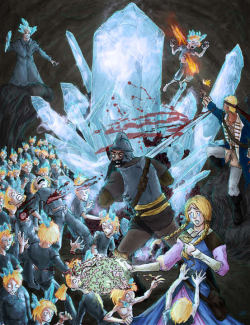
The Doom-Cave of the Crystal-Headed Children, by James Edward Raggi IV

The Doom-Cave of the Crystal-Headed Children (DCCHC) was the Free RPG Day release for the Lamentations of the Flame Princess RPG. If you were really lucky, your FLGS isn't run by a douchebag who refuses to carry LotFP products and you got a print copy earlier this year. Unlucky souls can still pick up a pdf copy of the adventure. DCCHC was initially funded on Indiegogo and that is the only way I was able to procure a print copy of the module.

James Raggi IV has a reputation for writing adventure modules that are basically traps for the PCs. Another blogger coined the term negadungeon to explain this kind of module, an adventure that is meant to destroy the PCs rather than to entertain or reward. I personally find assessments like this unfair, but I will say that he manages to craft adventures which seem uncompromisingly difficult from a cold reading.

The premise of DCCHC all by itself is weird and horrifying. All of the women in a small town are convinced that they gave birth to a son four years ago, named him Andrew, and yesterday he disappeared - despite the fact that nobody else remembers these multitudes of Andrews and there is no evidence that these Andrews exist except as a mass hallucination of the women of this town, one of these boys is seen outside of town, and... you'll have to read the adventure or play through it to find out who and what these Andrews are.

Having read that last paragraph, aren't you intrigued to find out what is going on? I know I was!

DCCHC is a great module because there is a ton of weird and dangerous stuff inside a dungeon complex that is authentically creepy and strange, but the real charm of this adventure is that the main hook that brings the PCs to the cave could all be resolved in the very first rooms. The plot involving the many Andrews takes up about 6 pages of a 36 page adventure. Everything else around the crystal-headed children is just icing on the cake!

Even though it was a Free RPG Day offering, you can still get "The Doom-Cave of the Crystal-Headed Children" for free (or purchase it as a pay-what-you-want pdf) at DriveThruRPG

Monday, August 18, 2014

The Islands of Purple-Haunted Putrescence, by Venger Satanis

The Islands of Purple-Haunted Putrescence (IPHP) is an OSR hexcrawl over a gonzo science-fantasy landscape populated with strange creatures, unique challenges, and deranged populations. IPHP was initially funded on Kickstarter and was one of those rare gaming projects that actually saw an early delivery.

The first half of the book consists of background information about the islands as well as lots of useful tools for inserting weird ideas and background data for the PCs. I would think of this part of the book as a grab bag of inspirational ideas and useful character building tools. Some players might balk at having a randomly generated flashback to their childhood or having a random personal connection to the islands, but with the right group of people this can be really charming and adds the to astronomical creepiness of the island's history. My favorite part of this section are the purple stones, a mechanical method to reward players for acting in the islands' interests (yes, you read that correctly), and the mysterious crystals native to the islands, powerful but nonmagical artifacts left behind by the decaying corpses of ancient wyrms.
The second half of the book describes the islands, hex by hex. There are lots of weird diversions scattered across the three islands, but there doesn't seem to be alot of effort made to connect them together in any discernible way. A constant theme is aliens from another dimension/planet who have crashed/landed and are up to some kind of mischief, or just minding their own business. There are pop culture references appearing just as often but are obscured in ways to not be immediately noticeable or recognizable, and some of the treasure includes items that might be found in our modern world which I found amusing, but some gamers might find distracting.

Some things I don't like:
1) There are sometimes multiple encounters listed for a single hex, but the map itself doesn't have distance marked so it's difficult to know exactly how big each hex is. One of the islands is said to be over 1000 square miles and a rough estimate means each hex represents about 30 square miles. A simple map key would have saved me the time to try and figure this out. This isn't egregious, but a lot of sections probably could have used some proofreading from a fellow gamer because there are lots of little things like this that seem overlooked.
2) There are lots of encounters that result in a save or die scenario, and I personally dislike these because I would either never use them or feel the need to rewrite them.

Some things I really like:
1) It's almost like having two sourcebooks because the first half is written with a general approach and many of the ideas can be used outside of a IPHP adventure. But hen you have the second half, which can be used as a straight up hexcrawl or as a collection of ideas to throw into your own games.
2) Despite the randomness of each encounter, each has enough detail to build off of and potentially create a whole session worth of adventure around. Played right, and this module could make a campaign last for months or years.
3) The artwork is great. There's a lot of great talent inside and I would love to see more of it!
4) Amazing Larry in hex 016

This book is a lot of fun! I don't see myself running it as a straight adventure but I can definitely see myself taking things from it frequently (and perhaps randomly) in order to spice up my own OSR games.

You can purchase both pdf and print versions of "The Islands of Purple-Haunted Putrescence" at DriveThruRPG

Monday, March 31, 2014

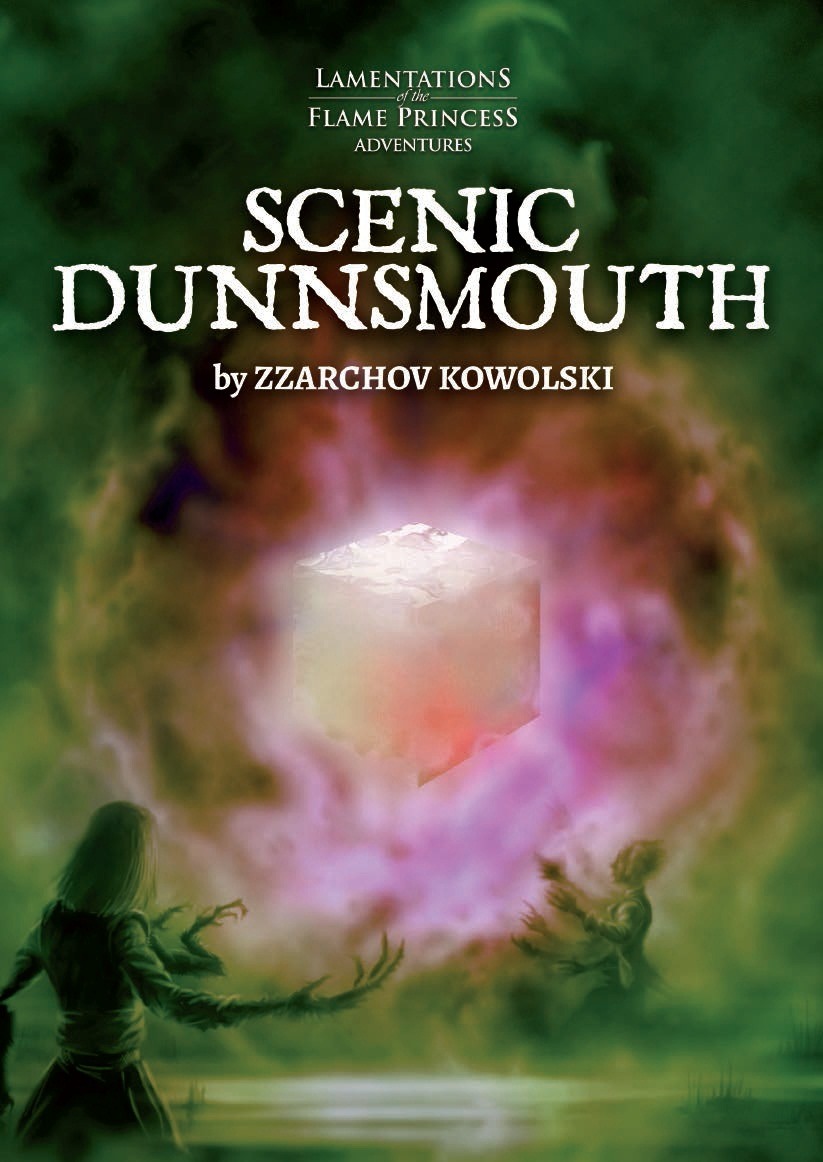
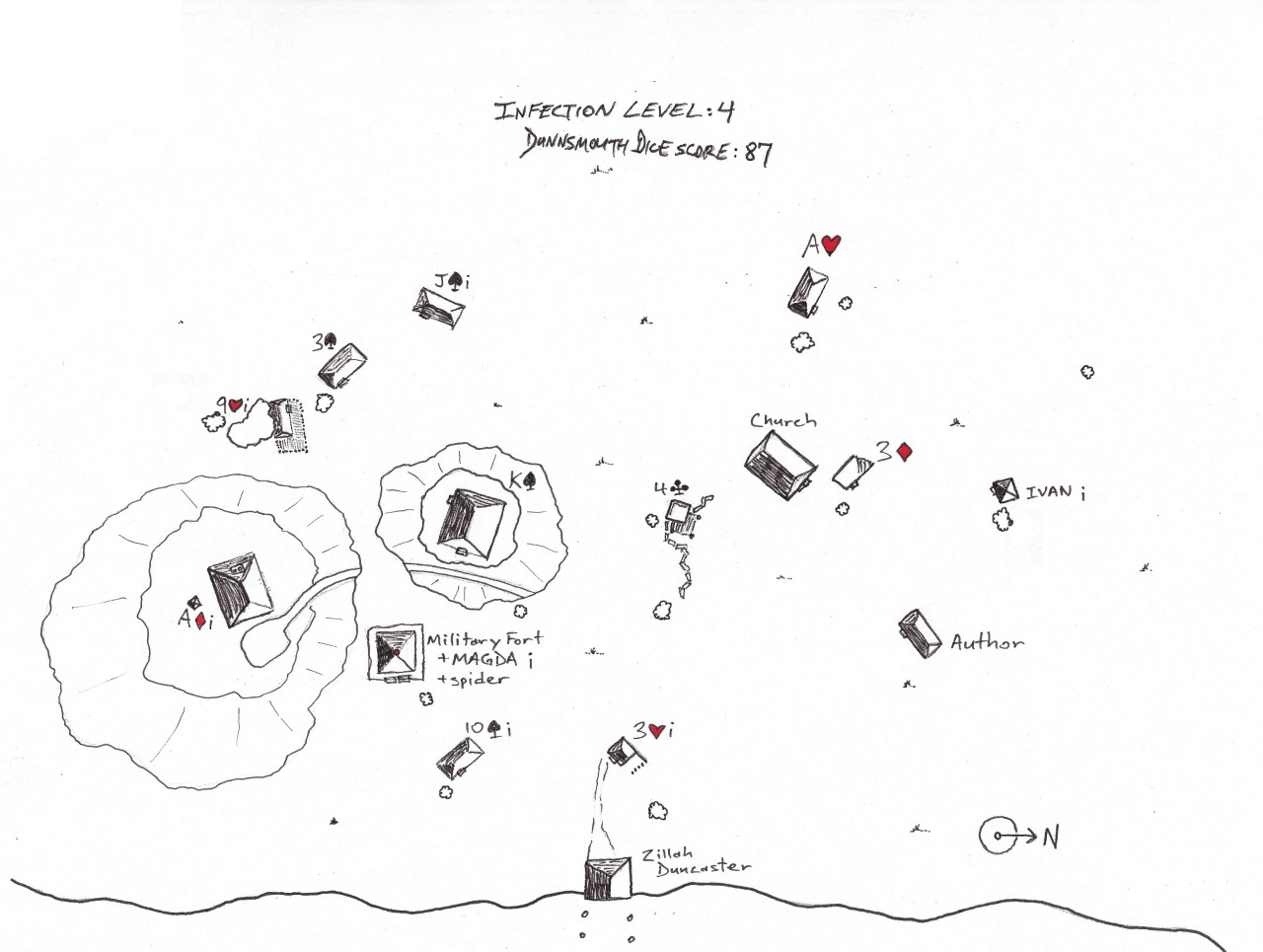
my version of Scenic Dunnsmouth

Scenic Dunnsmouth is a sandbox-style horror adventure module, and it requires a bit of legwork and design before being able to run it properly. The author, Zzarchov Kowolski, is having a little map making contest in support of the module. I had already constructed three versions of Dunnsmouth before he announced the contest, but I felt like making an all-new version for the contest.

I consider this my wife's map since she insisted on rolling the dice. To be honest she rolled really well and I think this is the best map I've produced out of the four. The adventure reminds me a lot of the Village of Hommlet so I tried to replicate some of the style of that module's map. All of the rules for building Dunnsmouth from the book were followed with a few exceptions:
1) I put the Time Cube inside a residence by drawing a card for the d4 (automatically infected)
2) I placed Magda in the farthest kicker die from Ivan
To make reference with the pdf easier I just used the card suits for the locations unless a basic description would suffice. Also, the shoreline is left ambiguously straightish because I plan on using this map as a river location within my current game.

Click on the image to make it bigger

I put the map above as well as a text-free version into this pdf for easy printing: MARIE'S VERSION OF SCENIC DUNNSMOUTH

Tuesday, March 11, 2014

short and sweet: Qelong and Scenic Dunnsmouth

It is rare for me to read a role-playing game and feel awed. I don't gush about my favorite games or game authors the same way I do about my favorite comic books, movies, or video games. Today I'm being uncharacteristic.
These are spoiler-free reviews.

Qelong, by Kenneth Hite
For the first time in years I simply could not put a book down, and it was an adventure module. I lost track of time while reading it, and was even late for work because I found myself wanting to read just one more page. Fans of Kenneth Hite are probably nodding sagely and wondering why I am so surprised. Outside of his Suppressed Transmission articles, which I found fun to read but never very useful for gaming, I haven't read anything else written solely by him. That changed after reading Qelong. I've slowly been collecting his work now that I know how good it is. Qelong is brilliant and engrossing! If you don't find inspiration from within this adventure module then you should start letting somebody else GM.
Buy it from DTRPG!
Buy it from LOTFP store!


Scenic Dunnsmouth, by Zzarchov Kowolski
I was completely gobsmacked by this module. The premise is pretty simple: mix one secluded village with a cult, sprinkle a powerful artifact into the middle, garnish with PCs and hijinks are bound to ensue. But the execution is where this seemingly cut-out scenery truly shines! The cooking metaphor above is apt given there is a lengthy set-up before the module can be used, but the random generation of key elements insures this module will never be played the same way twice. It's truly inspired work, and Scenic Dunnsmouth has made me an instant fan of Kowolski! He has crafted an adventure and setting all-in-one that oozes with menace, and I can't wait to play it.
Buy it from DTRPG!
Buy it from LOTFP store!

Tuesday, February 11, 2014

promoting kickstarters for a change

I usually only post about kickstarters when I'm complaining about their tardiness. I've grown really selective with what I invest my money into, and recently a few projects have come up that are really cool and I want to see them succeed.

LotFP Free RPG Day 2014
(left image is the cover for Doom Cave of the Crystal-Headed Children, art by Gennifer Bone; right image is the cover for World of the Lost by Rafael Chandler, art by Malcolm McClinton)
He's cutting it close to the wire to release for Free RPG Day this year, but I could see James Raggi doing a funding project like this every year now. I'm expecting the next project he throws up might be a "LotFP Free RPG Day 2015" project, and I would back that one too because I've only ever been disappointed by one of Raggi's projects (and it's one I never hear people talking about). This project is particularly interesting because it's set up to put some responsibility into the hands of the donor, you have to email James to tell him what rewards you want. One of the rewards is an adventure written by Rafael Chandler and the only way it will ever be published is through this campaign!


The Islands of Purple-Haunted Putrescence (an OSR module)
(art by Faustie)
A modest little kickstarter campaign from an accomplished self-publisher and a gamer in my neck of the woods. Seriously, he lives about 5 minutes away from me. He and I have the same haunts though we've never played a game together. I'd like to see him succeed both because he's a local and judging from his work we have similar tastes. I'm not sure where he comes up with his titles but I wish I had that same level of crazy creativity.


Darkest Dungeon
I think anybody who is an OSR gamer will want to take a look at this one even though it's a video game. I've been on their mailing list for a couple of months now and I knew this kickstarter campaign was coming. After one day of being live they're already very close to funding, because it's a video game I expect feature creep to potentially be an issue but this is one game that I would love to see hit some stretch goals.

And that's it. Go forth and spend some of your money to help make these projects happen and get cool games in return!

Wednesday, November 13, 2013

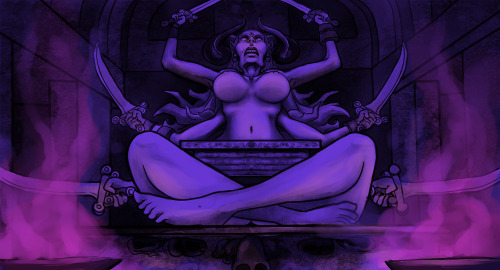
Death Frost Doom

In my regular group we've been playing Dungeon World, and I've been grinning and bearing it because the GM had the idea of trying a Lamentations of the Flame Princess module using the Dungeon World system. It was an interesting crossbreed.

Spoilers ahead, so if you haven't played Death Frost Doom stop reading here. If you have played Death Frost Doom, then read on.